[pageLogInLogOut]

#Recycling / Circular Economy

ReHubs elects new Board of Directors to lead the next phase of ReHubs’ strategy to recycle 2.7 million tonnes of textile waste annually by 2035

ReHubs has elected its new Board of Directors, marking an important milestone as the industry alliance continues to accelerate the industrial scale-up of textile-to-textile recycling across Europe. The election took place during the ReHubs Annual Event in Brussels on June 23rd, held alongside the Textile Recycling Expo and Future Fabrics Expo. The newly elected Board combines expertise from across the textile value chain, reflecting ReHubs' collaborative approach to solving the industry’s textile waste crises.

Newly elected Board members include: Luca Campadello (Erion), Kasper Damsø (NewRetex), Gianluca Pandolfo (Reju) and Paolo Sandri (Indorama Ventures).

Re-elected Board members include: Dirk Vantyghem (EURATEX), Felix Poza (Inditex) and Véronique Allaire Spitzer (Refashion).

Interim CEO Robert van de Kerkhof (PEPPER-i2) has been elected Chairperson of the Board, with Kasper Damsø and Véronique Allaire Spitzer elected as Co-Chairpersons.

Together, the Board represents expertise spanning producer responsibility organisations (PROs), fibre and materials innovation, recycling technologies, brands and industry associations. This diversity of perspectives is fundamental to ReHubs' mission of bringing the entire value chain together to industrially scale textile-to-textile recycling.

The newly elected Board will guide ReHubs as it continues implementing its strategy to recycle 2.7 million tonnes of textile waste annually by 2035, helping to build the infrastructure, partnerships and market conditions needed to make textile circularity a commercial reality.

The ReHubs Annual Event in Brussels provided members with an opportunity to review progress, exchange insights and define priorities for the years ahead. Discussions focused on accelerating investment, strengthening strategic partnerships, supporting innovation and overcoming the systemic barriers to scaling textile-to-textile recycling across Europe.

"The transition to a circular textile industry is urgently needed, but cannot be achieved by any single organisation," said Robert van de Kerkhof, Interim CEO of ReHubs.

"ReHubs was founded on the belief that meaningful progress comes from collaboration across the entire value chain. With this new Board, we have the expertise, commitment and shared ambition to continue building the partnerships needed to accelerate textile-to-textile recycling at industrial scale."

Véronique Allaire Spitzer, Board Member and Co-Chair (Refashion) commented, "I'm pleased to continue serving on the ReHubs Board as we build on the progress made over the past two years. There is still significant work ahead, and I look forward to continuing to work with the members to accelerate textile-to-textile recycling in Europe."

Kasper Damso, Board Member and Co-Chair (NewRetex), shared "We are at a pivotal time for the industry, which is why I'm pleased to join the ReHubs Board. ReHubs brings together leading organisations to address shared challenges, and I look forward to helping turn our collective ambition into practical action."

As ReHubs enters its next chapter, the alliance remains committed to uniting the industry to accelerate the transition towards a truly circular textile ecosystem. Building on the momentum generated over the past two years, the newly elected Board will continue driving collaboration, supporting industry-wide projects and advancing the conditions needed to unlock textile-to-textile recycling across Europe.
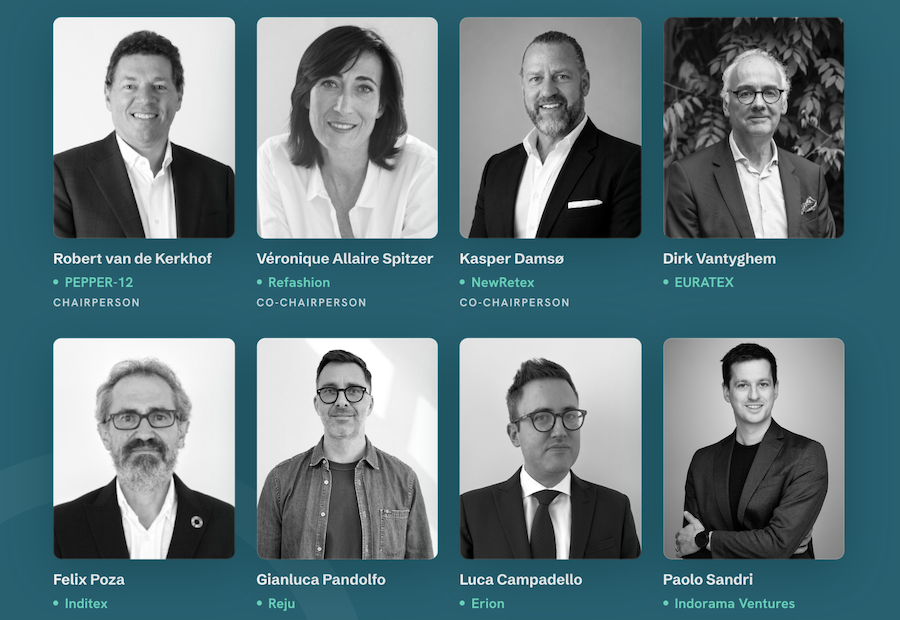

The new 2026 REHUBS Board © 2026 REHUBS


More News from REHUBS

#Recycling / Circular Economy

Europe needs tipping point to scale textile-to-textile recycling, BCG and ReHubs say

A new report from Boston Consulting Group (BCG) and ReHubs, titled “Advancing Textile Circularity – Europe’s textile waste challenge: Scaling Textile-to-Textile requires enabling mechanisms”, highlights the urgent need for systemic action to tackle Europe’s growing textile waste and scale a circular textile economy.

#Recycling / Circular Economy

A circular European value chain turns post-consumer textile waste into new garments for Dutch retailer Zeeman

A closed-loop recycling project has successfully transformed 24 tons of post-consumer textiles into nearly 50,000 garments for Dutch retailer Zeeman, with each product containing a high-rate of 70% recycled content. This achievement represents a major milestone in accelerating textile-to-textile recycling in Europe.

#Recycling / Circular Economy

REHUBS to unveil strategy and tactical action plan to industrialise textile circularity by 2032

Europe’s circular economy in textiles and apparel is facing a daunting challenge. Increasing volumes of discarded textiles, fragile collection systems, and the flood of ultra-fast fashion are intensifying a crisis of overproduction, waste, and lost value. Despite advances in recycling technology, very few textiles today are recycled back into new textiles, with most waste still downcycled, incinerated, or exported.

#Recycling / Circular Economy

REHUBS to build industry-wide circularity roadmap and action plan in response to increasing textile waste challenges in Europe

ReHubs is leading systemic change across the textile and apparel industry, bringing together key stakeholders to achieve ambitious circularity goals through aligned efforts in infrastructure, policy, and finance. Since its inception, ReHubs has been the catalyst and engine for transforming Europe’s textile and apparel recycling landscape.

More News on Recycling / Circular Economy

#Research & Development

ALADIN paves the way for circular and demand-driven textile production in Europe

Textile production can be organized sustainably by utilizing short supply chains and preventing overproduction. This can already be achieved today by intelligently connecting and efficiently utilizing existing infrastructure. At the same time, production becomes circular when innovative technologies and materials are used that enable high-quality recycling. The ALADIN research project, launched in May 2026 and co-funded with five million euros under the EU Horizon Europe program, is creating the conditions for this.

#Recycling / Circular Economy

Ence and ShareTex begin initial testing of the ATENEA innovation project to promote textile recycling in Spain

Ence and ShareTex are making progress on the Atenea R&D project, which aims to develop a complete value chain for textile recycling in Spain. Specifically, the goal of the ATENEA project—which is funded by the Center for Technological Development and Innovation (CDTI)—is to connect all the necessary stages for the recovery of textile waste, from collection and management, through recycling and transformation into new raw materials, to their incorporation into new textile products.

#Recycling / Circular Economy

DePoly Inaugurates its Showcase Plant in Monthey Switzerland

What if used plastic bottles, PET packaging material and polyester textiles could become raw materials just as high performing as virgin resources? That is the ambition of DePoly, a circular materials company based in Sion, Switzerland which inaugurated its Showcase Plant in Monthey on July 6th & 7th. The first depolymerization facility of its kind and scale in Switzerland, this industrial Showcase Plant represents a major milestone in the company's growth and its journey toward commercialization.

#Recycling / Circular Economy

Commission clarifies rules on plastic bottles recycling

The European Commission today adopted new rules on recycling of single-use plastic beverage bottles made primarily of polyethylene terephthalate (PET bottles). These rules establish, for the first time, a methodology to calculate, verify and report chemically recycled content. This is part of the Commission’s December 2025 plastics package.

Latest News

#Nonwovens

Katharina Obergruber appointed to the Management Board of Sandler AG

The Supervisory Board of Sandler AG has appointed Katharina Obergruber to the company’s Management Board. Effective September 1, 2026, the Board will consist of Philipp Ebbinghaus (CEO), Dr. Ulrich Hornfeck (currently CCO, future COO), and Katharina Obergruber (CCO). Katharina Obergruber, currently Chief Sales Officer Hygiene and member of the Management Team of Sandler AG, will assume responsibility for all sales activities as Chief Commercial Officer. She will assume this role from Dr. Ulrich Hornfeck, who will focus primarily on production and supply chain topics.

#Sustainability

Global Standards establishes new non-profit foundation to strengthen governance

Global Standards gGmbH, the nonprofit organisation behind the globally recognised Global Organic Textile Standard (GOTS), announced a new governance structure designed to support its long-term mission and reinforce organisational autonomy of its Voluntary Sustainability Standards and programmes.

#Textile chemistry

DyStar releases FY2025 sustainability report, marking a new milestone towards its 2030 targets

DyStar, a leading specialty chemicals company with more than a century of expertise in product development and innovation, today announced the release of its FY2025 Sustainability Report, marking a significant milestone in its sustainability journey and reinforcing its commitment to long-term value creation.

#Research & Development

TERIS reaches milestone: Fraunhofer consortium develops new standards for tire analysis

In the “TERIS” project, the Fraunhofer institutes ICT, IGD, and IWM—led by the Fraunhofer Institute for Structural Durability and System Reliability LBF—have reached a decisive milestone. For the first time, the teams aim to generate, analyse, and predict tire wear in the laboratory in a standardized and practical manner. As part of this milestone, results are now available on reference abrasion, particle analysis, tribological models, AI-based surface analysis, a test bench concept, and methods for accelerated aging and VOC detection. The tire industry, testing services, and environmental agencies will in future benefit from reliable, rapid laboratory procedures for emissions assessment.

TOP