[pageLogInLogOut]

#Recycling / Circular Economy

Europe needs tipping point to scale textile-to-textile recycling, BCG and ReHubs say
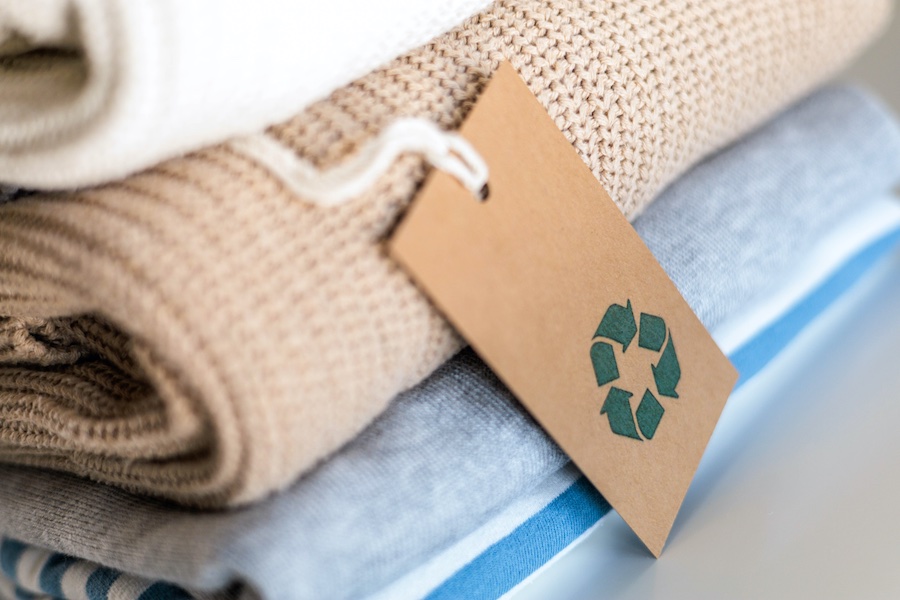
© 2026 ReHubs
A new report from Boston Consulting Group (BCG) and ReHubs, titled “Advancing Textile Circularity – Europe’s textile waste challenge: Scaling Textile-to-Textile requires enabling mechanisms”, highlights the urgent need for systemic action to tackle Europe’s growing textile waste and scale a circular textile economy.


The report establishes the first harmonized fact base on textile waste in Europe. It finds that Europe generates around 15.2 million tonnes of textile waste every year, including 13.3 million tonnes of post-consumer waste. However, only a small share of this waste is collected and sorted for recycling, leaving most textile waste outside recycling systems.

As a result, textile-to-textile recycling currently represents less than 1% of post-consumer textile waste in Europe. At the same time, waste volumes continue to rise rapidly. Without decisive action, Europe’s textile waste could reach the equivalent of around 80 football stadiums filled with discarded textiles every year by 2035.

The report shows that scaling textile-to-textile recycling is technically possible but requires reaching a critical tipping point of c. 2.7 million tonnes of recycling annually by 2035 to unlock economies of scale and make the ecosystem viable.

Reaching this milestone will require €8-11 billion in capital investment and €5-6.5 billion in recurring annual operating costs, as well as coordinated supply- and demand-side measures across the value chain.

The analysis also underlines that textile-to-textile recycled fibers represent a new product category with structurally higher processing costs. Under current market conditions, they cannot compete directly with incumbent recycled materials or virgin fibers without targeted enabling mechanisms and coordinated policy support.

Scaling textile circularity will therefore require coordinated collaboration across the entire value chain, from improved collection and sorting infrastructure to demand signals from brands and clear policy frameworks that support investment and innovation.

Robert van de Kerkhof, CEO at ReHubs commented: “Europe has the opportunity to build a truly circular textile ecosystem, but it will require systemic change across the entire value chain. Textile-to-textile recycling is technically possible today, but scaling it requires coordinated action from industry, policymakers, and investors. Through collaboration across the value chain, ReHubs is helping to drive the transformation needed to build a circular textile economy in Europe.”

Nicolas Manuelli, Managing Director & Partner at BCG commented:“This report shows that scaling textile-to-textile recycling in Europe is achievable, but it requires the right economic conditions. Textile-to-textile recycled fibers are a new product category with higher processing costs, meaning they will not scale without enabling mechanisms. Supply-side and demand-side measures, combined with appropriate financing tools and supportive trade and industrial policies, will be essential to unlock investment and accelerate the transition to a circular textile system.”
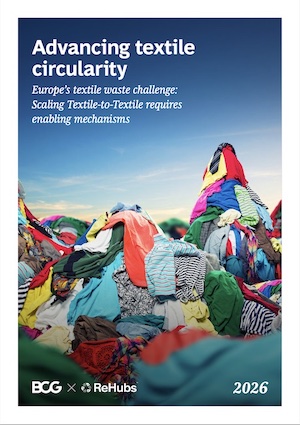

© 2026 BCG / ReHubs
© 2026 BCG / ReHubs


Get the report:

https://www.bcg.com/publications/2026/france-advancing-textile-circularity-in-europe-the-case-for-system-level-scale-up



More News from REHUBS

#Recycling / Circular Economy

A circular European value chain turns post-consumer textile waste into new garments for Dutch retailer Zeeman

A closed-loop recycling project has successfully transformed 24 tons of post-consumer textiles into nearly 50,000 garments for Dutch retailer Zeeman, with each product containing a high-rate of 70% recycled content. This achievement represents a major milestone in accelerating textile-to-textile recycling in Europe.

#Recycling / Circular Economy

REHUBS to unveil strategy and tactical action plan to industrialise textile circularity by 2032

Europe’s circular economy in textiles and apparel is facing a daunting challenge. Increasing volumes of discarded textiles, fragile collection systems, and the flood of ultra-fast fashion are intensifying a crisis of overproduction, waste, and lost value. Despite advances in recycling technology, very few textiles today are recycled back into new textiles, with most waste still downcycled, incinerated, or exported.

#Recycling / Circular Economy

REHUBS to build industry-wide circularity roadmap and action plan in response to increasing textile waste challenges in Europe

ReHubs is leading systemic change across the textile and apparel industry, bringing together key stakeholders to achieve ambitious circularity goals through aligned efforts in infrastructure, policy, and finance. Since its inception, ReHubs has been the catalyst and engine for transforming Europe’s textile and apparel recycling landscape.

#Recycling / Circular Economy

Robert van de Kerkhof is new ReHubs CEO

ReHubs, the European textile recycling alliance, is announcing today a change in its daily leadership: Robert van de Kerkhof is taking over as interim CEO from Chris Deloof, who returns to Ghent University after 2 years of successful engagement with the organisation.

More News on Recycling / Circular Economy

#Recycling / Circular Economy

AI Circular Economy Conference 2026 fuels innovation at the intersection of AI and Circular Economy

The AI Circular Economy Conference 2026, organised by nova-Institute, brought together 116 participants from 15 countries in Cologne and online to explore the transformation of the chemical and materials industry supported and accelerated by artificial intelligence. During the two-day event, leading experts from industry, research, start-ups and the investment community discussed how AI can maximise the potential of renewable carbon creating efficient circular value chains. The conference featured 24 presentations and multiple panel discussions, highlighting the growing convergence of digital technologies and circular material systems. It demonstrated how artificial intelligence is progressing from the experimental stage to real industrial implementation within the circular economy.

#Recycled_Fibers

Circ deepens access to recycled fibers with Xinxiang Bailu Chemical Fiber Co., Ltd. partnership agreement

Circ®, a global leader in textile‑to‑textile recycling, today announced a new partnership agreement with Xinxiang Bailu Chemical Fiber Co., a Canopy Dark Green Shirt producer and one of the world’s leading producers of viscose filament. The agreement marks a significant step in Circ’s continued expansion in China and strengthens its position within the country’s rapidly evolving circular textile ecosystem; further supporting Circ’s ability to supply recycled fibers near existing fashion supply chains.

#Recycled_Fibers

Worn Again Technologies unveils the Accelerator

Worn Again Technologies unveils the Accelerator, the next major step towards commercialising its pioneering Textile-to-Fibre recycling process and proving the technical and economic feasibility of polycotton recycling.

#Recycling / Circular Economy

Textile‑to‑textile recycling leader Circulose joins Spinnova’s ecosystem to accelerate technology scale‑up

Textile‑to‑textile recycling leader Circulose joins Spinnova’s ecosystem (consortium) to help advance the scale‑up of Spinnova’s technology. Spinnova has actively sought partners to accelerate commercial scale‑up, and Circulose, as a key player in textile recycling, strengthens the ecosystem by providing a raw material that is in high demand across the industry.

Latest News

#Techtextil 2026

Future ready nonwovens and fiber processing solutions – Meet Trützschler at Techtextil 2026

From April 21 to 24, 2026, the Trützschler Group will present its future‑ready solutions at Techtextil in Frankfurt, Germany. At Booth C61 in Hall 12.0, Trützschler Nonwovens will showcase its latest developments for efficient nonwovens production, including comprehensive service and consulting solutions. Highlights include the fully upgraded X‑Series nonwoven cards suitable for spunlace, needle‑punching and air‑through bonding (ATB) processes, as well as the T‑ONE digital working environment enhanced with new features. Trützschler Card Clothing will complement the presentation with a new card wire designed with a specially engineered surface for high‑performance nonwoven applications. Visitors can also take a closer look at Trützschler’s complete solution for the recycling of textile waste, TRUECYCLED.

#Techtextil 2026

Gebr. Otto highlights versatility at Techtextil with regional supply chains, yarn innovations and new hygiene segment

At this year’s Techtextil, Gebr. Otto places its versatility at the center of its presentation. In addition to spinning, twisting and dyeing – traditionally focused on fine cotton – textile processors will also find a competent development partner for technical specialty solutions. The Dietenheim-based spinning mill has now built up a decade of experience in the production of technical yarns, particularly from aramids. A new hygiene segment has also been established, where yarns for medical and hygiene products are currently being produced. In the future, this department could also develop textile products for the food sector. Gebr. Otto will once again be present at the BW-i joint stand, booth D81, hall 12.1. What is wound onto the spool is determined by the customer: Gebr. Otto develops according to specific customer requirements and transforms its own ideas into yarn innovations.

#Europe

Commission presents proposal for EU Inc. - unlocking the full potential of the Single Market for Europe's entrepreneurs

Today, the European Commission presented its proposal for EU Inc., a new single set of corporate rules, building the cornerstone and starting point for the EU's 28th regime. EU Inc. is an optional, digital-by-default European corporate framework. It will make it easier for businesses to start, operate and grow across the EU – incentivising them to stay in Europe, and encourage those who once looked elsewhere to return.

#Man-Made Fibers

OnceMore® from Södra brings end-to-end traceability for circular Man-made Cellulosic Fibers (MMCF) using TextileGenesis

OnceMore® from Södra, the world’s first large-scale process for recycling blended fabrics into high‐quality dissolving pulp, will begin using TextileGenesis, a Lectra company, to strengthen traceability from raw material to retail across the value chain. OnceMore® produces dissolving pulp made from blended textile waste and wood sourced from responsibly managed Swedish forests. By integrating TextileGenesis, OnceMore® supports the growing need for verified data and secure, transparent tracking throughout increasingly complex supply chain.

TOP