[pageLogInLogOut]

#Recycling / Circular Economy

H&M Foundation highlights economic barriers to scaling circular textile systems
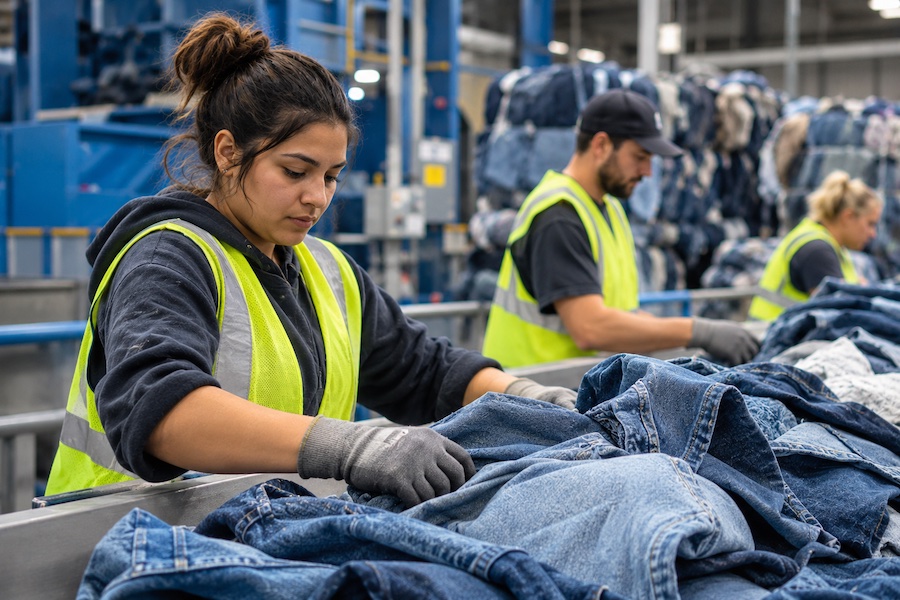
Textile collection and sorting are essential to scaling circularity. The H&M Foundation highlights the need for economically viable recycling systems that include all participants across the textile value chain. © 2026 AI-generated illustration / TexData International.
Discussions at Textile Exchange 2026 underline the need for coordinated investment, reliable material flows and a fair distribution of costs and risks across the textile recycling value chain.


Scaling circularity in the textile industry requires more than advances in recycling technologies and material innovation. According to insights shared by the H&M Foundation following Textile Exchange 2026 in Vancouver, the transition towards circular textile systems also depends on closer coordination between collectors, sorters, recyclers, manufacturers, brands and investors.

While many industry stakeholders share the ambition of establishing circular material flows, practical implementation remains challenging. Investment decisions are often interdependent: recyclers require reliable demand before expanding capacity, brands need consistent supplies of recycled materials before making purchasing commitments, and investors seek confidence in the commercial viability of new business models.

The H&M Foundation argues that overcoming these barriers requires a more integrated approach to developing circular value chains.

Circularity requires coordinated investment

Discussions at the conference highlighted the importance of developing feedstock availability, recycling capacity, financing, infrastructure and market demand as interconnected elements.

Improving individual stages of the recycling process is not sufficient if other parts of the value chain remain underdeveloped.

Recycling companies, for example, may be able to expand processing capacity but still depend on access to suitable textile waste in sufficient quantities and consistent quality. Collection and sorting businesses, meanwhile, require reliable markets, adequate infrastructure and commercially viable pricing to supply recyclable materials.

According to the H&M Foundation, progress often stalls because individual stakeholders are waiting for commitments from others before investing themselves.

Reducing this uncertainty through coordinated commitments could help accelerate the development of commercially viable circular textile systems.

Inclusive circularity and the economics of textile sorting

A central theme of the H&M Foundation's assessment is the concept of inclusive circularity, which emphasises the participation of all actors involved in recovering, processing and reintroducing materials into production.

The Foundation argues that collection, sorting and aggregation activities must be economically sustainable if circular textile systems are to operate at industrial scale.

During the conference, participants highlighted that sorting textiles for recycling can currently generate financial losses despite being an essential step in supplying suitable feedstock to recycling facilities.

This illustrates a broader challenge: the costs and risks of establishing circular supply chains are not necessarily distributed among the same stakeholders that ultimately benefit from the resulting materials.

The H&M Foundation therefore advocates business models that enable collectors, sorting companies and other upstream participants to receive viable returns for their contribution.

Bringing the textile value chain together

During Textile Exchange 2026, the H&M Foundation hosted a discussion in collaboration with Textile Exchange, bringing together representatives from different stages of the textile value chain.

Participants included stakeholders involved in material collection, manufacturing, recycling, sourcing, finance, standards and policy development.

The discussions focused on identifying barriers to implementation and exploring how cooperation could help address challenges that individual organisations cannot resolve independently.

Particular attention was given to the role of first-mile actors, including businesses and workers responsible for collecting, sorting and preparing materials for recycling.

According to the Foundation, these stakeholders should not only participate in circular systems but also contribute to decisions about how they are designed and implemented.

From shared ambitions to practical commitments

The H&M Foundation concludes that industry-wide sustainability ambitions must increasingly translate into coordinated commercial commitments.

Reliable feedstock supplies, long-term purchasing agreements, financing mechanisms and partnerships could help reduce investment risks and create greater confidence across the value chain.

The organisation also emphasises that the transition to circular textiles must consider how economic value is distributed. Placing additional costs and responsibilities on upstream suppliers without corresponding commercial benefits could undermine the long-term resilience of circular systems.

The findings underline a fundamental challenge for the textile industry: achieving circularity at scale requires not only technological innovation but also economically viable relationships between all participants in the material value chain.



More News from H&M Group

#Sustainability

Practical toolkit to drive coordinated climate action launched

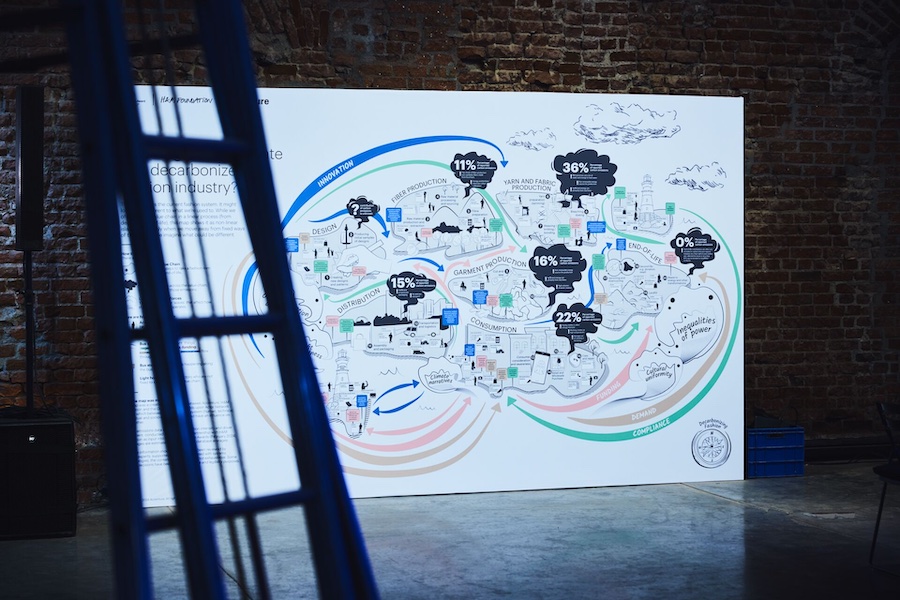
An open-access workshop toolkit enables brands, suppliers, policymakers and investors across the textile industry to apply the System Map in their own work, identifying leverage points to halve emissions and enable a just transition.

#Sustainability

Pioneering open-source framework shows how early innovation drives a just and net-zero fashion future

The non-profit H&M Foundation, in collaboration with Accenture, has unveiled From Signals to Systems Change, an insight report calling on the fashion industry to rethink its role in transformation. At its core is the Reimagined System Map, a pioneering open-source framework that visualises how early-stage innovation could drive a just and net-zero textile future.

#Sustainability

H&M Foundation funds pioneering initiative to build the factories of the future

The H&M Foundation is committing SEK 53 million (approx. EUR 5 million) towards Future Forward Factories, a five-year initiative led by Fashion for Good, to address fashion’s most polluting stage: tier 2 textile processing.

#Textiles & Apparel / Garment

Global Change Award 2026: Nominations now open

On 1 September, the H&M Foundation launched the nomination round for the Global Change Award 2026. The international innovation challenge is looking for early-stage ideas that can drive the textile and fashion industry towards circularity and climate neutrality.

More News on Recycling / Circular Economy

#Spinning

Trützschler expands technical service capabilities for spinning mills in Pakistan

Faster support, shorter downtime and advanced repair capabilities: customers across Pakistan can now benefit from the Trützschler Service Station at its new location in Lahore. By combining Trützschler service expertise with state-of-the-art diagnostic equipment, the new facility helps spinning mills resolve technical issues more quickly and maintain reliable production.

#Recycling / Circular Economy

ReHubs calls on industry experts to shape Textiles Recycling Expo 2027 conference programme

ReHubs is proud to continue its collaboration with Textiles Recycling Expo as the Structural Partner for the third consecutive year, reinforcing its commitment to bringing together the organisations, expertise and solutions needed to scale textile-to-textile recycling across Europe.

#Recycling / Circular Economy

Blue Jeans Go Green celebrates 20 years of denim recycling with more than six million items collected

Cotton Incorporated is celebrating the 20th anniversary of its Blue Jeans Go Green™ denim recycling program. Since its launch in 2006, the initiative has collected more than six million denim items, diverted over 3,000 tons of textile waste from landfills and enabled the production of more than 12 million square feet of denim-based insulation. What began as a college campus collection drive has developed into a nationwide recycling initiative involving consumers, retailers, schools and community organisations across the United States.

#Recycling / Circular Economy

Textiles Recycling Expo USA 2027 opens registration and expands with manufacturing exhibition

The second edition of Textiles Recycling Expo USA will take place on 7–8 April 2027 in Charlotte, North Carolina. Following a debut that attracted more than 1,800 visitors and 95 exhibitors, the event will expand its exhibition and conference programme and will be held alongside the new Textiles Manufacturing Expo.

Latest News

#Man-Made Fibers

Lenzing improves profitability as strategic transformation gains momentum

The Lenzing Group reported improved operating profitability in the first nine months of 2026 despite declining revenue and a challenging market environment. Revenue decreased by 2.3 percent to EUR 1.93 billion, while adjusted EBITDA remained stable at EUR 353 million. The adjusted EBITDA margin increased from 17.9 percent to 18.3 percent, reflecting progress in the company's strategic transformation under its “Grow Nonwovens. Reset Textiles.” strategy.

#Textiles & Apparel / Garment

Texworld Apparel Sourcing Paris marks 30th anniversary with a redesigned exhibition concept

Texworld Apparel Sourcing Paris will celebrate its 30th anniversary from 25 to 27 January 2027 at the Paris-Le-Bourget Exhibition Centre. With more than 1,000 international exhibitors expected, the anniversary edition will introduce a redesigned exhibition layout across Halls 3 and 4, bringing fabric manufacturers and garment producers closer together. The event will also highlight Spring-Summer 2028 trends, sustainable sourcing and new opportunities for international textile trade.

#Digital Printing

Mimaki highlights growing demand for hybrid UV printing across European markets

Insights from Mimaki's European partner network reveal how hybrid UV printing is responding to different regional market needs, driven by growing demand for flexible, application-oriented printing technologies.

#India ITME 2026

New momentum for British textile machinery in India

The British Textile Machinery Association (BTMA) is looking to India ITME 2026 as a major opportunity to strengthen industrial partnerships and mutually expand exports, following the introduction of the UK-India Free Trade Agreement and the formation of the UK-India Textile Machinery Coalition (UKITMC).

TOP