[pageLogInLogOut]

#Recycling / Circular Economy

Nike debuts the ISPA Link Axis, an exploration into circular design
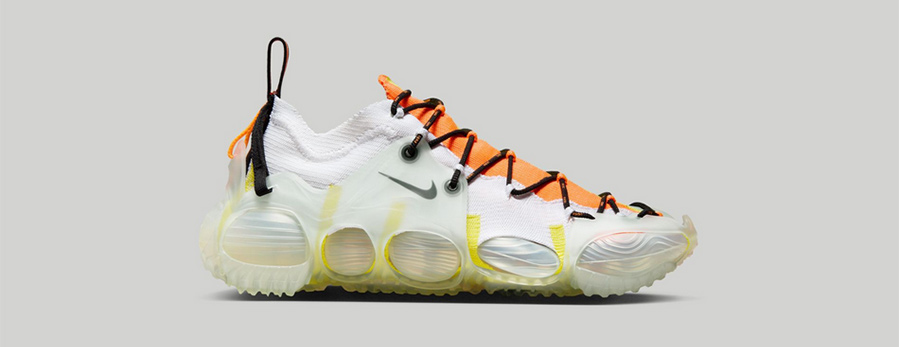
ISPA Link Axis © 2023 Nike
Make the bold bolder. That’s the vibe of the new Nike ISPA Link Axis, Nike’s first exploration into creating a fully circular shoe, furthering its culture of innovation.

What to know

• Nike introduces the ISPA Link Axis, its first exploration into creating a fully circular shoe, furthering its culture of innovation.

• Every part of the Link Axis can be recycled. The design uses interlocking components, as few materials as possible and zero glue.

• The Link Axis helps move Nike closer to its circular vision — a closed-loop system that yields no waste — to help protect the planet and the future of sport.

• The shoe arrives in a Total Orange and Sonic Yellow colorway and is available September 12 on SNKRS.


Every part of the Link Axis can be recycled. The design uses interlocking components, as few materials as possible and zero glue. The Link Axis has a 100 percent recycled polyester Flyknit upper that’s precisely engineered to fit over the outsole (compared to the traditional cut-and-sew method used for the Nike ISPA Link), and its 100 percent recycled TPU tooling was achieved by using scrap airbag material. The shoe also has a 20 percent recycled TPU cage. Because recycling changes some material properties, the cage is an exercise in balancing the desire to use recycled content with the need for durability and traction.

These industry-pushing innovations are thanks to the Nike ISPA team. ISPA (Improvise, Scavenge, Protect, Adapt) is a Nike design philosophy that challenges creators to experiment, break molds and reimagine products. In the case of the Link Axis, it helps move Nike closer to its circular vision — a closed-loop system that yields no waste — to help protect the planet and the future of sport.

For more than 30 years, Nike teams have pursued design solutions in service of the athlete and the planet. They’ve unlocked new, lower-impact materials (see: Nike Grind, Nike Air) and created pinnacle performance footwear and iconic lifestyle silhouettes leveraging recycled content (see: Alphafly Next Nature, the Move to Zero collections). As the climate crisis has intensified for athletes around the world, Nike teams have shifted into a higher gear, embracing circular design principles as creative accelerants. Those include the 10 principles outlined in the Nike 2019 Circular Design Guide, an open-source workbook to share learnings and insights with the larger design community and anyone interested in how design can help lessen impact on the planet.


For the Link Axis, the ISPA team considered the circular design principle of “disassembly,” or the ability to easily take a product apart to recycle its components, one of the more challenging principles to implement in footwear design. A good shoe is flexible and durable. Traditionally, designers use glue and other bonding elements to achieve these aims, but that makes a shoe nearly impossible to disassemble and recycle. Recycling shoes usually requires shredding, an energy-intensive process that limits how the recycled materials can be used. Creating a shoe that can be taken apart would reduce the carbon footprint of the product and open up new possibilities for its life cycle.

The Link Axis is the new pinnacle for disassembly and embodies the circular design principles of material choice, waste avoidance and refurbishment.

The Link Axis arrives in a Total Orange and Sonic Yellow colorway — a nod to the first Link Axis prototype — and is available September 12 on SNKRS.

To learn more about how and why Nike created the ISPA Link Axis, check out "Why Nike Is Making Shoes You Can Take Apart."

More News from Nike

More News on Recycling / Circular Economy

#Recycling / Circular Economy

Countdown to Textiles Recycling Expo 2026: Brussels prepares for Europe’s textile recycling gathering

With only two weeks remaining until the start of the second edition of the Textiles Recycling Expo 2026, preparations are entering the final phase. The exhibition and conference, dedicated exclusively to textile recycling and circularity, will take place on 24–25 June 2026 at Brussels Expo and is expected to attract stakeholders from across the textile recycling value chain.

#Recycled Fibers

Indorama Ventures enables brands to scale circular textiles through proven, traceable supply chains

Indorama Ventures, a global leader in recycled polyester staple fibers and filament yarns, will exhibit at Textiles Recycling Expo in Brussels on June 24–25. At the event, the company will show how brands and textile manufacturers can build traceable, circular textile supply chains by working with proven partners who deliver recycled materials on an industrial scale.

#Recycled Fibers

RECOVER™ launches Recover™ Yarns to accelerate recycled cotton uptake

Recover™, a leading materials science company and one of the world’s largest producers of recycled cotton fiber, today announces the launch of Recover™ Yarns, a curated portfolio of ready-to-use yarn solutions designed to accelerate the adoption of recycled cotton across the apparel supply chain.

#ITM 2026

Uster’s new Recycling Opening Index guides spinners to the perfect blend

Uster AFIS 6 now offers the key data for better decisions when blending recycled fibers. Process control is decisive in determining the quality and economic outcome. The new R Recycling Module of AFIS 6 introduces the Recycling Opening Index (ROI), so spinners can optimize their circularity credentials. It was officially launched at ITM 2026 in Istanbul, Türkiye.

Latest News

#ITM 2026

KARL MAYER presents a textile TEXTRONIC® innovation at ITM 2026

With highly efficient machines and continuous textile innovations, KARL MAYER underscores its role as a reliable partner for discerning top-tier customers. Just in time for ITM 2026 in Istanbul, the industry leader is introducing a true innovation: an eyelash lace with its characteristic fringed look – combined with a previously unattainable 4-way stretch. While the established fabric could until now only be produced as rigid version or with one-dimensional stretch, the new elasticity in both dimensions expands the possibilities for cross-band panel fabrics.

#Raw Materials

Better Cotton Initiative welcomes new and returning Council members

The Better Cotton Initiative (BCI) has confirmed a series of appointments and reappointments to its Council, the multistakeholder board responsible for BCI’s strategic direction.

#Man-Made Fibers

DYNEEMA® and NP Aerospace advance personal protection for military servicewomen

Dyneema®, owned by Avient Corporation, an innovator of materials solutions, is supplying its high-performance unidirectional (UD) materials to world-leading armor manufacturer NP Aerospace, enabling the production of armor systems designed specifically to fit the female body. With 2,000 new armor systems, including 4,000 plates, made in the United Kingdom (UK) and delivered in June 2026, this collaboration addresses a long-standing lack of high-quality personal protection specially built for female defense and security personnel.

#Man-Made Fibers

Textile Exchange publishes comprehensive polyester LCA study

Textile Exchange has released a new Life Cycle Assessment (LCA) study on polyester, providing detailed data on the environmental impacts of both virgin and recycled polyester production. The study aims to strengthen understanding across the fashion, textile and apparel industries and support more informed decision-making regarding polyester sourcing and production.

TOP