[pageLogInLogOut]

#Raw Materials

Ralph Lauren Corporation applauds selection of U.S. regenerative cotton fund as an AIM for Climate Innovation Sprint Partner at COP26

Ralph Lauren Corporation today applauded the selection of the recently launched U.S. Regenerative Cotton Fund as an Agriculture Innovation Mission for Climate (AIM for Climate) Innovation Sprint Partner, a joint initiative created by the United States and the United Arab Emirates to support investments in climate-smart agriculture over the next five years. The selection was announced during the United Nations Climate Change Conference (COP26) in Glasgow on Nov. 2, 2021.

“We must come together as a global community to address the challenges of today so that future generations inherit a world filled with natural beauty and inspiration. That’s why we are working toward our Net Zero goal, and it’s why the U.S. Regenerative Cotton Fund, created through partnership between the Ralph Lauren Corporate Foundation and the Soil Health Institute, complements our goals. We’re honored that this work is recognized as an AIM for Climate Innovation Sprint Partner,” said Patrice Louvet, President and Chief Executive Officer, Ralph Lauren Corporation.

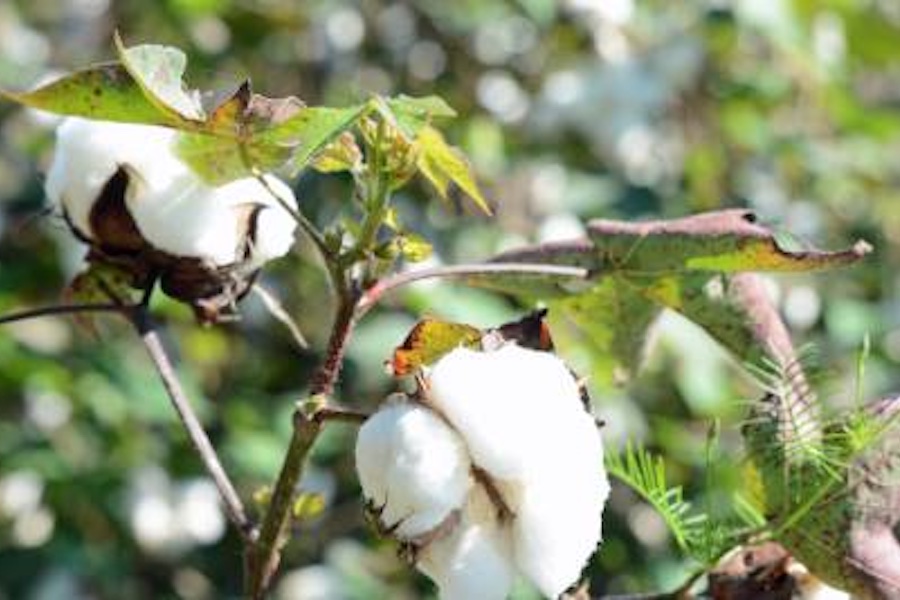
The Ralph Lauren Corporate Foundation committed an inaugural grant to the Soil Health Institute to launch the U.S. Regenerative Cotton Fund, a first-of-its-kind initiative to support long-term, sustainable cotton production in the United States, with the goal of eliminating one million metric tons of carbon dioxide equivalent (CO2e) from the atmosphere by 2026. The U.S. Regenerative Cotton Fund is supported by a $5 million grant from the Ralph Lauren Corporate Foundation.

Recently, the Company also joined a series of commitments reflective of the scope and mission of COP26 that underscore ongoing efforts made as part of its Global Citizenship & Sustainability goals. They include:

• We Mean Business Coalition – G-20 Climate Statement: Aligned with the Company’s recent announcement to achieve net zero global greenhouse gas emissions from its operations and value chain by 2040, the Ralph Lauren Corporation signed a statement in support of urging G-20 nations to strengthen their Nationally Determined Contributions by at least halving global emissions by 2030 and committing to achieve net zero emissions by no later than 2050. Additional details can be found here.


• Clean Energy Demand Initiative: To utilize the Company’s scale to create impact, the Ralph Lauren Corporation is actively advocating for cost-effective and robust clean energy procurement options in several key global markets where the Company operates or sources its products. Additional details can be found here.

• Textile Exchange – Preferential Tariff Project: As a member of the U.N. Fashion Industry Charter for Climate Action and the Textile Exchange, the Ralph Lauren Corporation signed a policy statement issued to all COP26 participating nations requesting that policymakers work closely with the apparel, textile and footwear industry to develop thoughtful trade policy mechanisms, specifically those that would drive the adoption of environmentally preferred materials and enable achievement of the Textile Exchange’s industry goal of a 45% greenhouse gas emissions reduction by 2030 in the pre-spinning phase of textile fiber and materials production, in line with the Paris Agreement. Additional details can be found here.

Each of these commitments is inspired by Ralph Lauren’s grounding purpose, to inspire the dream of a better life through authenticity and timeless style, which has guided its design vision and how it operates its business for more than 50 years. Additionally, these efforts all build on the Company’s work to pioneer, foster and scale sustainable innovation through partnerships and investments, including its work with Natural Fiber Welding Inc. and Color on Demand, and aligns with its commitment to the climate goals identified in the Paris Agreement.
More News from TEXDATA International

#Texprocess 2026

Texprocess 2026: Automation, digitalisation and AI redefine textile processing

Making investment decisions in textile processing has become significantly more demanding. Increasing energy costs, a shortage of skilled labour and ongoing geopolitical uncertainties are compelling companies to focus on technologies that deliver clear gains in efficiency and process reliability. This applies equally to apparel manufacturing and to the processing of technical textiles and high-performance materials. As a result, modernisation initiatives are assessed more carefully – even as the need to upgrade production systems continues to intensify.

#Techtextil 2026

Techtextil 2026: Between innovation pressure & market reality

From 21 to 24 April 2026, Techtextil in Frankfurt am Main will once again become the central meeting point for the international technical textiles and nonwovens industry. Running in parallel, Texprocess will focus on the industrial implementation of textile processing technologies as the leading platform in this field. Together, the two trade fairs form a closely integrated presentation and working platform along the entire textile value chain – from material development to finished applications.

#Techtextil 2026

Between geopolitical pressure and industrial resilience

In this interview, Dr. Janpeter Horn (VDMA) discusses the current challenges facing textile machinery manufacturers, shaped by geopolitical tensions, regulatory developments and subdued investment. He also outlines why innovation strength, integrated solutions and strategic positioning remain key to global competitiveness.

#Texprocess 2026

Between investment restraint and modernization pressure

Texprocess 2026 takes place in a complex market environment shaped by uncertainty and innovation pressure. In this interview, Elgar Straub (VDMA) explains why the trade fair is particularly relevant this year and which technologies are driving efficiency and competitiveness.

More News on Raw Materials

#Raw Materials

China projected to increase cotton production, yields, and imports in 2026/27

World cotton production in the 2026/27 season is projected at 25.9 million tonnes, exceeding global consumption of 25.2 million tonnes, according to the May 2026 issue of Cotton This Month. That means both production and consumption are expected to remain close to current season levels, while global cotton trade is projected to decline by 2.7% to approximately 9.6-9.7 million tonnes.

#Raw Materials

ICAC launches Carbon Credits Initiative to deliver new income streams to cotton farmers

The International Cotton Advisory Committee (ICAC) has announced a new initiative designed to unlock additional income streams for cotton farmers through participation in carbon credit markets, linking sustainable production practices directly to financial returns.

#Raw Materials

ECCO introduces first shoe featuring innovative protein-based fibre

ECCO, in partnership with Spinnova, announces the launch of the limited edition ECCO BIOM® 720, a first-of-its-kind shoe utilising an often overlooked leather by-product, transformed into a protein-based fibre. The fibres are produced using patented technology that advances material innovation while reducing waste and supporting full resource use across the leather and textile industry.

#Raw Materials

Kraig Biocraft Laboratories reports major progress converting record-setting spider silk cocoon production into reeled silk

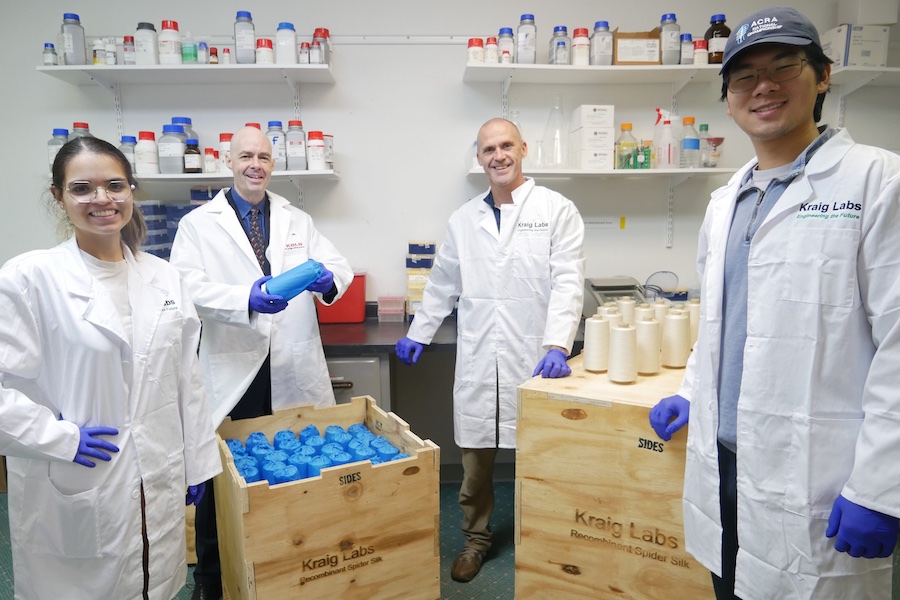
Kraig Biocraft Laboratories, Inc. (OTCQB: KBLB) (“the Company”, “Kraig Labs”, or “Kraig’s”), a world leader in spider silk technology*, today announced significant progress in the processing of its recently produced recombinant spider silk cocoons into reeled silk.

Latest News

#INDEX 2026

STFI highlights textile circular economy and alternative fibres at INDEX™ 2026

From 19 to 22 May 2026, INDEX will invite visitors to Lake Geneva for the world's leading nonwovens trade fair. The Centre of Excellence in Nonwovens at the Sächsisches Textilforschung- sinstitut e.V. (STFI) will be in attendance to present the latest developments in nonwovens research. In the field of the textile circular economy, the STFI will present acoustically effective nonwovens made from chemical recycling residues. The range also includes innovations aimed at replacing conventional raw materials, such as the biobased and biodegradable polymer polybutylene succinate (PBS) and Kendyr as an alternative to cotton.

#Associations

Italian textile machinery sector faces weak start to 2026 despite domestic growth

In the first quarter of 2026, order intake for Italian textile machinery manufacturers recorded a decrease of 5% compared to the same period in 2025, reflecting a still challenging start to the year. The decline affected foreign markets (-7%), while the domestic market showed growth (+21%).

#Nonwovens

Temafa Maschinenfabrik GmbH supplies a complete decortication plant for processing hemp straw to Hanffaser Geiseltal eG

Temafa Maschinenfabrik GmbH, a leading supplier of machinery and plants for fibre processing, has successfully secured an order to supply a complete plant for processing hemp straw to Hanffaser Geiseltal eG, based in Mücheln.

#Techtextil 2026

FET’s revolutionary gel spinning system wins Techtextil Innovation Award

FET has received the prestigious Techtextil Innovation Award 2026 in the New Production Technology category. The Techtextil Innovation Award honours outstanding ideas in textile technology, sustainability, AI and the creation of technical textiles, selected by an international jury of experts. Ranging from new materials to new production technologies, this award recognises progressive ideas that are driving forces for numerous industries, such as automotive, medical and construction.

TOP