[pageLogInLogOut]

#Raw Materials

U.S. Cotton Trust Protocol announces Levi Strauss & Co and their legacy brands as new members

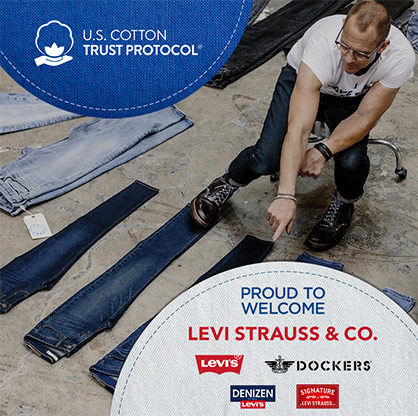
The U.S. Cotton Trust Protocol welcomes new members Levi Strauss & Co, one of the most recognizable denim companies worldwide, and their legacy brands Levi’s®, Dockers®, Denizen® by Levi’s®, and Signature by Levi Strauss & Co.™

More than 90 percent of Levi Strauss & Co’s products are cotton-based. The company has committed to sourcing 100 percent more sustainably grown cotton focusing on decreasing water use, cutting carbon emissions, and reducing fertilizer and pesticide use. This corporate commitment to more sustainable and resilient cotton sourcing is part of a broader internal initiative designed to move the company toward a more sustainable and circular product strategy. “At Levi Strauss & Co., the quality and sustainability of the cotton we use is critical to our business and important to our customers,” said Jeffrey Hogue, Chief Sustainability Officer, Levi Strauss & Co. “Membership in the U.S. Cotton Trust Protocol will be an important step and a key partnership in our efforts to source 100 percent more sustainably grown cotton.” 
© 2021 U.S.Cotton
© 2021 U.S.Cotton


The Trust Protocol will aid Levi Strauss & Co.’s efforts by providing verified data on sustainability practices from U.S. cotton growers and access to aggregate year-over-year data on critical metrics including water use, greenhouse gas emissions, energy use, soil carbon, soil loss and land use efficiency. Levi Strauss & Co will also participate in the pilot phase of the Protocol Credit Management System which provides its members with complete supply chain transparency through use of TextileGenesis’ blockchain technology.


“Levi Strauss & Co. is a globally recognized and respected brand and we are proud to welcome them as members,” said Dr. Gary Adams, president of the U.S. Cotton Trust Protocol. “During the past 35 years, the U.S. cotton industry has made significant progress in reducing our environmental impact and the Trust Protocol is aligned with the 2025 national goals to further those improvements. As a member, Levi Strauss & Co. will receive farm level data which will help them progress their sustainability efforts and achieve their cotton sourcing goals.”

The Trust Protocol has welcomed more than 450 brand, retailer, mill and manufacturer members since its launch in 2020. This includes Gap Inc. and its collection of purpose-led lifestyle brands Old Navy, Gap, Banana Republic and Athleta as well as global apparel manufacturer Gildan. The Trust Protocol has also welcomed UK retailers Tesco, Byford and Next Plc. Other Trust Protocol member announcements include the first 10 U.S. mills to join and the first members in Latin America.

The U.S. Cotton Trust Protocol is aligned with the UN Sustainable Development Goals, recognized by Textile Exchange and Forum for the Future, and part of the Sustainable Apparel Coalition, Cotton 2025 Sustainable Cotton Challenge, Cotton 2040 and Cotton Up initiatives.

More News from TEXDATA International

#Texprocess 2026

Texprocess 2026: Automation, digitalisation and AI redefine textile processing

Making investment decisions in textile processing has become significantly more demanding. Increasing energy costs, a shortage of skilled labour and ongoing geopolitical uncertainties are compelling companies to focus on technologies that deliver clear gains in efficiency and process reliability. This applies equally to apparel manufacturing and to the processing of technical textiles and high-performance materials. As a result, modernisation initiatives are assessed more carefully – even as the need to upgrade production systems continues to intensify.

#Techtextil 2026

Techtextil 2026: Between innovation pressure & market reality

From 21 to 24 April 2026, Techtextil in Frankfurt am Main will once again become the central meeting point for the international technical textiles and nonwovens industry. Running in parallel, Texprocess will focus on the industrial implementation of textile processing technologies as the leading platform in this field. Together, the two trade fairs form a closely integrated presentation and working platform along the entire textile value chain – from material development to finished applications.

#Techtextil 2026

Between geopolitical pressure and industrial resilience

In this interview, Dr. Janpeter Horn (VDMA) discusses the current challenges facing textile machinery manufacturers, shaped by geopolitical tensions, regulatory developments and subdued investment. He also outlines why innovation strength, integrated solutions and strategic positioning remain key to global competitiveness.

#Texprocess 2026

Between investment restraint and modernization pressure

Texprocess 2026 takes place in a complex market environment shaped by uncertainty and innovation pressure. In this interview, Elgar Straub (VDMA) explains why the trade fair is particularly relevant this year and which technologies are driving efficiency and competitiveness.

More News on Raw Materials

#Raw Materials

China projected to increase cotton production, yields, and imports in 2026/27

World cotton production in the 2026/27 season is projected at 25.9 million tonnes, exceeding global consumption of 25.2 million tonnes, according to the May 2026 issue of Cotton This Month. That means both production and consumption are expected to remain close to current season levels, while global cotton trade is projected to decline by 2.7% to approximately 9.6-9.7 million tonnes.

#Raw Materials

ICAC launches Carbon Credits Initiative to deliver new income streams to cotton farmers

The International Cotton Advisory Committee (ICAC) has announced a new initiative designed to unlock additional income streams for cotton farmers through participation in carbon credit markets, linking sustainable production practices directly to financial returns.

#Raw Materials

ECCO introduces first shoe featuring innovative protein-based fibre

ECCO, in partnership with Spinnova, announces the launch of the limited edition ECCO BIOM® 720, a first-of-its-kind shoe utilising an often overlooked leather by-product, transformed into a protein-based fibre. The fibres are produced using patented technology that advances material innovation while reducing waste and supporting full resource use across the leather and textile industry.

#Raw Materials

Kraig Biocraft Laboratories reports major progress converting record-setting spider silk cocoon production into reeled silk

Kraig Biocraft Laboratories, Inc. (OTCQB: KBLB) (“the Company”, “Kraig Labs”, or “Kraig’s”), a world leader in spider silk technology*, today announced significant progress in the processing of its recently produced recombinant spider silk cocoons into reeled silk.

Latest News

#Associations

BTMA backs global growth while investing in future UK leaders

As one of a number of new initiatives launched this year, the British Textile Machinery Association (BTMA) is launching the UK-India Textile Machinery Coalition. The UK-India Free Trade Agreement, signed in July 2025, has implications that extend across sourcing, competitiveness and long-term trade dynamics, believes BTMA CEO Jason Kent.

#Sustainability

Number of GOTS-certified facilities grow 15% globally as demand for credible sustainability standards continues to strengthen

Global Organic Textile Standard (GOTS) certification continued to grow in 2025, with nearly 18,000 certified facilities worldwide, despite ongoing geopolitical uncertainty and rapidly evolving regulatory requirements across global textile supply chains.

#Man-Made Fibers

The LYCRA Company strengthens sustainability leadership, appoints Alistair Williamson as VP of Product Sustainability

The LYCRA Company has appointed longtime executive Alistair Williamson as vice president of product sustainability, reaffirming its commitment to developing sustainable solutions for apparel and personal care products. In this role, he will guide the company’s next chapter of sustainability strategy and oversee all initiatives aimed at reducing environmental impact across products, operations, and innovation platforms.

#Textile processing

trinamiX mobile NIR spectroscopy: New applications for the footwear and textile industry

trinamiX GmbH expands its solution portfolio for the circular economy, now enabling the identification of materials used in the footwear and textile industries. With its mobile near-infrared (NIR) spectroscopy solutions, trinamiX supports manufacturers, sorters, recyclers, and brand owners in reliably identifying materials and improving transparency across increasingly complex value chains.

TOP