[pageLogInLogOut]

#Raw Materials

Bremen is Cotton

© 2021 Bremer Baumwollbörse
Once again, the International Cotton Conference confirmed how closely Bremen is interwoven with the raw material cotton and its internationally networked supply chain. Ultimately, the organisers of the prestigious conference, the Bremen Cotton Exchange and the Fibre Institute Bremen, were able to bring the cotton world together in Bremen for the 35th time. The impression is that ‘Bremen’, especially internationally, is a synonym for cotton, cotton research and cotton quality. More than 450 participants from 32 countries attended the conference.

A Meeting of the Cotton Community on the World Wide Web

The conference, which was originally planned for 2020, had to be postponed for a year for well-known reasons. However, since it is still not possible to hold a face-to-face event at the moment, the cotton community met for the first time in the almost 150-year history of the Bremen Cotton Exchange in virtual conference rooms on the Internet.

Almost 90 Speakers in 14 Sessions

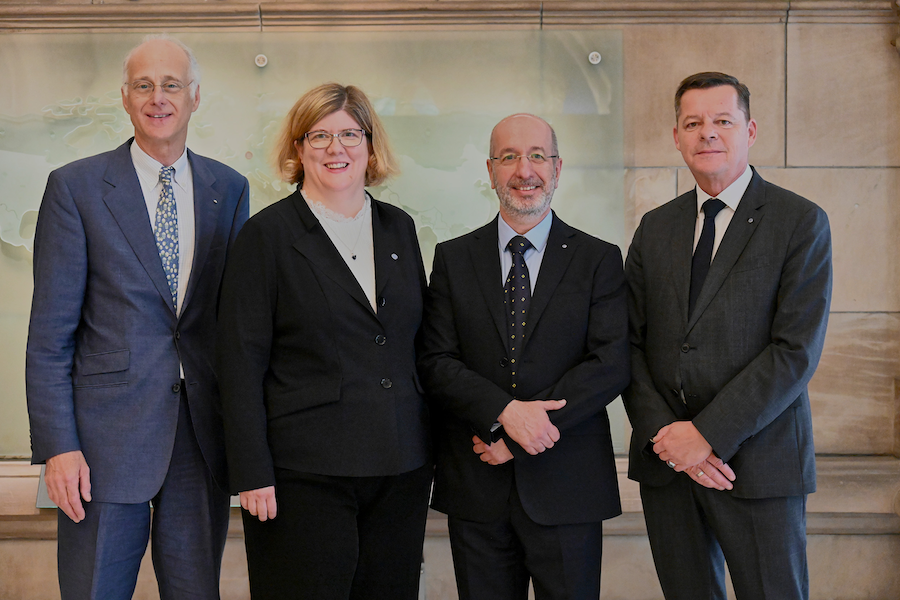
On 17 and 18 March, around 90 speakers and panellists contributed to the success of the conference with highly topical presentations, or by taking part in discussions and keynotes. Before this, the conference opened with speeches by Bremen's Mayor Dr Andreas Bovenschulte, Stephanie Silber, President of the Bremen Cotton Exchange and Prof. Axel Herrmann, Director of the Fibre Institute Bremen. The subsequent programme, with its 14 sessions, was convincing in its diversity and extensive range of information.

The conference sessions were divided into two parallel lecture strands, intended for visitors with different information interests. In the 'Conceptual Track', it was all about conveying information on a more political, strategic range of topics. These were, for example, sustainable cotton cultivation, transparency in the supply chain and corporate responsibility. In the more subject-specific 'Technical Track', the leading role was given to technological advances in cotton cultivation through digitalisation, increasing yields, improving fibre quality, quality testing and standardisation.

© 2021 Bremer Baumwollbörse


Alongside the sessions, there were poster presentations or poster talks and exchange discussions with experts. These partly followed on from the content of the lectures or extended the range of experience with informative impulses on other subjects. To achieve this, special virtual rooms were set up on the conference platform, which were open to participants during the conference for communication purposes of all kinds.


State of the Art Expert Knowledge

Each day of the conference began with two impressive keynotes from business or business associations, who approached the challenges of the cotton industry from different perspectives. They included Nanda Bergstein, Tchibo, Kai Hughes, ICAC, Heinz Zeller, Hugo Boss AG and Michael Alt and Eugen Weinberg, Commerzbank AG.

Panel discussions on subjects such as responsible raw material production, supply chain transparency and circular economy set clear accents. As did lectures on advances in cotton seed breeding and production, digitalisation in agriculture, cotton processing, cotton quality and testing, and the presentation of innovative textile products made from cotton.

There was also a convincing presentation by the Fibre Institute Bremen on the results of a survey of spinning mills carried out worldwide in cooperation with the Bremen Cotton Exchange. The survey dealt with disruptive quality defects in supplied cotton, the use of fibre blends and the use of cotton from alternative production methods. The results of a further survey conducted by the Bremen Cotton Exchange among clothing manufacturers and retailers also attracted a great deal of attention. It provided information on the evaluation of cotton quality and other cotton properties, the use of textiles made from other natural, mixed and/or man-made fibres, the importance of sustainability at retail level, and the willingness to make procurement processes transparent.

Last but not least, two days before the start of the conference, international network meetings were held by both the Steering Committee of the Discover Natural Fibres Initiative (DNFI) and the International Committee on Cotton Testing Methods (ICCTM) of the International Textile Manufacturers Federation (ITMF).

“We are very proud that the premiere of the hybrid version of the International Cotton Conference Bremen has ended successfully. I am therefore very grateful to everyone who made this possible,” stressed Stephanie Silber, President of the Bremen Cotton Exchange and Managing Director of the traditional cotton trading company Otto Stadtlander GmbH.

"The attractive composition of the conference programme once again shows how valuable the intensive cooperation between the Fibre Institute Bremen and the Bremen Cotton Exchange is, in which science and practice complement each other perfectly," said Prof. Axel Herrmann for the Fibre Institute Bremen (FIBRE).

“Again, the Bremen Conference has brought together leaders from around the world to address the critical ideas and challenges facing our industry. This conference continued to advance the sustainability efforts that are so important to all of us as we pursue the technical and market opportunities for cotton,” confirmed Mark Messura, Senior Vice President, Global Supply Chain Marketing for Cotton Incorporated.

Prof. Thomas Schneider, University of Applied Sciences for Technology and Economics (HTW), Berlin, added: “We have seen that cotton is indispensable for the future because of its properties as a natural, innovative, renewable, biodegradable, and recyclable raw material. The possibilities of its use go far beyond processing into clothing and are far from exhausted from the point of view of research.”

The next International Cotton Conference will be held on March 30-31, 2022, the year of the 150th anniversary of the Bremen Cotton Exchange.

We will continue to report in detail about the other contents of the cotton conference in our media, such as the Bremen Cotton Report, the websites of the Bremen Cotton Exchange and the Fibre Institute, as well as on the social media channels Facebook, LinkedIn, and Instagram. The conference news and programme details are still available on the conference website: https://cotton-conference-bremen.de/program/.

More News from Bremer Baumwollbörse

#Natural Fibers

Modern testing methods for raw cotton

The 38th International Cotton Conference Bremen will take place from 25 to 27 March 2026 at the Bremen Parliament. This conference has traditionally stood for in-depth expertise and international exchange. The program will focus on technical innovations, market trends, and regulatory frameworks across the entire value chain – from agriculture to the circular economy. With high-profile speakers, the conference is regarded as the key meeting point for the global cotton industry. Today’s focus: Cotton quality and testing methods.

#Natural Fibers

38th International Cotton Conference Bremen: Let´s Talk about Cotton!

The 38th International Cotton Conference Bremen, to be held on 25-27 March 2026 in Bremen’s parliament building on market square, once again sends a powerful signal for professional excellence and international dialogue. The focus is on the latest market trends and technical innovations throughout the entire value chain – from agriculture and quality assurance to processing and the circular economy. With its high-calibre speakers, the conference remains an indispensable forum for anyone involved in shaping the cotton industry scientifically, technically, or economically.

#Natural Fibers

38th International Cotton Conference Bremen launches registration and unveils key topics

Participants can now register online for the 38th International Cotton Conference Bremen, which will be held on 25-27 March 2026 at the Haus der Bürgerschaft parliament building on market square. All visitors can look forward to a high-calibre conference programme, numerous additional meetings and a valuable exchange of knowledge and information. The comprehensive range of topics covering the entire value chain will provide practical expertise, address current developments, answer key industry questions, and provide new impetus for the future.

#Natural Fibers

151st General Assembly of the Bremen Cotton Exchange

Economic change and personnel decisions were the dominant themes on the agenda of the Annual General Assembly of the Bremen Cotton Exchange on 26 June 2025. During the meeting, the new Executive Committee and Board of Directors of the raw material association, which is now almost 153 years old, were elected. Fritz. A. Grobien will take over as President.

More News on Raw Materials

#Raw Materials

Cotton production continues to exceed consumption, some growers shift away from cotton

World cotton lint production in the 2025/26 season is currently estimated at 26 million tonnes, continuing to exceed world consumption, which is estimated at 25.2 million tonnes, according to the February 2026 edition of Cotton This Month. Global production is estimated to be 1% higher than the previous season, while consumption is estimated to be 0.4% higher, resulting in a continued supply surplus in the world cotton market.

#Raw Materials

Better Cotton Initiative opens enrollment in the US with promising opportunities for producers

Producer enrollment for the US Program of the Better Cotton Initiative (BCI) is open until May 15 for the 2026-2027 season. With over 2,600 members spanning the cotton supply chain and more than 11,000 users of its Better Cotton Platform (BCP) as of 2025, BCI’s standard is implemented in 15 countries and covers one fifth of global cotton production.

#Natural Fibers

Human Rights Day: Cotton made in Africa reinforces its commitment to ensuring respect for human rights in cotton production

The sustainable cotton standard Cotton made in Africa (CmiA) has always focussed on respect for human rights, including by prohibiting child labour and discrimination. With the new version of the CmiA standard coming into force, AbTF raises requirements for due diligence in the areas of human rights and risk management.

#Research & Development

How innovations drive BASF’s success

“Innovation has always been part of BASF’s DNA. Especially in these volatile times, it is crucial to leverage our innovative strength to develop competitive solutions that differentiate us as a company in our markets and give us a competitive edge,” said Dr. Stephan Kothrade, Member of the Board of Executive Directors of BASF and Chief Technology Officer, at the company’s Research Press Briefing held today. To achieve this, BASF implemented its “Winning Ways” strategy about a year ago with the clear goal of becoming the preferred chemical company to enable its customers’ green transformation.

Latest News

#Dyeing, Drying, Finishing

Orthopac RVMC-20 plus: German Engineering for Smarter Weft Straightening

In times of rising cost pressure and growing quality demands, textile producers worldwide are searching for solutions that combine precision, efficiency, and sustainability. With its latest innovation, the Orthopac RVMC-20 plus, Mahlo once again demonstrates the strength of German engineering: improving proven technology to meet today’s challenges.

#Knitting & Hosiery

KARL MAYER and Lenzing partner to advance warp knitting with scalable cellulose fiber solutions

The Lenzing Group, a leading supplier of regenerated cellulosic fibers for the textile and nonwovens industries, together with KARL MAYER, the global market leader in warp knitting machines and warp preparation systems, debut a joint innovation project during Premiere Vision, Paris.

#Textile chemistry

RUDOLF gets the exclusive global distribution rights for Sanitized® textile technologies

With effect from today, RUDOLF officially assumes exclusive global distribution rights for Sanitized® textile technologies from SANITIZED AG. This is the next milestone in the strategic collaboration announced in 2025, with the partnership between the two companies now fully implemented and expanded worldwide.

#Europe

ICAC to support European Commission on pending PEF legislation

The International Cotton Advisory Committee (ICAC) is proud to announce that it has been included as a member of the European Commission’s Technical Advisory Board (TAB) on the Product Environmental Footprint methodology. The Commission developed the Product Environmental Footprint (PEF) to assess and communicate the life cycle environmental performance of products and organizations.

TOP