[pageLogInLogOut]

#Raw Materials

Breeding and cotton production: Progressive cotton farming works like this
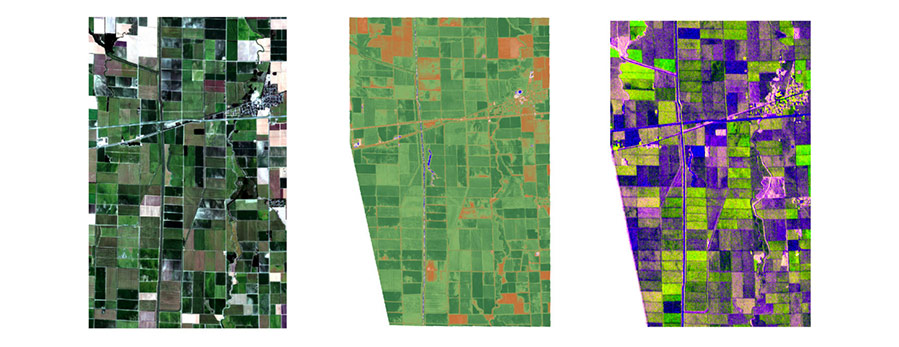
Different satellite images of a cotton field in Mississippi © Melchionna – Remote Sensing
On 17 and 18 March, the doors will open for the International Cotton Conference Bremen – The Hybrid Edition. This time around, the meeting point of the global cotton and textile world will be mainly virtual.
  • Genetic Engineering Today
  • Robot and Satellite Technology in Practice
  • Pure Agriculture: Seed Cultivation, Growing, Ginning

Wherever we look, transparency is being demanded along for the entire supply chain. Today, knowledge about cotton and its cultivation is not only important for raw material producers and the textile sector, but also increasingly for retail, as the key to the end consumer. Here, the conference has a lot to offer during two sessions in the afternoon on 17 March.

Robots and Satellite Technology in Cotton Cultivation

Gaylon Morgan, Director of Agricultural and Environmental Research at Cotton Incorporated, Cary, North Carolina, USA, is a specialist in the further development of cotton cultivation methods and leads the conference sessions “Cotton Breeding and Production”. The sessions provide an overview of developments in the field of seed breeding, the use of robots and satellite technology in cotton cultivation and the improvement of ginning processes. The focus is on both ecological and economic sustainability.

Long-Term GMO Study

David Albers, Product Development Manager for Bayer Crop Science in St. Louis, Missouri, USA, provides information on the results of a long-term study on the use of transgenic seeds. This compares yield and quality results from the 1980s, i.e. those directly before the introduction of transgenic seeds, with those from four decades later until today.

Status Quo of African Seed Breeding Systems

Marc Giband, Research Associate at the Agricultural Research Centre for International Development (CIRAD) in Montpellier, France, has taken part in seed breeding projects in West and Central Africa. Together with other African and European scientists, he was involved in extensive analyses of the state of seed breeding development in Africa. The cotton yields on the continent are still well below the world average and there is still great potential here.


Robot Technology is Changing Modern Agriculture

Alex Thomasson is Professor and Department Head of Agricultural and Biological Engineering at Mississippi State University, USA. In his lecture “Robot technology for the cotton harvest” he presents the possibilities of using robots that make the harvesting process more productive and reduce CO² emissions by using fewer large machines. For example, robot harvesters can perform multiple harvesting procedures within the growing season, during which they only access the ripe, open cotton buds. This reduces crop losses and ensures better fibre quality.

In addition, a poster presentation by Cotton Incorporated draws attention to robots that are used for targeted weeding in the cotton field, which can influence the use of herbicides.

Satellite Images Reveal Plant Growth Problems

Physicist Sabrina Melchionna is the owner of Remote Sensing, Bremen, Germany. She advises companies on ground observation through satellites and data acquisition. Based on satellite data, digital maps are created that provide ecological status images. In her lecture, she presents examples of ground observation images of cotton fields that provide information about plant health and growth. The information from the satellite data can help farmers to work in a resource-optimised manner and to offer higher-quality crops.

Optimising Ginning Processes

In the ginning process, cotton fibres are mechanically separated from the seeds after harvest. Greg Holt heads the Cotton Production and Processes Research Department at the US Department of Agriculture, Lubbock, Texas. In his lecture he shows that contamination by cotton wrapped in plastic can be traced back to round modules deposited in the field after the machine harvest. If the smallest plastic particles remain in the cotton, this leads to defects in the dying of yarns and fabrics, and thus to complaints in the event of product failure.

Carlos B. Amijo from the Agricultural Research Service of the US Department of Agriculture (USDA) in Mesilla Park, New Mexico, provides information on the development of ginning techniques that help ensure that the fibre length uniformity index achieved meets the requirements of newer and more efficient spinning technology. This would provide the textile industry with longer and more uniform fibres, making yarn production more efficient.




More News from Bremer Baumwollbörse

#Natural Fibers

38th International Cotton Conference Bremen: Let´s Talk about Cotton!

The 38th International Cotton Conference Bremen, to be held on 25-27 March 2026 in Bremen’s parliament building on market square, once again sends a powerful signal for professional excellence and international dialogue. The focus is on the latest market trends and technical innovations throughout the entire value chain – from agriculture and quality assurance to processing and the circular economy. With its high-calibre speakers, the conference remains an indispensable forum for anyone involved in shaping the cotton industry scientifically, technically, or economically.

#Natural Fibers

38th International Cotton Conference Bremen launches registration and unveils key topics

Participants can now register online for the 38th International Cotton Conference Bremen, which will be held on 25-27 March 2026 at the Haus der Bürgerschaft parliament building on market square. All visitors can look forward to a high-calibre conference programme, numerous additional meetings and a valuable exchange of knowledge and information. The comprehensive range of topics covering the entire value chain will provide practical expertise, address current developments, answer key industry questions, and provide new impetus for the future.

#Natural Fibers

151st General Assembly of the Bremen Cotton Exchange

Economic change and personnel decisions were the dominant themes on the agenda of the Annual General Assembly of the Bremen Cotton Exchange on 26 June 2025. During the meeting, the new Executive Committee and Board of Directors of the raw material association, which is now almost 153 years old, were elected. Fritz. A. Grobien will take over as President.

#Natural Fibers

The 151st General Meeting of the Bremen Cotton Exchange on 26 June 2025

The General Assembly of the Bremen Cotton Exchange will take place in Bremen and online on 26 June 2025. All members, partners and friends of the association are cordially invited to attend this important event.

More News on Raw Materials

#Natural Fibers

Human Rights Day: Cotton made in Africa reinforces its commitment to ensuring respect for human rights in cotton production

The sustainable cotton standard Cotton made in Africa (CmiA) has always focussed on respect for human rights, including by prohibiting child labour and discrimination. With the new version of the CmiA standard coming into force, AbTF raises requirements for due diligence in the areas of human rights and risk management.

#Research & Development

How innovations drive BASF’s success

“Innovation has always been part of BASF’s DNA. Especially in these volatile times, it is crucial to leverage our innovative strength to develop competitive solutions that differentiate us as a company in our markets and give us a competitive edge,” said Dr. Stephan Kothrade, Member of the Board of Executive Directors of BASF and Chief Technology Officer, at the company’s Research Press Briefing held today. To achieve this, BASF implemented its “Winning Ways” strategy about a year ago with the clear goal of becoming the preferred chemical company to enable its customers’ green transformation.

#Natural Fibers

ICAC to collaborate with Uzbekistan and Bizpando on regenerative agriculture

The Government of Uzbekistan has allocated 55,000 hectares of land to implement a regenerative agriculture program for cotton as part of a collaborative project with the International Cotton Advisory Committee (ICAC) and Bizpando, a company with a a blockchain-based internet platform designed to ensure supply chain compliance.

#Natural Fibers

World Cotton Trade declined 4.1% in 2024/25, according to ICAC's 2025 World Cotton Trade Report

Washington, DC — The International Cotton Advisory Committee (ICAC) has released the 2025 World Cotton Trade Report, which covers trade developments in raw cotton since 1980. An annual publication, it provides analysis of world trade by region; import/export projections by country; matrices of trade flows; and seasonal estimates of export commitments to date.

Latest News

#Recycled_Fibers

Leading fashion brands step up to unlock the next chapter of Circulose

Since 2024, under new ownership and leadership, Circulose has set a renewed strategic direction focused on securing long-term commitments with partner brands to bring CIRCULOSE® back to market at scale. This strategy has proven successful.

#Research & Development

More safety and comfort for protective clothing thanks to auxetic fabrics

When everyday materials are pulled, they stretch or elongate in the direction of the pull and become narrower in cross-section. We can also observe this property in two-dimensional textiles. Auxetic structures behave differently here. They have the striking property of not changing under tensile stress or even increasing their width or thickness. These properties are advantageous, for example, in protective textiles or textile filter media. The DITF are researching auxetic fabrics for various applications.

#Recycled_Fibers

Recycling mixed-fibre garments becomes a reality: RadiciGroup, The LYCRA Company and Triumph take circular fashion a step forward

The process, which is both economically and environmentally sustainable, has enabled the production of an underwear set made from 100% recycled nylon and LYCRA® fibre in a closed-loop system.

#Spinning

First PA66 spinning plant with EvoQuench successfully commissioned

With the successful commissioning of a multi-digit PA66 spinning line for microfiber yarns, Chinese textile company Shandong Nanshan Fashion Technology Co., Ltd. has added yarn production to its textile value chain.

TOP