[pageLogInLogOut]

#Raw Materials

With U.S. Cotton Trust Protocol, brands and retailers can now source US cotton with more confidence

(c) 2020 US Cotton Trust Protocol
Starting today, brands and retailers can join the U.S. Cotton Trust Protocol, a new system for responsibly grown cotton that will provide annual data for six areas of sustainability in line with the UN Sustainability Goals. This year-on-year data available for the first time will allow brands and retailers to better measure progress towards meeting sustainability commitments.

The Trust Protocol brings quantifiable and verifiable goals and measurements to responsible cotton production

“One of our goals in developing the Trust Protocol is to give brands and retailers greater confidence when including US cotton in their sourcing mix”, said Ken Burton, Executive Director of the U.S. Cotton Trust Protocol. “Participating brands and retailers will now be able to demonstrate measurable progress in reducing their environmental footprint and in achieving sustainability targets.”

The Trust Protocol underpins and verifies sustainability progress through sophisticated data collection and independent third-party verification. By working with Field to Market: The Alliance for Sustainable Agriculture and Control Union Certifications North America, the Trust Protocol enables brands and retailers to better track the cotton entering their supply chain. Brands who become members of the Trust Protocol will have access to aggregate year-over-year data on water use, greenhouse gas emissions, energy use, soil carbon and land use efficiency.

“At Levi Strauss & Co the quality and sustainability of the cotton we use is critical to our business and important to our customers. We are deeply committed to sourcing sustainable cotton and reducing water usage, carbon emissions, and chemical usage”, said Liza Schillo, Senior Manager, Global Sustainability Integration, Levi Strauss & Co and Trust Protocol board member. “We are therefore in strong support of the introduction of standards – including the U.S. Cotton Trust Protocol – that champion sustainably grown cotton and drive wider adoption over the long-term of sustainable cultivation practices.”

The Trust Protocol is a complement to existing sustainability programs and is designed from the ground up to fit the unique cotton mass-growing environment of the United States.

Last month the Trust Protocol was added to Textile Exchange’s list of 36 preferred fibres and materials that more than 170 participating brands and retailers can select from as part of Textile Exchange’s Material Change Index programme.

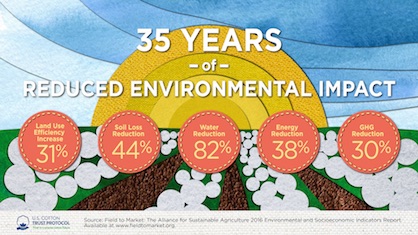
35 Years of Continuous Improvements

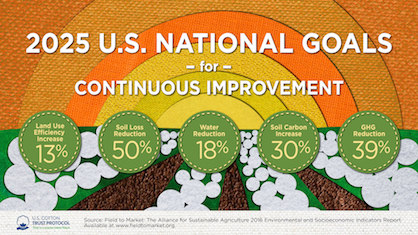
Over the past 35 years US cotton has made significant improvements in growing cotton responsibly.

To continue the progress the Trust Protocol has ambitious national goals for 2025. By this date, the Trust Protocol aims to have more than half of all US cotton production included in the programme.

“Achieving a transition towards agricultural sustainability requires broad public and private partnerships and a vital part of my work at The Nature Conservancy includes looking at ways to collaborate with key agricultural stakeholders”, said Dr Kris Johnson, Deputy Director of Agriculture, The Nature Conservancy, North American Region, and U.S. Cotton Trust Protocol board member. “Informed by science-based targets, the Trust Protocol provides evidence of and encourages continuous improvements in US cotton production.”
(c) 2020 U.S. Cotton Trust Protocol


More News from TEXDATA International

#ITM 2026

ITM 2026: The new geography of textile production

New production hubs are emerging across North Africa and Central Asia, while Türkiye is accelerating its transformation toward higher-value, technology-driven and more sustainable textile manufacturing.

#Research & Development

“Production is a product”

From technical textiles and AI-driven robotics to the limitations of textile circularity: Professor Dr Thomas Gries looks back on more than two decades of development at ITA Aachen. In the interview, he explains why production technology remains a decisive success factor, discusses international collaborations and innovation ecosystems, and shares his views on the transformation of production landscapes and the challenges facing an increasingly regulated industry.

#Knitting & Hosiery

“We need to move away from the price trap and return to a value-driven mindset.”

With its new Textile Innovation Center, KARL MAYER is sending a strong signal for innovation, collaboration, and the future of textile applications. In this interview, Karl Josef Mayer discusses new opportunities in warp knitting, the processing of staple fibres, recycling, the changing role of machinery manufacturers, and why the textile industry must once again focus more strongly on the value of textiles. by Oliver Schmidt

#Associations

“Innovation, resilience and international experience remain the great strengths of the Swiss textile machinery industry”

Geopolitical uncertainty, growing competitive pressure from China, new free trade agreements and the shift towards a circular economy are currently reshaping the global textile industry. In this interview, Cornelia Buchwalder discusses the current mood within the Swiss textile machinery sector, the industry’s distinctive innovative strength, new market opportunities in India and Asia, and the technological trends that could shape the upcoming trade fair cycle leading up to ITMA 2027.

More News on Raw Materials

Latest News

#Nonwovens

EDANA launches landmark continence report to mark the start of the World Continence Week

Today marks the official commencement of the World Continence Week. To honour this global awareness initiative, EDANA has published a comprehensive report titled "The Central Role of Absorbent Hygiene Products in the Management of Adult Urinary Incontinence: Benefits, Costs and Environmental Impact." The World Continence Week (WCW) is an annual global initiative dedicated to raising public awareness about incontinence and bladder or bowel health issues. Traditionally held in June, this awareness week aims to shed light on a condition that affects millions of people worldwide but is frequently kept secret due to widespread social stigma, embarrassment, and taboo.

#Associations

Mario Jorge Machado re-elected President of EURATEX

The EURATEX General Assembly has re-elected Mario Jorge Machado as President of EURATEX, renewing its confidence in his leadership at a crucial moment for the European textile and clothing industry. The sector is facing rising costs, global competitive pressure and an increasingly challenging transition towards sustainability and digitalisation.

#ITM 2026

ITM 2026 makes happy participants with its international and qualified visitor profile

ITM 2026 International Textile Machinery Exhibition, one of the most prestigious meeting points of the textile machinery sector, attracted attention in its first three days, particularly with its diverse international visitor numbers. Industry professionals from all over the world had the opportunity to closely examine the latest technology machines and solutions displayed in operation. Thousands of visitors from approximately 100 countries, primarily Egypt, Pakistan, India, Uzbekistan, Syria, Turkmenistan, Tajikistan, Morocco, Algeria, and Tunisia, met at the Tüyap Fair and Congress Center for new investment and cooperation opportunities.

#ITM 2026

KARL MAYER presents a textile TEXTRONIC® innovation at ITM 2026

With highly efficient machines and continuous textile innovations, KARL MAYER underscores its role as a reliable partner for discerning top-tier customers. Just in time for ITM 2026 in Istanbul, the industry leader is introducing a true innovation: an eyelash lace with its characteristic fringed look – combined with a previously unattainable 4-way stretch. While the established fabric could until now only be produced as rigid version or with one-dimensional stretch, the new elasticity in both dimensions expands the possibilities for cross-band panel fabrics.

TOP