[pageLogInLogOut]

#Other suppliers

Seeing beyond the patterns with Shelton Vision
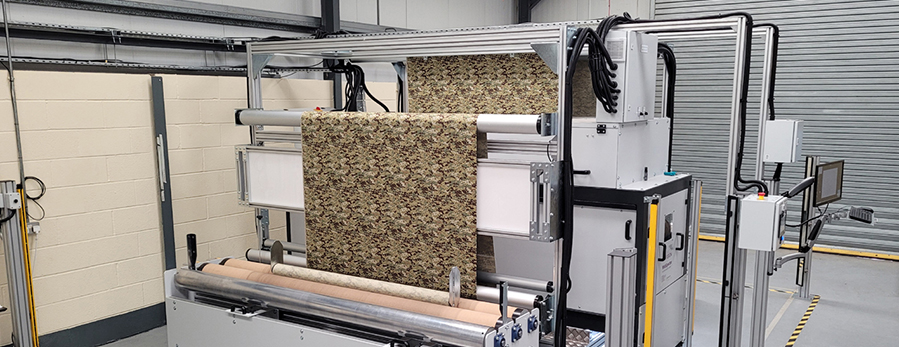
The patent-pending system has been validated through factory trials on a purpose built full scale in-house demonstration system. © Shelton Vision
A ground breaking and unique new fabric inspection technique for accurately detecting the most subtle of defects on patterned fabrics during high speed production has been developed by BTMA member Shelton Vision, of Leicester, UK.

The patent-pending system has been integrated into the company’s WebSpector platform – one of the most powerful plain fabric inspection systems on the market – and validated through factory trials on a purpose-built full scale in-house demonstration system with sophisticated fabric transport capabilities.

As a result, a first system has already been ordered by a manufacturer of both plain and patterned fabrics, including camouflage, in Colombia.
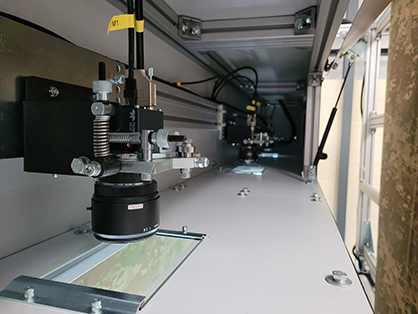
The Shelton WebSpector machine vision system offers a sophisticated platform for automated defect detection of over 97%. © Shelton Vision


This follows the successful conclusion of a 21-month Innovate UK project in which techniques for the resolution of complex pattern deformations were developed by machine vision and computer scientists in the company, backed up by the machine vision and robotics department at Loughborough University.

Restrictions

Traditional methods for defect detection rely on human inspection which is ineffective, with detection rates under 65%, while the Shelton WebSpector machine vision system offers a sophisticated platform for automated defect detection of over 97%, but until now has been restricted to plain textiles.

“What our new system basically does is essentially make the ‘good’ pattern invisible to the detection software,” explains Shelton Vision Managing Director and CEO Mark Shelton. “Building on our market leading vision system for plain textiles, we have developed template matching techniques for the resolution of complex pattern deformations in order for the system to pick up defects in the pattern as well as underlying defects.”


While pattern matching and neural network approaches have previously been tried for patterned textiles they have failed to provide a practical solution due to the extreme complexity associated with pattern matching on deformable substrates like textiles, as well as the time required to train a neural network for each pattern type.

Challenges

“The challenge is that fabrics are not rigid and can be creased or stretched and are also subject to local distortion,” says Mark. “As a result, inspection without the technique we have developed, would lead to thousands of false positives. Our sophisticated pattern inspection software techniques ensure a clean image, allowing the detection of faults on fabrics running at speeds of up to a hundred metres a minute.”

The full system consists of:

A camera and lighting system for optimum image capture at high speed and associated image processing hardware.

Self-training software utilising statistical analysis to automate the system configuration for new textile products.

An advanced suite of defect detection algorithms for the detection of all textile defect types.

An AI-driven defect classification system which learns and automates defect naming in real time, as well as a real time defect grading capability based on client decision rules.

A system for recording and retrieving complete roll map images for subsequent review and quality control.

The generation of textile roll maps with complete defect data allows for an optimised textile cut plan, improved downstream processing and quality assurance.

“Defect detection represents a major industry challenge,” says Jason Kent, CEO of the British Textile Machinery Association. “The failure to provide textiles within defect tolerance limits can lead to whole batch recalls, resulting in costly customer claims and downstream production delays. Poor defect management is also a major source of industrial waste. The potential addressable market for patterned textile vision systems is estimated to be well in excess of £5 billion when considering on loom, on knitting machine, in process and final finished fabric inspection. No other vision system on the market offers these features for patterned textiles, so it’s a great example of UK innovation at its best.”

Founded in 1940, the British Textile Machinery Association actively promotes British textile machinery manufacturers and their products to the world. The non-profit organisation acts as a bridge between its members and the increasingly diverse industries within the textile manufacturing sector.

More News from TEXDATA International

#Recycling / Circular Economy

textile.4U publishes special edition “Top 100 Textile Recycling Companies 2025”

With a comprehensive 176-page special edition, textile.4U is dedicating its latest issue entirely to one of the most dynamic and influential topics in today’s textile industry: textile recycling. The new issue, published exclusively in high-quality print, presents the Top 100 textile recycling companies researched and selected by TexData – organizations that already play a key role in the transition to circular textiles or are expected to have a significant impact in the near future.

#Recycling / Circular Economy

Responsible Textile Recovery Act of 2024 signed by Governor

Senator Josh Newman (D-Fullerton) is proud to announce that Senate Bill 707 (SB 707), the Responsible Textile Recovery Act of 2024, has been signed into law by the Governor of California, Gavin Newsom. This groundbreaking legislation establishes the country’s first Extended Producer Responsibility (EPR) textile recycling program, marking a significant step forward in the state’s efforts to combat waste and promote sustainability.

#Textiles & Apparel / Garment

Modtissimo promotes sustainability with 28 coordinates in the Green Circle

Modtissimo is proving more and more to be a textile and clothing show that delivers the latest innovations in the area of sustainability, with the iTechStyle Green Circle being the main showcase for companies' creations. In this 60+4 edition, taking place on 12 and 13 September, 28 coordinates will be exhibited in a section organised by CITEVE and curated by Paulo Gomes.

#Europe

The EU and Egypt team up to mobilise private sector investments at Investment Conference and sign a Memorandum of Understanding underpinning €1 billion in macro-financial assistance for Egypt

At the EU-Egypt Investment Conference, co-organised by the EU and the Government of Egypt on 29-30 June, the EU and Egypt are teaming up to intensify private sector investments in Egypt. They are also signing a Memorandum of Understanding (MoU) for the disbursement to Egypt of up to €1 billion in Macro-Financial Assistance.

More News on Other suppliers

#ITMA Asia + CITME Singapore 2025

Asteks to meet the global market at ITMA ASIA + CITME Singapore 2025

Getting ready to take its place at ITMA ASIA + CITME Singapore 2025 with advanced grinding solutions and a wide range of aprons and cots, Asteks is expanding its target for the Asian market. The company, focusing on strengthening relations with current and potential customers, will highlight the “Made in Türkiye” label with its innovative and competitive products.

#Dyeing, Drying, Finishing

WickView Moisture Management Tester recognized by new AATCC industry standard

James Heal’s WickView Moisture Management Tester now has an official industry standard, with the new test method just released by The American Association of Textile Chemists and Colorists (AATCC), TM217-2025 – Liquid Moisture Management Vertical and Horizontal Wicking - Image Analysis.

#Other suppliers

New impulses for the textile care industry: Texcare 2024 supporting programme

The focus of Texcare International 2024 (6-9 November) will be on the major challenges facing the textile care industry, including automation, energy saving, circular models and textile hygiene. Together with its partners, the leading trade fair has designed a supporting programme that can offer progressive impulses for the future of the sector.

#Other suppliers

Microfactory for filter bags developed in Sweden

After an intensive few years of development, ACG Kinna Automatic and ACG Nyström – members of TMAS, the Swedish textile machinery association –have delivered the first microfactory for the production of fully finished filter bags to a major international filtration industry customer, in cooperation with JUKI Central Europe.

Latest News

#Natural Fibers

38th International Cotton Conference Bremen: Let´s Talk about Cotton!

The 38th International Cotton Conference Bremen, to be held on 25-27 March 2026 in Bremen’s parliament building on market square, once again sends a powerful signal for professional excellence and international dialogue. The focus is on the latest market trends and technical innovations throughout the entire value chain – from agriculture and quality assurance to processing and the circular economy. With its high-calibre speakers, the conference remains an indispensable forum for anyone involved in shaping the cotton industry scientifically, technically, or economically.

#Recycled_Fibers

Leading fashion brands step up to unlock the next chapter of Circulose

Since 2024, under new ownership and leadership, Circulose has set a renewed strategic direction focused on securing long-term commitments with partner brands to bring CIRCULOSE® back to market at scale. This strategy has proven successful.

#Research & Development

More safety and comfort for protective clothing thanks to auxetic fabrics

When everyday materials are pulled, they stretch or elongate in the direction of the pull and become narrower in cross-section. We can also observe this property in two-dimensional textiles. Auxetic structures behave differently here. They have the striking property of not changing under tensile stress or even increasing their width or thickness. These properties are advantageous, for example, in protective textiles or textile filter media. The DITF are researching auxetic fabrics for various applications.

#Recycled_Fibers

Recycling mixed-fibre garments becomes a reality: RadiciGroup, The LYCRA Company and Triumph take circular fashion a step forward

The process, which is both economically and environmentally sustainable, has enabled the production of an underwear set made from 100% recycled nylon and LYCRA® fibre in a closed-loop system.

TOP