[pageLogInLogOut]

#Natural Fibers

Better Cotton enhances due diligence and decent work approaches in Uzbekistan
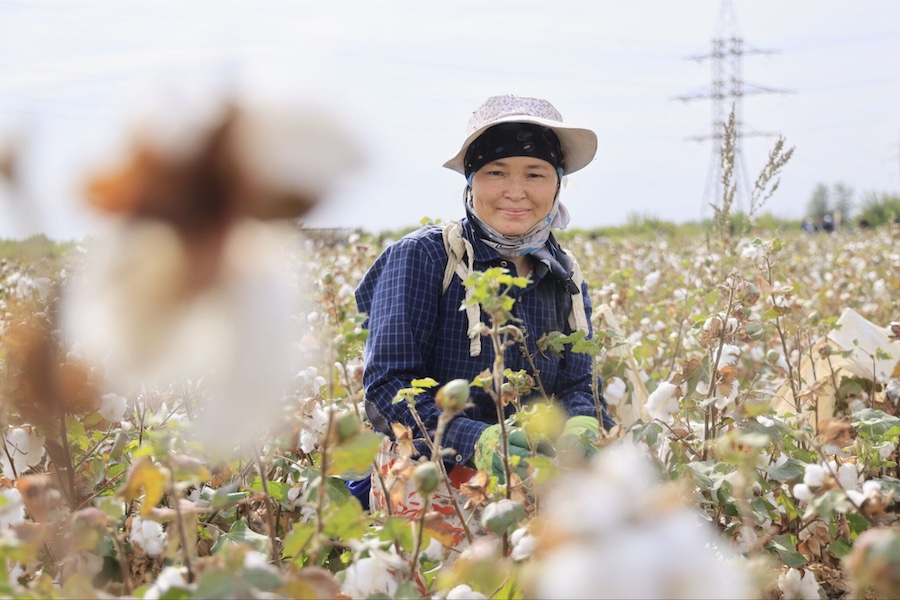
Better Cotton, the world’s largest cotton sustainability initiative, has announced significant progress in the delivery of its Uzbekistan programme, including the adoption of stronger and more refined approaches to due diligence and decent work activities.
Woman working at a cotton field in Uzbekistan. © 2025 Photo credit: Uzbekistan’s Ministry of Agriculture


Katerina Gorbunova, Head of Better Cotton’s programme in Uzbekistan, said: “In collaboration with our Programme Partner, the German Agency for International Cooperation (GIZ), we have strengthened the programme’s framework and the services we offer to accelerate change across the country’s cotton sector.” 

Better Cotton’s Uzbek programme has strengthened in-country verification of licensed clusters by building the capacity of independent civil society groups and third-party auditors, plus implementing an updated due diligence methodology to ensure more robust and local oversight. 

This new-and-improved approach includes in-depth interviews and questionnaires with both cluster management and workers. It also consists of checks on financial health, ethics, and governance, providing a more comprehensive view of risk and performance across participating enterprises. The insights generated through this process are used to inform targeted interventions. 

Decent work-related actions have also evolved in light of Better Cotton recently becoming a certification scheme. The organisation now conducts preliminary assessments of newly onboarded clusters before the season begins to determine their readiness for certification and if requirements are not met, audits are postponed to the following season. 

For clusters with active licences, second party checks by qualified Better Cotton staff are conducted to identify potential decent work-related issues and, if necessary, trigger a more comprehensive examination by external labour rights monitoring organisations. 

Since August 2024, Better Cotton and GIZ have expanded training to cover not only innovative and regenerative agricultural practices, but also social sustainability and decent work principles following recent changes to Uzbek labour laws. 

This effort deployed a cascading training methodology to target cotton cluster management on the basis that they can subsequently educate workers, who can then support their peers. 

Gorbunova said: “The Uzbek cotton sector has tremendous potential to be a leader in the production of more sustainably produced cotton. This can only be achieved through collaboration, robust and transparent processes, and perseverance. Better Cotton is uniquely positioned to help unlock this potential and will continue to engage stakeholders across the country to make our vision a reality.” 

Paul Schumacher, Cotton Project Manager at GIZ Uzbekistan, added: “Today, sustainable agricultural methods, trade facilitations and decent work are no longer parallel efforts, they are parts of one sustainable system. With the right networks and shared effort, as we created within the frame of Better Cotton, we turn individual action into systemic change.”
More News from Better Cotton

#Raw Materials

Better Cotton Initiative marks certification anniversary with progress update and accreditation

One year since becoming a certification scheme, the Better Cotton Initiative (BCI) has announced that more than 3,000 supply chain actors have been certified. At farm level, more than 30% of farms and producer units supplying BCI Cotton have received a positive audit outcome.

#Raw Materials

Better Cotton Initiative opens enrollment in the US with promising opportunities for producers

Producer enrollment for the US Program of the Better Cotton Initiative (BCI) is open until May 15 for the 2026-2027 season. With over 2,600 members spanning the cotton supply chain and more than 11,000 users of its Better Cotton Platform (BCP) as of 2025, BCI’s standard is implemented in 15 countries and covers one fifth of global cotton production.

#Natural Fibers

Better Cotton Initiative partners with Uzbek government agency to offset certification costs

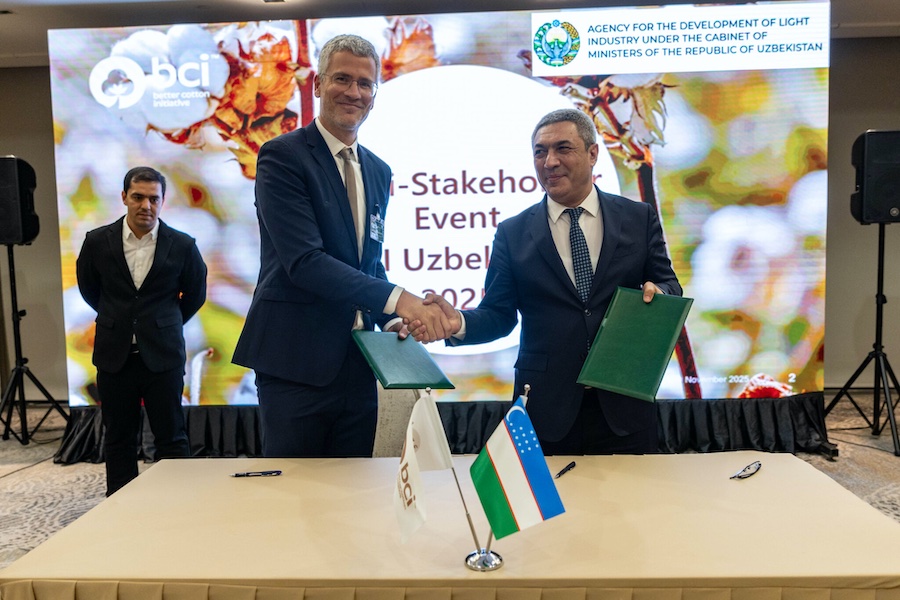
The Better Cotton Initiative (BCI) has today announced a strategic agreement with Uzbekistan’s Light Industry Agency to increase financial support for cotton farming clusters adopting sustainable agricultural practices.

#Natural Fibers

Better Cotton Initiative surpasses 50% traceable BCI Cotton milestone

Two years since the launch of its traceability solution, the Better Cotton Initiative (BCI) has announced that over 50% of BCI Cotton volumes entering global fashion and textile supply chains are now traceable, deriving from 15 countries.

More News on Natural Fibers

#Raw Materials

ICAC projects slight decline in production, relative stability for consumption

Global cotton production is projected to decline by 4% in the 2026/27 season to 24.8 million tonnes, while consumption is expected to remain relatively steady at 25.0 million tonnes, according to the March 2026 edition of Cotton This Month.

#Raw Materials

Beyond the wardrobe – innovative cotton takes the spotlight

Cotton can do more – a lot more. Cutting-edge textiles and high-tech products made from 100% cotton prove just how powerfully performance and sustainability can come together. That very surge of innovation is front and centre at the 38th Bremen Cotton Conference, taking place March 25–27, 2026, at Bremen’s Parliament on the historic market square – culminating in a bold and dedicated closing session on Friday. In the spotlight: performance upgrades for pure cotton, smart strategies for circular textile waste solutions, and pioneering concepts for demanding technical applications. From natural fibre–reinforced composites to highly effective flame-retardant solutions, cotton steps out of the closet and shows the future potential woven into every fibre.

#Spinning

Measure and control the fiber – optimize yarn quality

Producing consistent yarn quality is an everyday challenge – and a very difficult one. Detailed knowledge and understanding of the fiber raw material is absolutely critical to achieving the best possible quality in the yarn. To help spinners, Uster experts have put together guidelines for avoiding yarn irregularity claims, in a special edition of the Uster News Bulletin.

#Raw Materials

Esquel Group adds two new extra-long staple cotton varieties approved

Esquel Group’s Xinjiang Research & Development Center has successfully developed two new Sea Island cotton (Extra-Long-Staple cotton, ELS cotton) varieties named “Yuan Loong 37” and “Yuan Loong 42,” which have been officially approved and granted registration numbers. Both varieties have also obtained Plant Variety Rights certificates, marking another significant breakthrough for the Group in cotton breeding and commercial application.

Latest News

#Techtextil 2026

Knowledge that drives progress: Techtextil and Texprocess forums strengthen the global textile industry with a future-oriented programme

From AI-supported production optimisation and digital manufacturing solutions to circular technologies and bio-based high-performance materials: the Techtextil and Texprocess forums provide answers to the key challenges of the global textile industry with a curated content programme. As hubs for innovation and knowledge, they enhance competitiveness and offer orientation in changing markets. From 21 to 24 April 2026, Frankfurt is once again the global meeting point for thought leaders from industry, research and business.

#Techtextil 2026

Enhanced protection without added weight: Innovative technology for flame-retardant textiles doubles reaction time and ensures high wearing comfort

Flame-retardant textiles have long faced the same dilemma: the higher the level of protection, the greater the compromise in comfort, weight and breathability. This is especially important for workwear and protective clothing worn for long hours, where comfort is crucial to wearer acceptance and satisfaction. At Techtextil 2026 in Frankfurt, Swiss company Textilcolor AG will unveil pyroshell™, an innovative flame-retardant technology designed to tackle this challenge. Protection is provided by a graphite-based functional layer integrated into the textile structure, which doubles the reaction time before burns occur while significantly enhancing comfort. The material does not release any toxic fumes and offers textile manufacturers entirely new opportunities to design and produce protective and functional garments. It is also durable enough to withstand up to 50 industrial washes.

#Composites

JEC WORLD 2026 opens: Paris becomes the World Capital of composites

JEC World 2026 opens tomorrow, March 10, at Paris Nord Villepinte, bringing together the entire composites ecosystem for three days of exhibitions, conferences, technical sessions, strategic industry gatherings, and business meetings. As the “festival of composites”, JEC World is also a destination for a broad spectrum of other professional visitors, eager to discover how these advanced materials can offer sustainable solutions to their industries.

#Spinning

Barmag presents the next generation of POY production – energy-efficient and partial-automated

With POY 2.0, Barmag is introducing a completely redesigned spinning concept that takes the production of partially oriented yarn (POY) to a new level in terms of technology and economy. The solution, which was presented to a selected audience of experts for the first time at ITMA Asia + CITME 2025, was met with great enthusiasm: several yarn producers worldwide immediately expressed their interest in a pilot plant.

TOP