[pageLogInLogOut]

#Man-Made Fibers

Textile Exchange publishes comprehensive polyester LCA study
© 2026 Textile Exchange
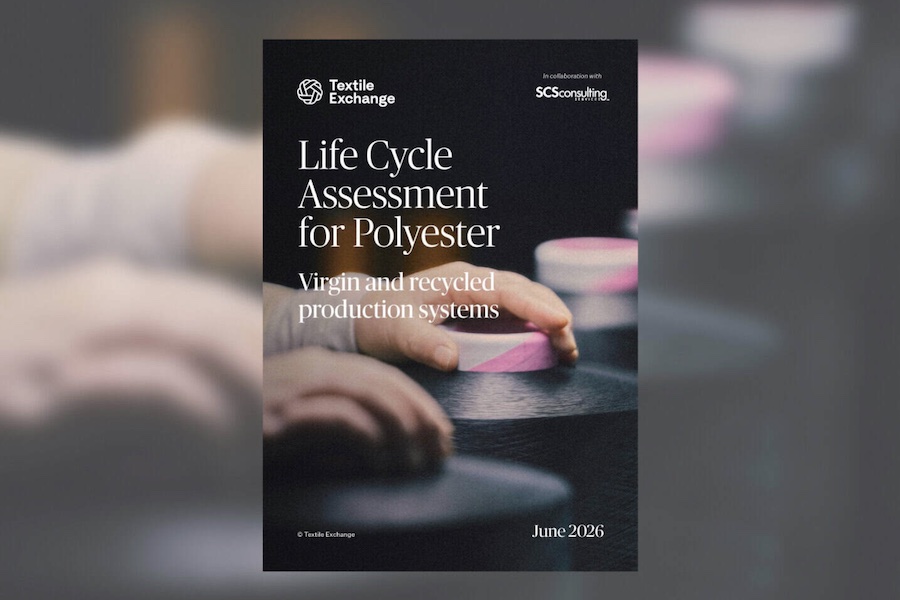
Textile Exchange has released a new Life Cycle Assessment (LCA) study on polyester, providing detailed data on the environmental impacts of both virgin and recycled polyester production. The study aims to strengthen understanding across the fashion, textile and apparel industries and support more informed decision-making regarding polyester sourcing and production.

According to Textile Exchange, the study identifies key environmental hotspots across different polyester production routes and includes new data on both thermomechanical and chemical recycling technologies. It also provides what is believed to be the first publicly available data on the environmental impacts of virgin polyethylene terephthalate (PET) production in Southeast Asia, a region that accounts for more than half of global virgin PET production.

The assessment focuses on virgin polyester production in Southeast Asia and recycled polyester production in China, Europe and the United States. Like all Textile Exchange LCA studies, it follows a cradle-to-gate approach, covering impacts from resource extraction through fiber formation. In addition, the study incorporates a broader “LCA+” methodology, including an assessment of human rights impacts associated with polyester production.

One of the central findings is that the environmental performance of polyester depends heavily on the production technology used. Key impact hotspots identified include the production of virgin fossil-based feedstocks, waste collection and sorting for recycled polyester, energy consumption and transportation.

To support industry-wide environmental modelling and progress tracking, the data from the study will be integrated into several major sustainability databases, including the Higg Materials Sustainability Index (MSI), Ecoinvent and the Quantis World Apparel and Footwear Life Cycle Assessment Database (WALDB). Textile Exchange notes that the data is primarily intended as proxy data for situations where source-specific LCA data is unavailable.

The polyester study is the second publication in Textile Exchange’s ongoing series of fiber-specific LCA studies. Earlier this year, the organization published its cotton LCA study, with additional assessments scheduled for release throughout 2026 and 2027.

To ensure scientific rigor and impartiality, the study was conducted in accordance with ISO standards, led by specialized LCA consultants, reviewed by independent expert panels and developed in consultation with a broad range of industry stakeholders.

Textile Exchange emphasizes that, as with all LCA data, results should be interpreted carefully and within their intended context. The organization advises against direct comparisons between different studies, regions or production systems, as methodological choices, assumptions and system boundaries can significantly influence outcomes.

Explore the full LCA study:

https://textileexchange.org/knowledge-center/reports/polyester-life-cycle-assessment/?utm_source=polyesterlca_email&utm_medium=email&utm_campaign=polyesterLCA&utm_term=null&utm_content=general

More News from Textile Exchange

#Sustainability

Textile Exchange unveils agenda for 2026 conference in Vancouver

Textile Exchange has released the agenda for its 2026 Conference, which will take place from October 12–16 in Vancouver, Canada. Under the theme “The Implementation Era,” the event will focus on translating sustainability commitments into practical action and scaling solutions across businesses, supply systems, and landscapes.

#Raw Materials

Textile Exchange publishes cotton Life Cycle Assessment study to strengthen impact data

Textile Exchange has published the first in a series of seven Life Cycle Assessment (LCA) studies designed to improve the quality and robustness of environmental impact data for raw material production across the fashion, textile, and apparel industry. The first LCA study focuses on cotton and addresses critical data gaps and methodology variability through new high-quality data across key producing countries. The study includes organic, regenerative, recycled, and country averages for conventional cotton production systems, providing a clearer picture of the associated environmental impact.

#Sustainability

Textile Exchange unveils commitment-based pathway for members to accelerate responsible raw material production

Textile Exchange has unveiled further details about its new membership structure, designed to guide the fashion, textile, and apparel industry in a collective course of action toward preferred production systems for raw materials and fibers.

#Yarns

Textile Exchange publishes the final criteria for its new Materials Matter Standard, marking a pivotal shift in connecting certification to impact

Textile Exchange has published the final criteria for its Materials Matter Standard—a major milestone in the organization’s multi-year transition toward a unified, impact-driven standards system for raw material production and primary processing. 

More News on Man-Made Fibers

#Spinning

Object Carpet tests production of rPET BCF yarn on Neumag BCF line

In a joint project with Object Carpet GmbH, Denkendorf; the Institute for Textile Technology (ITA), Augsburg; and Next Generation Recyclingmaschinen GmbH (NGR), Feldkirchen, Austria, Barmag investigated the processing of recycled polyester for BCF yarn. The goal was to evaluate the fundamental suitability of 100% recycled carpet material for reuse in carpet yarn production to create a closed-loop system in carpet manufacturing. To date, commercial rPET BCF processes have been based solely on rPET from bottle pellets.

#Man-Made Fibers

Bemberg™ makes its debut with a dedicated space at Milano Unica

For the first time, Bemberg™ will exhibit with its own dedicated space at Milano Unica, the leading international trade show for premium textiles and accessories, taking place from 7th to 9th July at Rho Fiera Milano.

#Carpets

DOMOTEX Hannover 2028 off to a strong start with expanded portfolio

Preparations for DOMOTEX 2028 are already gaining strong momentum. Following its successful repositioning as the Home of Flooring & Interior Finishing, around 100 international manufacturers have already secured their place during the initial registration phase.

#Nonwovens

Lenzing Group highlights scalable, bio-based nonwovens solutions at leading global industry fairs

From CIDPEX in China to Techtextil in Frankfurt and INDEX in Geneva, the Lenzing Group showcases ready-for-market, bio-based nonwoven solutions and receives industry recognition for LENZING™ Nonwoven Technology.

Latest News

#Nonwovens

EDANA announces five new board members following 2026 Annual General Meeting

The EDANA Board of Governors is elected or re-elected at the Annual General Meeting by the member companies. The Governors are senior executives (business leaders) from member companies, based in different countries and representing different sectors of the nonwovens industry. The Board has central responsibility for guiding EDANA's overall strategy and approving its policies and priorities. It meets three times a year.

#Nonwoven machines

DiloGroup - Complete nonwoven needling line for hygiene materials in the United States

DiloGroup has received an order for a complete needling line designed for the production of hygiene materials in the United States. This project further strengthens our position in the American hygiene sector and reflects the continued demand for reliable, high-performance nonwoven equipment.

#Natural Fibers

Cotton made in Africa partners receive top marks in independent verifications

Cotton made in Africa® (CmiA) and CmiA Organic are two internationally recognised standards that aim to promote sustainable development in the African cotton sector south of the Sahara. To ensure the standards’ credibility among brands, retailers, and consumers, independent verifiers evaluate compliance on the ground. The verification results for 2025, now published in the Aggregated Verification & Implementation Report, were very strong: The verifiers awarded consistently very good remarks regarding management, people, prosperity, and the environment.

#Associations

Bangladesh: Italian textile machinery mission stops in Dhaka and Chittagong

Technological upgrading and the transition toward higher value-added production are driving the new Italian industrial mission to Bangladesh. This year, the mission will split between the country’s two main manufacturing hubs, where Italian manufacturers will meet the leaders of the local textile supply chain in two strategic stages: July 7th in Dhaka and July 9th in Chittagong.

TOP