[pageLogInLogOut]

#ITMA Asia + CITME 2020

Jeanologia walks with Chinese textile industry accompanying it to achieve the total revolution of the manufacturing process
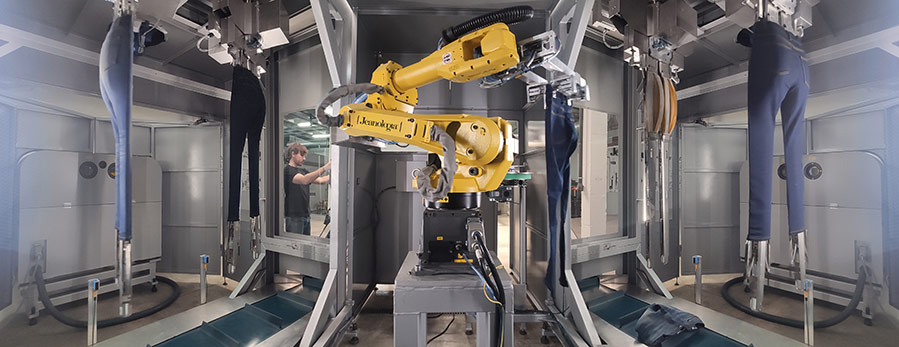
© 2021 Jeanologia
At ITMA Shanghai, the company will introduce a new sourcing model based on automatization, sustainability, digitalization, on demand manufacturing, and operational cost reduction

At ITMA Shanghai, Jeanologia, world leaders in sustainable and eco efficient technology development, will introduce its new operational model reinforcing its commitment to the Chinese textile industry accompanying it to achieve the total revolution of the manufacturing process.

The model is focused on automatization, sustainability, digitalization, on demand manufacturing, and operational cost reduction, it integrates all the technologies of the company bringing a set of technological solutions, to reach an automated production that reduces operational costs and environmental impact.

15 years ago, introducing its technology, Jeanologia started the biggest transformation that the Chinese denim industry had ever seen. But this was only the beginning. The industry still had deficiencies and continues to use archaic and polluting production methods.

Now, with implementation of Jeanologia transformational technologies G2 Dynamic, laser, G2 Ozone, e-Flow, Smart Boxes, Color Box, H2Zero, and their end-to-end digital solutions is possible to connect fabric, design and finishing changing the way jeans are produced and made improving manufacturing costs and significantly reducing the time to market.

As Danny Zheng, Jeanologia Area Manager in China, has highlighted, "China is ready to accelerate its transformation and we are ready to lead it." For years, they have dominated the global textile industry as a key player on a global scale, he noted, "now is time to move to the next level where automation, digitization and sustainability, all together, consolidate it as a world power."

It is time to move from fast fashion to accurate fashion, to produce what we need instead of selling what we produce, helping the Chinese industry to produce with zero waste without compromising product authenticity or increasing costs and adapting to the new market needs, overcoming these challenges that are so important to its future”, has added.

Handman, a step further

At ITMA Shanghai, the company will introduce also Handman, a new solution that, through the combination of its eco technologies, makes sustainable production scalable marking the beginning of a completely automated new era.


Handman is the future of Jeans manufacturing, that will help China to accelerate their transformation on manufacturing and supply chain, consolidating itself as a key player on a global scale and creating the perfect setting to turn the Chinese market into the most competitive and efficient, increasing its productivity and offering a totally sustainable product.

The technology is equipped by two lasers and a robot cabinet. A human and a robot work together to produce with scalability, agility, sustainability, and efficiency. Two humans working with two robots and two lasers can produce 10,000 vintage jeans in 24 hours without discharge.

A strong position in the China market

Jeanologia has been present in China for more than 15 years and is the technological partner for the main brands in the country that have started their transformation to sustainability.

Currently 10% of jeans production in China is done using the company’s technology, either for exports of global brands like GAP, American Eagle, H&M, Uniqlo, Levi's, Primark, Lee, Wrangler or G-Star among others; or for companies operating within the national market like Jack & Jones China, Meters Bonwe, or PeaceBird.

Today, more than 100 customers in the country market place their confidence in Jeanologia using technology developed by the company, and the number of machines has steadily increased in the last years with more than 400 equipment installed and operating in different parts of the country.

It should be noted that last year the company opened an innovative Hub in Hong Kong, for consolidate its internationalization process and be closer to clients offering them the best service.

The Spanish company mission has been to create an ethical, sustainable, and eco-efficient industry through their disruptive technology and know-how. Their laser, G2 ozone, e-flow, Smart Boxes, Colorbox and H2Zero, have revolutionized the textile industry. They offer infinite design and garment finishing possibilities, while saving water, energy, and chemicals, eliminating discharge and toxic emissions.
More News from TEXDATA International

#ITM 2026

ITM 2026: The new geography of textile production

New production hubs are emerging across North Africa and Central Asia, while Türkiye is accelerating its transformation toward higher-value, technology-driven and more sustainable textile manufacturing.

#Research & Development

“Production is a product”

From technical textiles and AI-driven robotics to the limitations of textile circularity: Professor Dr Thomas Gries looks back on more than two decades of development at ITA Aachen. In the interview, he explains why production technology remains a decisive success factor, discusses international collaborations and innovation ecosystems, and shares his views on the transformation of production landscapes and the challenges facing an increasingly regulated industry.

#Knitting & Hosiery

“We need to move away from the price trap and return to a value-driven mindset.”

With its new Textile Innovation Center, KARL MAYER is sending a strong signal for innovation, collaboration, and the future of textile applications. In this interview, Karl Josef Mayer discusses new opportunities in warp knitting, the processing of staple fibres, recycling, the changing role of machinery manufacturers, and why the textile industry must once again focus more strongly on the value of textiles. by Oliver Schmidt

#Associations

“Innovation, resilience and international experience remain the great strengths of the Swiss textile machinery industry”

Geopolitical uncertainty, growing competitive pressure from China, new free trade agreements and the shift towards a circular economy are currently reshaping the global textile industry. In this interview, Cornelia Buchwalder discusses the current mood within the Swiss textile machinery sector, the industry’s distinctive innovative strength, new market opportunities in India and Asia, and the technological trends that could shape the upcoming trade fair cycle leading up to ITMA 2027.

More News on ITMA Asia + CITME 2020

Latest News

#Research & Development

ALADIN paves the way for circular and demand-driven textile production in Europe

Textile production can be organized sustainably by utilizing short supply chains and preventing overproduction. This can already be achieved today by intelligently connecting and efficiently utilizing existing infrastructure. At the same time, production becomes circular when innovative technologies and materials are used that enable high-quality recycling. The ALADIN research project, launched in May 2026 and co-funded with five million euros under the EU Horizon Europe program, is creating the conditions for this.

#Nonwovens

Katharina Obergruber appointed to the Management Board of Sandler AG

The Supervisory Board of Sandler AG has appointed Katharina Obergruber to the company’s Management Board. Effective September 1, 2026, the Board will consist of Philipp Ebbinghaus (CEO), Dr. Ulrich Hornfeck (currently CCO, future COO), and Katharina Obergruber (CCO). Katharina Obergruber, currently Chief Sales Officer Hygiene and member of the Management Team of Sandler AG, will assume responsibility for all sales activities as Chief Commercial Officer. She will assume this role from Dr. Ulrich Hornfeck, who will focus primarily on production and supply chain topics.

#Recycling / Circular Economy

Ence and ShareTex begin initial testing of the ATENEA innovation project to promote textile recycling in Spain

Ence and ShareTex are making progress on the Atenea R&D project, which aims to develop a complete value chain for textile recycling in Spain. Specifically, the goal of the ATENEA project—which is funded by the Center for Technological Development and Innovation (CDTI)—is to connect all the necessary stages for the recovery of textile waste, from collection and management, through recycling and transformation into new raw materials, to their incorporation into new textile products.

#Recycling / Circular Economy

DePoly Inaugurates its Showcase Plant in Monthey Switzerland

What if used plastic bottles, PET packaging material and polyester textiles could become raw materials just as high performing as virgin resources? That is the ambition of DePoly, a circular materials company based in Sion, Switzerland which inaugurated its Showcase Plant in Monthey on July 6th & 7th. The first depolymerization facility of its kind and scale in Switzerland, this industrial Showcase Plant represents a major milestone in the company's growth and its journey toward commercialization.

TOP