[pageLogInLogOut]

#ITMA 2015

Lower Energy Costs for BCF Yarn Production
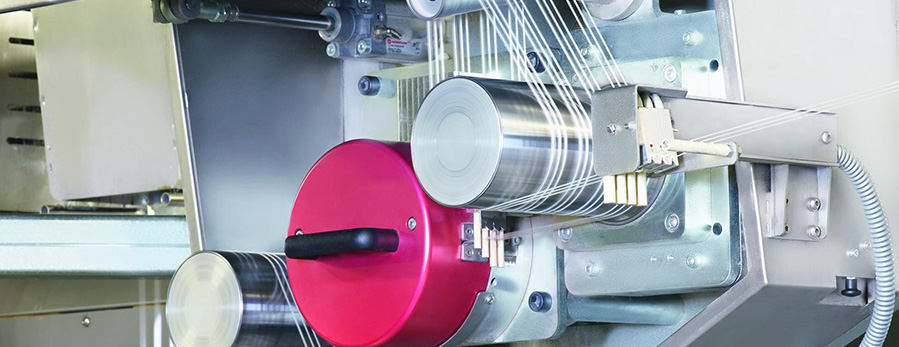
RoTac3 the rotating tangle unit from Oerlikon Neumag
RoTac3 the rotating tangle unit from Oerlikon Neumag, global market and technology leader for turnkey plants for the production of BCF carpet yarn, is a highlight on booth A105 in hall 4 at ITMA 2015. Its successful launch is a further signal that energy saving and yarn quality are playing a growing role in the production of BCF carpet yarn.

50 per cent less compressed air consumption

For RoTac3 makes high energy savings possible thanks to its innovative technology. In comparison to conventional tangle units, the RoTac3 technology forms the tangle knots with a pulsating instead of a continuous air current. This means that compressed air is only consumed if a tangle knot is to be formed. This is achieved with a special tangle nozzle that rotates with the yarn. Several holes are incorporated around the nozzle cover, according to the number of desired knots and the distance between them. If a hole is now positioned over the compressed air opening, an air blast is released and tangles the yarn.

Therefore tangle knots can not only be produced at defined distances and strengths. The discontinuous compressed air impulse also considerably reduces the required volume flow and compressed air consumption – by up to 50 per cent compared to conventional tangle units, depending on the yarn type. Since energy consumption is reduced as a result, RoTac3 bears the e-save label from Oerlikon Manmade Fibers for particularly energy efficient, environmentally friendly technologies.

Customers confirm improved processing quality

Given increasing process speeds and air pressures to enhance productivity in BCF production, this energy saving is a major advantage, but not the only one. The RoTac technology also eliminates tangle dropouts, which can occur repeatedly at a high process speed with conventional tangling. Last but not least, it ensures very gentle yarn guiding and reduced yarn tension as well as better process stability. This particularly supports future trends such as fine titer and sophisticated polymers.

“Many of our customers also confirm that the yarn quality for the downstream processes has improved and the corresponding process steps have been made easier“, says Martin Rademacher. At ITMA 2015, the company is thus expecting further encouragement for the successful product, which is available as a component with the three-end BCF plant S+ or can be retrofitted.


More News from Oerlikon Neumag, Zweigniederlassung der Oerlikon Textile GmbH & Co. KG

More News on ITMA 2015

Latest News

#Sustainability

Ying McGuire becomes new CEO of Cascale

Cascale today announced the appointment of Ying McGuire as Chief Executive Officer, effective June 1, 2026.

#Technical Textiles

Sustainable, lightweight, and sound absorbing: Polyester-based front trunk solution for BEVs

As car manufacturers look to further reduce their carbon footprint, Autoneum has developed an innovative front trunk solution for battery electric vehicles (BEVs), made entirely from polyester-based textile. The Ultra-Silent Frunk offers significant weight reduction, improved acoustic and thermal insulation, and uses up to 70 percent recycled material, supporting sustainable and efficient vehicle design. Autoneum, global technology leader in acoustic and thermal management for vehicles, has already received orders for the new frunk from three major OEMs in Asia and Europe to be built in three BEV models. Series production for two BEVs has been underway in China and Germany since last year.

#Raw Materials

Modern testing methods for raw cotton

The 38th International Cotton Conference Bremen will take place from 25 to 27 March 2026 at the Bremen Parliament. This conference has traditionally stood for in-depth expertise and international exchange. The program will focus on technical innovations, market trends, and regulatory frameworks across the entire value chain – from agriculture to the circular economy. With high-profile speakers, the conference is regarded as the key meeting point for the global cotton industry. Today’s focus: Cotton quality and testing methods.

#Spinning

Rieter responds to higher raw material prices

Global political and economic developments have been leading to rising raw material and energy costs for some time. The textile machinery industry is also affected by this trend. Rieter machines and components consist to a large extent of steel, copper, aluminum and electronics. These materials in particular have seen higher demand and higher prices in recent months.

TOP

