[pageLogInLogOut]

#Index 2017

Index 2017: Oerlikon Neumag premiers electro-charging unit

Oerlikon Neumag will be premiering its newly-developed concept for electrostatically charging meltblown nonwovens at the Index 2017 in Geneva. The new in-line charging unit differs from other concepts currently available on the market as a result of its high level of flexibility when charging the most diverse nonwoven products, particularly in the case of nonwovens with lower basis weights and tenacities.

Oerlikon Neumag presents innovative electro-charging unit for meltblown systems Users can set the optimum charging condition depending on the filter application. High wrapping angles at the guide rollers ensure optimum charging, which can be carried out on both sides, positive and negative. Laboratory trials have shown that – in conjunction with the Oerlikon Neumag meltblown technology – the Oerlikon Neumag charging unit can also be used to manufacture EPA- and HEPA-class filters. To this end, an H14-class filter with an efficiency of 99.995% was produced with an overall pressure loss of less than 100 Pa.

Electro-charging for superior filter separation performance Oerlikon Neumag meltblown technology is one of the most efficient methods for producing very fine and highly-separating filter media made from plastic fibers. Depending on the application, the pore size of a meltblown nonwoven material ranges from 5 to 40 µm. Here, smaller pores increase the mechanical filtration performance, albeit at the expense of higher pressure losses. The fineness of the meltblown fibers used for filter media lies in the 200 to 2,500 nm range. However, even fibers with nanoscale fineness are often not sufficient to separate the finest particles from air or liquid flows. Electrostatically charging filter media can significantly and inexpensively improve the filter performance without increasing the throughput resistance.
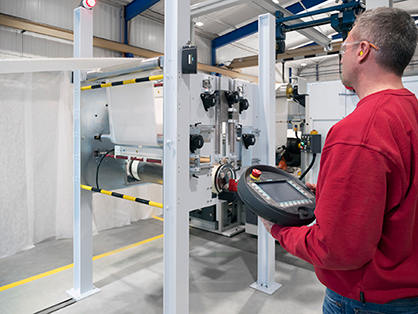
Pic: ONE meltblown electro charging unit by Oerlikon Neumag


More News from Neumag, Zweigniederlassung der Barmag GmbH & Co. KG

More News on Index 2017

Latest News

#Spinning

Ibrahim Fibres and Trützschler: A strong partnership enters its next phase with the TC 30Si

For more than two decades, Ibrahim Fibres and Trützschler have grown side by side, driven by a shared ambition to continuously improve spinning performance, strengthen technology leadership and set new benchmarks in the textile industry. Today, Ibrahim Fibres is a leading yarn and polyester staple fiber manufacturer in Pakistan. The company operates the largest number of Trützschler cards in the country, with more than 200 machines running across its mills in Faisalabad, and plays an important role in one of Asia’s largest textile industries.

#Digital Printing

USColorworks expands digital platform with Kornit Atlas MATRIX and Atlas MAX PLUS solutions

Kornit Digital Ltd. (NASDAQ: KRNT), a global pioneer in sustainable, on-demand digital fashion and textile production, today announced that USColorworks, a North Carolina-based apparel decoration and fulfillment company specializing in custom and on-demand printing for retail and promotional markets, has expanded its Kornit digital production platform with the addition of Atlas MATRIX and Atlas MAX PLUS systems to deliver high-quality, on-demand apparel across cotton, blended fabrics and polyester.

#Functional Fabrics

CovationBio introduces two new bio-based innovations at Functional Fabric Fair New York

Covation Biomaterials LLC (“CovationBio®”) is showcasing its two new bio-based innovations, Xatryx® and Sorona® elasterell-p fiber, at this year’s Functional Fabric Fair in New York City, July 7–9, 2026. Attendees can visit CovationBio at Booth #404 to explore this next generation of bio-based performance materials.

#Research & Development

Geotextiles made from recycled materials: GREEN leads the way into the industry

For the industry, recycled materials are creating new opportunities in geotextile production. In the GREEN project, the Fraunhofer Cluster of Excellence Circular Plastics Economy CCPE demonstrates that recycled polypro-pylene (PP), polyethylene terephthalate (PET), and high-density polyeth-ylene (HDPE) can be processed into nonwovens, fibers, and membranes that meet industrial requirements. This creates opportunities for use in existing production lines and new value chains in the geotextile market.

TOP

