[pageLogInLogOut]

#Associations

Promoting sustainability, digitalisation and resilience

The EU project ADDTEX has reached an important milestone with the two publications White Book and E-Book. Both publications contain comprehensive guidelines, findings and policy recommendations to support the sustainable, digital and resilient transition of the textile industry. The focus is on technical textiles, whose innovations are considered key to the competitiveness and resilience of the European industry.

The ADDTEX project brings together partners from a total of twelve European countries. The IVGT, Frankfurt is a partner for Germany and represents the interests of its members and the entire technical textiles sector. The aim of the project is to sustainably promote close co-operation between industry, science, politics and civil society. This innovative approach, known as the ‘quadruple helix model’, is intended to help prepare the industry for the challenges of a volatile, uncertain, complex and ambiguous environment (VUCA), which have been exacerbated by crises such as the COVID-19 pandemic. ‘By focusing on green technologies, digitalisation and continuous training, we are making the technical textiles industry fit for the future,’ says Stefan Schmidt, IVGT project manager. ‘We want to strengthen the competitiveness and sustainability of this important sector.’
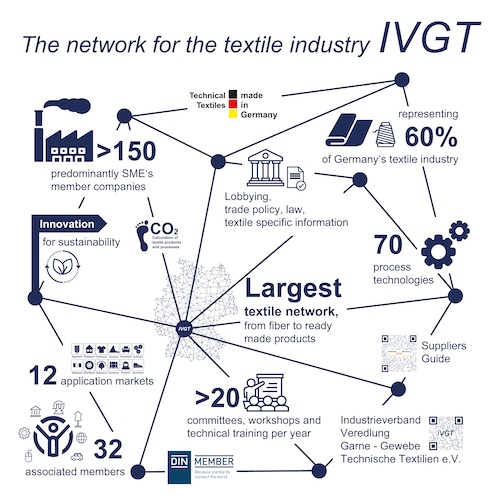
Industry clusters such as the IVGT play a crucial role by strengthening networks between companies, educational institutions and governments. They promote the exchange of knowledge, support the introduction of new technologies and help to drive forward circular economy projects. Picture: IVGT


Workshops as a basis for policy recommendations

Between September and October 2024, the ADDTEX partners organised interactive workshops in Germany, Greece, Italy and Spain. These served as a platform for a broad dialogue between industry, science and politics, in which innovative approaches and concrete strategies for action were developed. The participants focussed on topics such as sustainable practices, digital transformation and promoting resilience in the textile industry.
The future is digital! The IVGT offers a range of programmes to make you fit for the digital transformation. Image: IVGT


Key competences for change

A central aspect of the White Book is the emphasis on education and training to promote the dual transition - green and digital. The most important skills required of employees to shape a sustainable future for the industry are expertise in renewable energy, recycling, environmentally friendly materials and sustainable production (green transition), skills in data analysis, cyber security, IT and the ability to use AI-supported technologies (digital transition), as well as adaptability, innovation, risk management and cross-functional collaboration (promoting resilience). Ten aspects emerged as the most important political recommendations for action (see chart). These include, in particular, the promotion of sustainable practices in companies, investment in digital infrastructure along the textile value chain, support for collaborative research projects and industry-specific training funds to impart the essential skills mentioned. 

Further information www.addtex.eu; www.addtex.eu/resources/
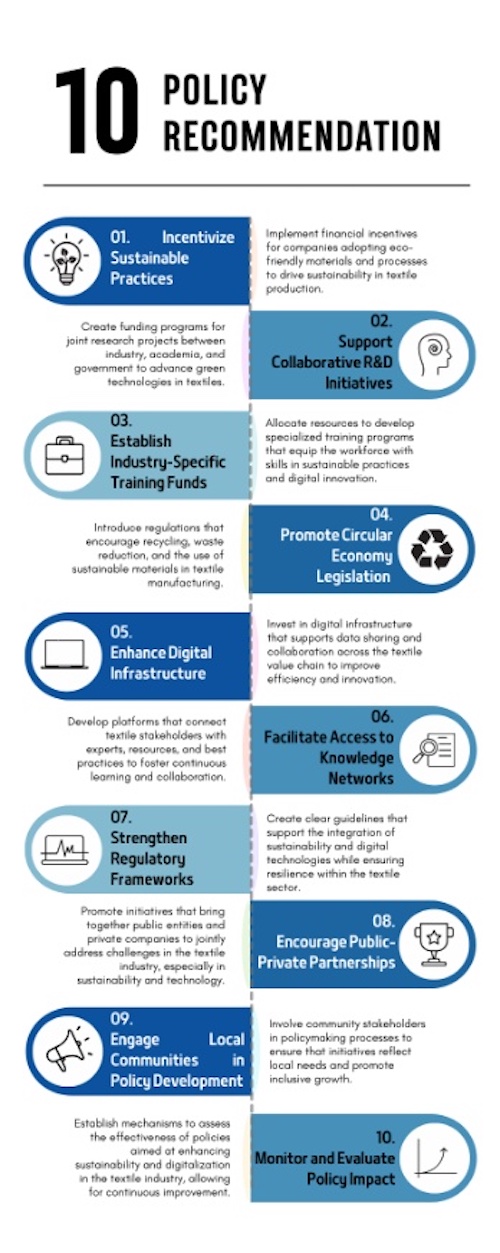


To promote both the double transition and the resilience of the industry, policy should incentivise sustainable practices and investment in green technologies. The developed recommendations for action as a graphic. Picture: ADDTEX


More News from Industrieverband Veredlung - Garne - Gewebe - Technische Textilien e.V.

#Recycling / Circular Economy

Eco-design as the foundation of circular textiles

Based on the results of an extensive European analysis, the Erasmus+ project Skills4Circularity is currently developing three practice-based training modules covering recycling technologies, eco-design for the circular economy and sustainable manufacturing. This was preceded by a comprehensive company survey and a joint analysis conducted by the project partners under the leadership of IVGT. The results show that the greatest challenges lie not so much in a lack of technology as in skills gaps.

#Associations

IVGT membership: expertise that pays off

For energy-intensive textile companies, government compensation mechanisms are an important economic factor. The IVGT successfully supports its member companies in applying for state aid and thereby regularly contributes to significant financial relief.

#Recycling / Circular Economy

New skills for a circular textile economy

Based on the results of a comprehensive analysis, the Erasmus+ project Skills4Circularity is developing three practical training modules covering recycling technologies, eco-design for the circular economy and sustainable manufacturing. The content of the first module, Recycling Technologies, has now been developed and validated together with industry representatives. The module provides participants with knowledge of regulatory requirements, material sorting and the preparation of textile waste for recycling.

#Recycling / Circular Economy

The textile industry in transition

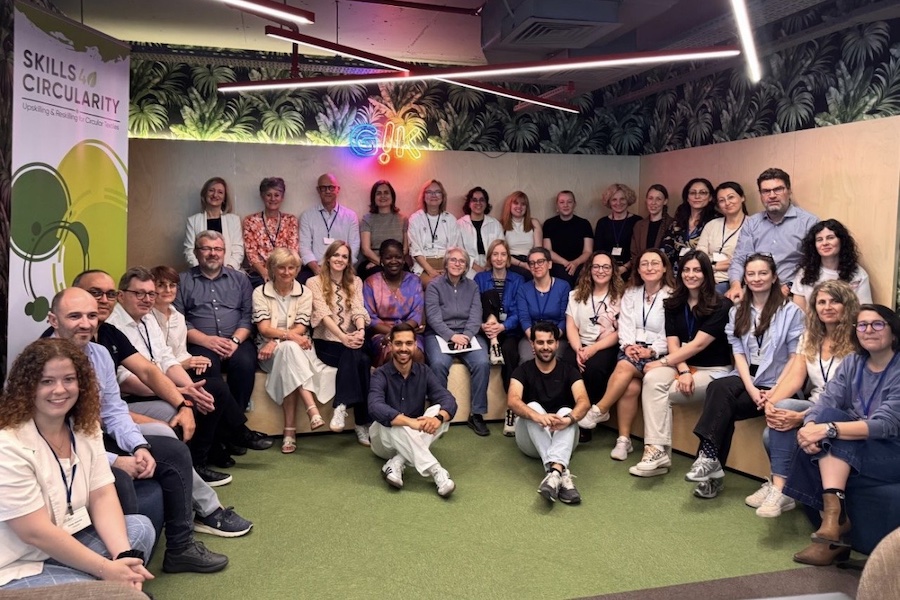
Recycling, traceability, eco-design and digitalisation are among the key future challenges facing the European textile industry. The Erasmus+ project Skills4Circularity, involving 21 partners from twelve countries, is investigating the skills required to address these challenges. As the German industry partner, the Industry Association for Finishing – Yarns – Fabrics – Technical Textiles (IVGT) is bringing the industry’s perspective to the project.

More News on Associations

#Associations

Business situation weakens slightly, but the industry stays cautiously optimistic

The International Textile Manufacturers Federation (ITMF) has published the results of its 39th Global Textile Industry Survey (GTIS), conducted from 14 to 22 July 2026 among companies along the entire global textile value chain. Worldwide, 10% of participants rated their business situation as good, 53% as satisfactory and 37% as bad — a balance of -26pp, down from -17pp in May but still well above the 2023 lows. All regions are now in negative territory, from South Asia at -3pp to North & Central America at -58pp.

#Associations

Italian textile machinery orders show quarterly recovery in Q2 2026

In the period between April and June 2026, order intake for Italian textile machinery manufacturers showed mixed but encouraging signals for the second half of the year. The order index at constant prices stood at 46.6 points (taking 2021=100 as the base year), showing a slight decrease of 3% compared to the same quarter of 2025. This trend was largely due to the contraction recorded in the domestic market, which fell by 25% compared to the corresponding period of the previous year.

#Associations

Consolidation amidst difficult market conditions

The International Textile Manufacturer Federation has published its International Textile Industry Statistics (ITIS) on productive capacity and raw materials consumption in the short-staple organized (spinning mill-) sector in virtually all textile-producing countries in the world.

#Recycling / Circular Economy

ReSpin joins TMAS to advance textile recycling technology

Swedish textile recycling company ReSpin has joined the Textile Machinery Association of Sweden (TMAS) as a new member. The company develops a patented mechanical recycling technology designed to transform textile waste into new fibres suitable for yarn production.

Latest News

#Recycled Fibers

Naia™ from Eastman strengthens western hemisphere textile connections at Apparel Sourcing Show Guatemala

As brands and retailers explore more diversified and responsive sourcing networks, the Naia™ brand from Eastman is strengthening its engagement with the textile and apparel value chain across the western hemisphere. From August 18–20, the company will participate for the first time in Apparel Sourcing Show Guatemala, a regional meeting point for apparel sourcing, manufacturing and nearshoring.

#Man-Made Fibers

Dornbirn GFC 2026 expands conference program with new thematic sessions

For 65 years, Dornbirn GFC has stood for innovation and is one of the world’s leading conferences in the fiber industry. From September 16 to 18, 2026, the international fiber community will meet in Dornbirn, Austria, to discuss current trends, technological developments, and forward-looking solutions. More than 600 experts from industry and academia from over 30 countries are expected to attend. With around 100 presentations by renowned speakers, a 2,5-day conference program, and three parallel presentation rooms with moderated sessions, Dornbirn GFC provides a first-class platform for knowledge exchange, networking, and international collaboration. Together, participants will generate ideas and impulses that will sustainably shape the future of the global fiber industry.

#Research & Development

Europe is committed to recycling end-of-life wind turbine blades

Starting in 2026, Europe’s wind energy industry has committed itself to ensuring that wind turbine blades do not end up in landfills once they reach the end of their service life. The EU-funded research project REWIND is exploring ways to reuse this composite waste. The German Institutes of Textile and Fiber Research Denkendorf (DITF) are one of 13 project partners from seven countries.

#Functional Fabrics

PERFORMANCE DAYS announces new focus topic & forums for October 2026

With its upcoming October 13–14, 2026 edition, PERFORMANCE DAYS is placing the spotlight on one of the textile industry’s most important transformations: “Bio-Based Materials – From Fiber to Fabric”, a two-part Focus Topic exploring the future of bio-based innovation across the textile value chain. Part 1, presented in October 2026, will focus on fibers and next-generation material developments, while Part 2 at the March 2027 edition will shift the perspective toward dyeing, finishing, additives, and processing technologies.

TOP