[pageLogInLogOut]

#Associations

EURATEX releases its latest economic survey: European Textiles and Clothing industry coming out of the Covid19-crisis, but facing new challenges ahead.
© 2021 EURATEX
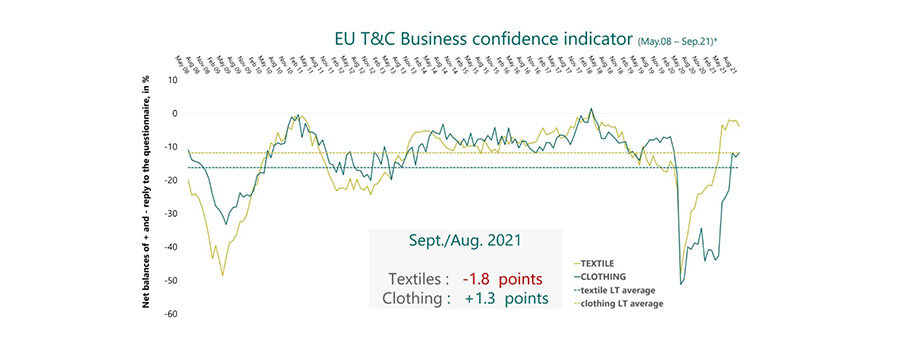
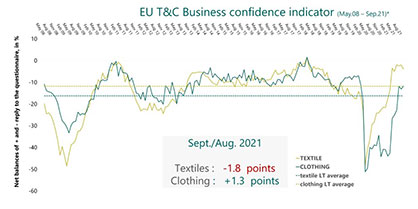
Latest economic data confirm further recovery of the textile and clothing industry. This recovery may however be disrupted by the current supply chain and energy problems.

Latest economic data on the European T&C industry confirm further recovery from the corona pandemic. The textile activity has now surpassed its pre-pandemic level from Q4 2019 (+3.6%); the clothing sector still remains 11.5% below, but continues to improve.

In quarter-on-quarter terms, the EU turnover showed signs of improvements across the sector. The textile turnover increased by +3.3% in Q2 2021, after slightly contracting in Q1 2021. Similarly, the business activity in the clothing sector expanded by +7% in Q2 2021, after increasing by +1% in the previous quarter.

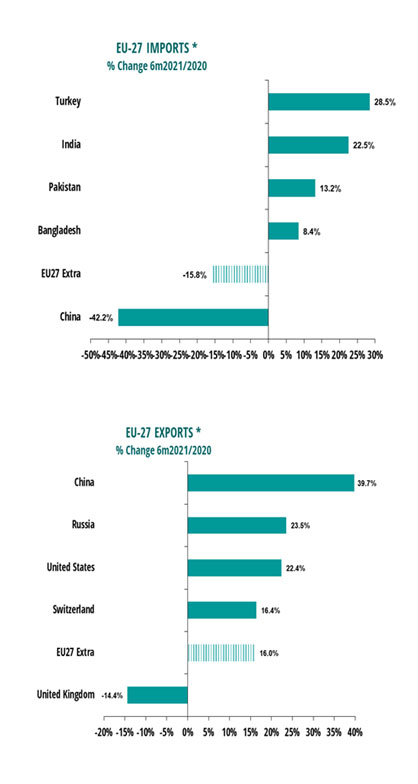
In the 2nd quarter 2021, the EU-27 trade balance for T&C improved, resulting mostly from an increase of export sales across third markets and a drop of textile imports. T&C Extra-EU exports boomed by +49% as compared with the same quarter of the previous year. T&C Extra-EU imports went down by -26% as compared with the same quarter of the previous year, following a decrease of imports from some main supplier countries. EU imports from China and the UK collapsed due to a combination of Brexit and weaker demand in Europe.

During the second quarter of 2021, job creation was slowly stabilising in the textile industry (-0.2% q-o-q), while employment in the clothing sector continued to be affected by lower levels of production activity in industry during the first part of the year (-1.2%). When compared to its pre-pandemic level in Q4 2019, EU employment in Q2 2021 was still 4.4% down in textiles and 11.8% down in clothing.
© 2021 EURATEX
© 2021 EURATEX


However, this fragile recovery is hampered by higher shipping costs and prices’ increase in raw materials and energy. The cost of energy, in particular gas, has increased more than 3 times since the beginning of this year. Since the announcement of the EU’s “Fit for 55” package, we have seen CO2 prices rising above €60. This inevitably has an impact on the industry’s competitiveness, especially in a global context. The future recovery is also threatened by some factors limiting production, such as shortage of labour force and equipment, which are putting additional pressure on T&C industries. 

Director General Dirk Vantyghem commented on these latest figures: “Our companies have shown great resilience during the pandemic, and their latest export performance is an encouraging sign of recovery. This recovery may however be disrupted by the current supply chain and energy problems. Once again, recent developments show that this transition towards more sustainable production can only work if organised in a global context, avoiding carbon leakage and with an effective level playing field. This must be considered in the upcoming EU Textiles Strategy.”

© 2021 EURATEX
© 2021 EURATEX


More News from European Apparel and Textile Confederation (EURATEX)

#Associations

European Business Coalition welcomes provisional application of EU–Mercosur Agreement and calls for Swift and full implementation

With the European Commission’s decision to provisionally apply the EU–Mercosur Interim Trade Agreement, a process spanning more than 25 years now moves decisively into its implementation phase.

#Europe

Antwerp Declaration community urges EU leaders to deliver emergency measures as Europe’s competitiveness crisis deepens

EURATEX, representing the European textile and fashion industry, joins the Antwerp Declaration Community’s call on EU Heads of State and Government to adopt emergency measures that restore industrial competitiveness and deliver tangible results for Europe’s manufacturing base in 2026.

#Europe

FITA, ABIT and EURATEX underline strategic importance of Mercosur – EU Partnership Agreement for the textile and apparel industry

The Argentine Textile Industry Federation (FITA), the Brazilian Textile and Apparel Industry Association (ABIT), and the European Apparel and Textile Confederation (EURATEX) continue to monitor the process of internalizing the Mercosur-European Union Partnership Agreement. This agreement is essential for the competitiveness of our industries, on both sides of the Atlantic.

#Associations

Industry associations warn against state-run EPR models in the EU

European industry associations, led by Euratex, have raised concerns over a growing trend in several EU Member States to introduce state-run Producer Responsibility Organisations (PROs) within Extended Producer Responsibility (EPR) schemes.

More News on Associations

#Associations

EDANA joins industry coalition urging a strong internal market legal basis for the New Circular Economy Act

EDANA has joined 67 European industry associations in a joint industry statement calling on the European Commission and co-legislators to anchor the forthcoming New Circular Economy Act (CEA) in the Internal Market legal basis (Article 114 TFEU).

#Associations

EDANA warns of consequences of misclassification of PET spunbond imports

EDANA would like to remind its members and industry stakeholders of the legal requirement to comply with the EU rules on customs classification when importing nonwovens from third countries outside the EU. In this regard, it was recently discovered that there appears to be a high level of customs misclassification occurring in our industry. This could have dangerous and costly consequences for importers.

#Associations

Engineering depth and diversity for composites

Airbond is the latest member of the British Textile Machinery Association (BTMA) to receive recognition for contributions to the composites industry. The engineering firm based in Pontypool, South Wales, has just received the Make UK Energy and Sustainability Award for its Lattice 3D Printing project.

#Composites

Alliance for European Flax-Linen & Hemp expands bio-materials presence at JEC World 2026

The Alliance for European Flax-Linen & Hemp is pleased to announce its participation at JEC World 2026, featuring a significantly expanded presence and an enhanced offering for the global composites industry.

Latest News

#Techtextil 2026

Monforts to showcase advanced coating solutions at Techtextil 2026

Over the past few years Monforts has significantly advanced its technologies for coating, with the successive introductions of the MontexCoat, coaTTex and VertiDry systems combining flexibility, precision and energy efficiency for the technical textiles market.

#Composites

JEC World 2026 returns with an unprecedented content program

Recognized worldwide as the leading trade exhibition for composite materials and their applications, JEC World returns on March 10-12, 2026, at Paris Nord Villepinte as the most ambitious edition to date, in line with its motto “Pushing the limits”. As the must-attend event for the composites industry, JEC World will offer an unprecedented program, blending conferences, markets insights, technical sessions, awards, and above all, a unique experience and invaluable connections.

#Raw Materials

Beyond the wardrobe – innovative cotton takes the spotlight

Cotton can do more – a lot more. Cutting-edge textiles and high-tech products made from 100% cotton prove just how powerfully performance and sustainability can come together. That very surge of innovation is front and centre at the 38th Bremen Cotton Conference, taking place March 25–27, 2026, at Bremen’s Parliament on the historic market square – culminating in a bold and dedicated closing session on Friday. In the spotlight: performance upgrades for pure cotton, smart strategies for circular textile waste solutions, and pioneering concepts for demanding technical applications. From natural fibre–reinforced composites to highly effective flame-retardant solutions, cotton steps out of the closet and shows the future potential woven into every fibre.

#Digital Printing

Keeping print inclusive: Empowering women in the print industry

Across all industries, cultivating a diverse and inclusive workplace is increasingly recognised as valuable and essential to long-term success. However, despite the print industry’s significant advancements in technology and innovation, visible representation of women remains limited. As the sector grapples with low recruitment, it’s important to challenge outdated perceptions. Creating real change, however, requires collective effort - no single company can do it alone.

TOP