[pageLogInLogOut]

#Associations

Free, fair and sustainable trade is an essential component of EURATEX strategy

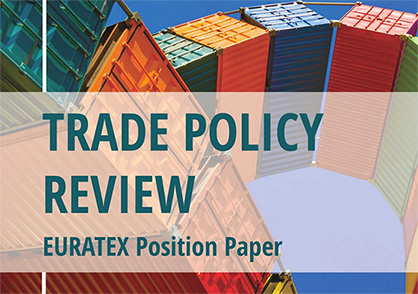
EURATEX responded to the EU consultation on the trade policy review, offering 60 specific points, which will help to develop an open but sustainable trade system, which guarantees the level playing field for European industry. The EU should invest in an ambitious regional agenda, focusing on important partners such as EUROMED and United States, and in multilateral efforts, in particular within the WTO.

In this rapidly changing and multi-polar world, facing an unprecedented health and economic crisis, European businesses need a stable and transparent global framework. EURATEX therefore welcomes the review of the EU’s trade policy. It is an opportunity to shape a modern strategy which supports our companies in prospering at global level.
© 2020 Euratex
© 2020 Euratex


The European textiles and clothing (T&C) industry is globalised, with complex value chains and inter-dependencies with many other sectors. T&C companies annual exports exceed €60 bln and imports well over €100 bln. 38% of the industry’s turnover is sold on global markets, whereby SMEs are particularly active (covering more than 50% of those global sales).

On that basis, EURATEX emphasises the following points:

  • We need open and “efficient” markets, but combined with effective controls where necessary, thus ensuring level playing field for European companies;
  • We need complementarity between the EU’s Trade and Industrial strategy, leading to increased resilience, e.g. through better access to raw materials and stockpiling of strategic goods;
  • We need an ambitious regional agenda, focusing on important partners such as United States, Turkey, Switzerland and the EUROMED region, but also open to new partnerships in Africa;
  • We need to invest in multilateral efforts, thus supporting WTO efforts to work on subsidies, public procurement, IPR, etc.;
  • We need to act “beyond” the conclusion of an FTA: ratification must be faster, and implementation of an agreement must come with information efforts and support to European SMEs, as part of a genuine European Economic Diplomacy strategy;
  • We need a more sustainable and fair trading system, based on rules, global environmental and social standards, which are effectively respected by all;
  • We need a modern trade policy, setting rules for new forms of trade such as e-commerce, and embracing the digital opportunities.

More News from European Apparel and Textile Confederation (EURATEX)

#Associations

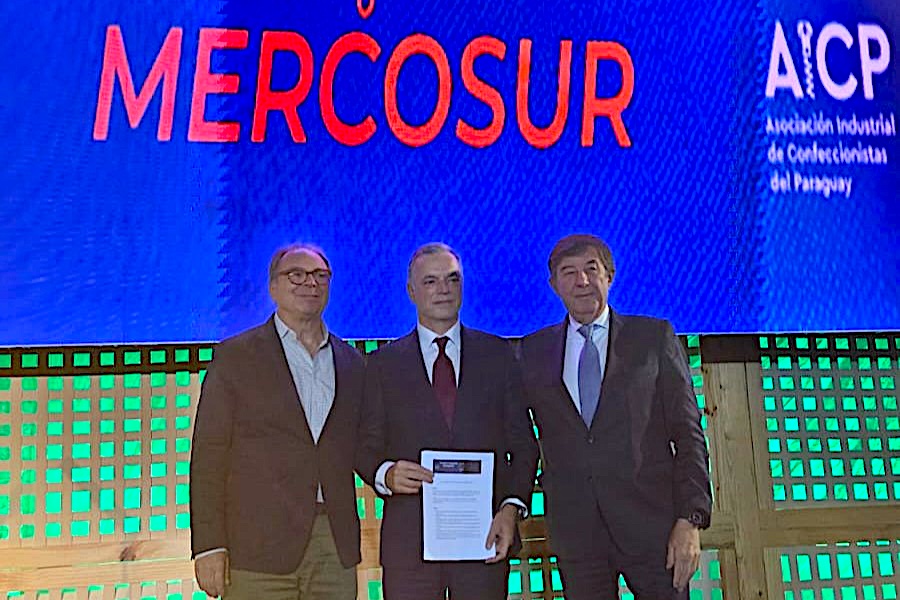
European Business Coalition welcomes provisional application of EU–Mercosur Agreement and calls for Swift and full implementation

With the European Commission’s decision to provisionally apply the EU–Mercosur Interim Trade Agreement, a process spanning more than 25 years now moves decisively into its implementation phase.

#Europe

Antwerp Declaration community urges EU leaders to deliver emergency measures as Europe’s competitiveness crisis deepens

EURATEX, representing the European textile and fashion industry, joins the Antwerp Declaration Community’s call on EU Heads of State and Government to adopt emergency measures that restore industrial competitiveness and deliver tangible results for Europe’s manufacturing base in 2026.

#Europe

FITA, ABIT and EURATEX underline strategic importance of Mercosur – EU Partnership Agreement for the textile and apparel industry

The Argentine Textile Industry Federation (FITA), the Brazilian Textile and Apparel Industry Association (ABIT), and the European Apparel and Textile Confederation (EURATEX) continue to monitor the process of internalizing the Mercosur-European Union Partnership Agreement. This agreement is essential for the competitiveness of our industries, on both sides of the Atlantic.

#Associations

Industry associations warn against state-run EPR models in the EU

European industry associations, led by Euratex, have raised concerns over a growing trend in several EU Member States to introduce state-run Producer Responsibility Organisations (PROs) within Extended Producer Responsibility (EPR) schemes.

More News on Associations

#Techtextil 2026

Precision, performance and progress: British textile machinery at Techtextil and Texprocess 2026

As global demand accelerates for lighter, stronger and more sustainable technical textiles, the machinery and testing technologies behind their manufacture are evolving at pace. At the Techtextil and Texprocess exhibitions in Frankfurt this April, eight members of the British Textile Machinery Association (BTMA) will demonstrate how advanced engineering continues to shape the performance, precision and resource efficiency of advanced fibre and fabric production.

#Nonwovens

INDA honors four industry leaders with 2026 Lifetime Service and Technical Achievement Awards

INDA, the Association of the Nonwoven Fabrics Industry, has announced the four distinguished recipients of the 2026 INDA Lifetime Service Award and Lifetime Technical Achievement Award. Tom Daugherty, Pricie Hanna, Carey Hobbs, and CK Wong are being recognized for their exceptional leadership, innovation, and enduring contributions to advancing the nonwovens industry and strengthening the global community it serves.

#Associations

Azerbaijan Textile Association (ATA) becomes member of ITMF

The Azerbaijan Textile Association (ATA) has officially become a Member Association of the International Textile Manufacturers Federation (ITMF), further strengthening Azerbaijan’s integration into the global textile value chain.

#Associations

EDANA joins industry coalition urging a strong internal market legal basis for the New Circular Economy Act

EDANA has joined 67 European industry associations in a joint industry statement calling on the European Commission and co-legislators to anchor the forthcoming New Circular Economy Act (CEA) in the Internal Market legal basis (Article 114 TFEU).

Latest News

#Techtextil 2026

Gebr. Otto highlights versatility at Techtextil with regional supply chains, yarn innovations and new hygiene segment

At this year’s Techtextil, Gebr. Otto places its versatility at the center of its presentation. In addition to spinning, twisting and dyeing – traditionally focused on fine cotton – textile processors will also find a competent development partner for technical specialty solutions. The Dietenheim-based spinning mill has now built up a decade of experience in the production of technical yarns, particularly from aramids. A new hygiene segment has also been established, where yarns for medical and hygiene products are currently being produced. In the future, this department could also develop textile products for the food sector. Gebr. Otto will once again be present at the BW-i joint stand, booth D81, hall 12.1. What is wound onto the spool is determined by the customer: Gebr. Otto develops according to specific customer requirements and transforms its own ideas into yarn innovations.

#Europe

Commission presents proposal for EU Inc. - unlocking the full potential of the Single Market for Europe's entrepreneurs

Today, the European Commission presented its proposal for EU Inc., a new single set of corporate rules, building the cornerstone and starting point for the EU's 28th regime. EU Inc. is an optional, digital-by-default European corporate framework. It will make it easier for businesses to start, operate and grow across the EU – incentivising them to stay in Europe, and encourage those who once looked elsewhere to return.

#Man-Made Fibers

OnceMore® from Södra brings end-to-end traceability for circular Man-made Cellulosic Fibers (MMCF) using TextileGenesis

OnceMore® from Södra, the world’s first large-scale process for recycling blended fabrics into high‐quality dissolving pulp, will begin using TextileGenesis, a Lectra company, to strengthen traceability from raw material to retail across the value chain. OnceMore® produces dissolving pulp made from blended textile waste and wood sourced from responsibly managed Swedish forests. By integrating TextileGenesis, OnceMore® supports the growing need for verified data and secure, transparent tracking throughout increasingly complex supply chain.

#Sustainability

Experts publish APAC policy priorities

Cascale today announced the publication of its APAC Policy Priorities Paper, developed by the Asia-Pacific (APAC) Policy Member Expert Team (MET) to identify key regional sustainability challenges and provide practical, aligned recommendations for policymakers and industry stakeholders across Asia-Pacific.

TOP