[pageLogInLogOut]

#Associations

EURATEX welcomes the modernisation of the PEM convention

The “PanEuroMed” (covering 24 partner countries in the EU’s neighbourhood region) is an important region for the EU, as trade with these countries accounted for €677 billion in 2019. For the EU textile and clothing sector, the region represents 29% of its exports. EURATEX therefore welcomes the Commission proposal to modernise the PEM Convention and its rules of origin, but calls for an ambitious information campaign, to ensure companies will fully benefit from it.

On 24 August 2020, the European Commission adopted a package of proposals that aims at increasing trade between the European Union and neighbouring countries in the Pan-Euro-Mediterranean (PEM) region. The proposal modernises the rules of origin of the PEM convention, as it introduces, for example, the principle of “full cumulation” and it lifts the current prohibition of duty-drawback.

EURATEX welcomes the current proposals and it appreciates the pragmatic solution proposed by the EC, even though a full and final agreement couldn’t be reached with all PEM partners. The proposed rules will facilitate the integration of T&C supply chains and thus give a boost to T&C production and trade within the region. In a moment when several companies are looking at moving their production from far away countries to a nearby production sites, it is very timely to have the PEM Convention implemented.


EURATEX calls the European Commission to not stop there, but continue negotiations with all PEM partner countries, and to launch an information campaign which will allow companies to fully understand and benefit from the new rules. According to Director General Dirk Vantyghem, “this is also a perfect opportunity to present a similar proposal to the UK, which should join the PEM convention too. It will be a win-win situation both for the EU and UK companies”. Indeed, if UK joins the PEM conventions, nearly 50% of EU exports in T&C would be covered by a single set of origin rules.

More News from European Apparel and Textile Confederation (EURATEX)

#Associations

Europe is losing its textile industry

EURATEX has released its latest Economic Update on the performance of the European textile and apparel industry in 2025. For the third consecutive year, the sector recorded negative results across all key indicators — production, turnover and employment — confirming a continued erosion of competitiveness across Europe.

#Associations

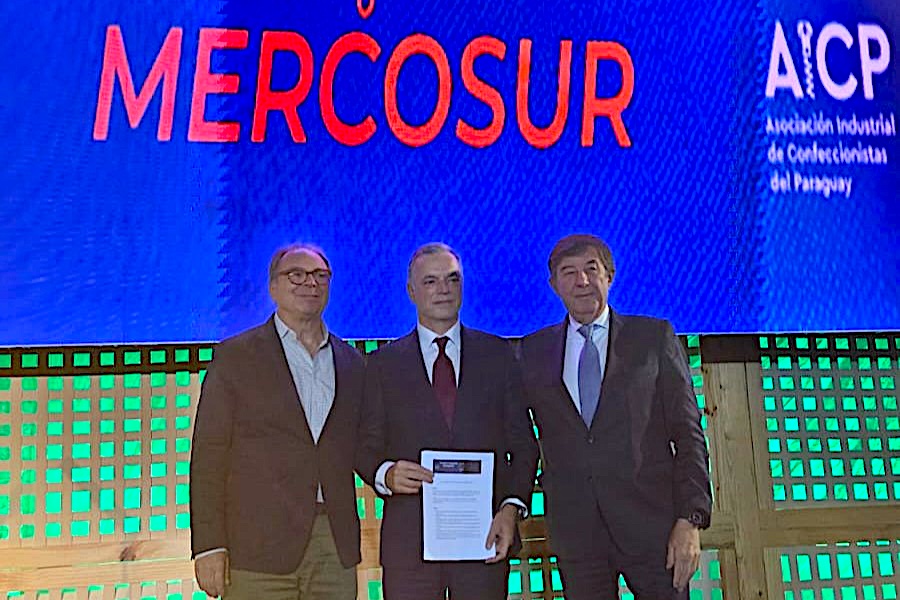
European Business Coalition welcomes provisional application of EU–Mercosur Agreement and calls for Swift and full implementation

With the European Commission’s decision to provisionally apply the EU–Mercosur Interim Trade Agreement, a process spanning more than 25 years now moves decisively into its implementation phase.

#Europe

Antwerp Declaration community urges EU leaders to deliver emergency measures as Europe’s competitiveness crisis deepens

EURATEX, representing the European textile and fashion industry, joins the Antwerp Declaration Community’s call on EU Heads of State and Government to adopt emergency measures that restore industrial competitiveness and deliver tangible results for Europe’s manufacturing base in 2026.

#Europe

FITA, ABIT and EURATEX underline strategic importance of Mercosur – EU Partnership Agreement for the textile and apparel industry

The Argentine Textile Industry Federation (FITA), the Brazilian Textile and Apparel Industry Association (ABIT), and the European Apparel and Textile Confederation (EURATEX) continue to monitor the process of internalizing the Mercosur-European Union Partnership Agreement. This agreement is essential for the competitiveness of our industries, on both sides of the Atlantic.

More News on Associations

#Associations

Italian textile machinery sector faces weak start to 2026 despite domestic growth

In the first quarter of 2026, order intake for Italian textile machinery manufacturers recorded a decrease of 5% compared to the same period in 2025, reflecting a still challenging start to the year. The decline affected foreign markets (-7%), while the domestic market showed growth (+21%).

#Techtextil 2026

Young talents honoured – 60 years Walter Reiners Foundation

At the Techtextil trade fair in Frankfurt at the end of April, Peter D. Dornier, chairman of the VDMA’s Walter Reiners Foundation, presented awards to five successful young engineers. Promotion and sustainability awards were presented in the categories of bachelor’s/project theses and diploma/master’s theses. Academic theses are eligible for the sustainability awards if, for example, they develop solutions for resource-efficient products and technologies.

#Associations

BTMA backs global growth while investing in future UK leaders

As one of a number of new initiatives launched this year, the British Textile Machinery Association (BTMA) is launching the UK-India Textile Machinery Coalition. The UK-India Free Trade Agreement, signed in July 2025, has implications that extend across sourcing, competitiveness and long-term trade dynamics, believes BTMA CEO Jason Kent.

#Raw Materials

China projected to increase cotton production, yields, and imports in 2026/27

World cotton production in the 2026/27 season is projected at 25.9 million tonnes, exceeding global consumption of 25.2 million tonnes, according to the May 2026 issue of Cotton This Month. That means both production and consumption are expected to remain close to current season levels, while global cotton trade is projected to decline by 2.7% to approximately 9.6-9.7 million tonnes.

Latest News

#INDEX 2026

“We clearly see that reliability, flexibility, service and total cost of ownership are becoming increasingly important again.”

The nonwovens industry continues to face a challenging market environment. Nevertheless, AUTEFA Solutions reports successful projects, new line sales and growing demand for energy-efficient and flexible solutions. In this interview, André Imhof of AUTEFA Solutions talks about competitiveness against Chinese suppliers, new service and recycling concepts, the growing importance of application development and the opportunities created by countercyclical investments.

#INDEX 2026

“Needle punching technology is more universal and sustainable than ever!”

Needle punching technology was long regarded as a rather traditional and comparatively slow technology within the nonwovens industry. In this interview, Johann Philipp Dilo explains why needle punching is more relevant than ever today – ranging from energy efficiency and resource conservation to hygiene applications, new machine concepts and design-oriented nonwoven solutions.

#Research & Development

Textile climate control system in workwear – exhibition at the 2026 SME Innovation Day!

Conventional protective workwear often reaches its limits during strenuous physical activity. In particular, the transport of sweat and excess body heat poses a problem. The German Institutes of Textile and Fiber Research (DITF) conducted research on flow-optimized, air-conducting textile structures that enable targeted climate control directly on the body. These structures can be integrated straight into protective work garments. The textile climate control system supports the body’s natural thermoregulation. This contributes to improved workplace safety and comfort.

#Nonwovens

PET spunbond from China – EDANA welcomes imposition of provisional anti-dumping measures

On 13 May 2026, after eight months of investigation, the European Commission imposed provisional anti-dumping duties of 45.6-50.0% on imports of PET spunbond from China. EDANA welcomes this expression of the Commission’s clear determination to protect EU industries from the unfair trade practices of Chinese producers.

TOP