[pageLogInLogOut]

#Associations

ITMF-Survey about the impact of the Corona-pandemic on the global textile industry

Between March 13-25, 2020, ITMF has conducted a survey among ITMF Members about the impact the Corona-pandemic had on the global textile value chain, especially on current orders and expected turnover in 2020. In total 34 companies from around the world participated in addition to two national textile associations with several hundred participants. Furthermore, between March 28-April 6, 2020, ITMF has conducted a second survey especially on current orders and expected turnover in 2020.

Worldwide, current orders are down by -8%

The results show that on average companies in all regions of the world suffered significant numbers of cancellations and/or postponements. On world average, current orders dropped by -8.0%. The decrease in orders ranges from -4.0% in South America to -13.3% in Africa. 
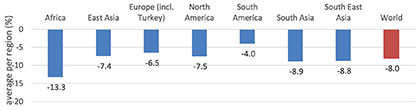
Corona-pandemic's impact on orders  /Source: ITMF Survey (March 13-25, 2020)
Corona-pandemic's impact on orders /Source: ITMF Survey (March 13-25, 2020)


Worldwide, expected turnover 2020 vs. 2019 is down by -10.5%

The results show that on average companies in all regions are expecting their turnovers in 2020 to be significantly lower than in 2019. On world average, the turnover in 2020 is expected tobe -10.5% lower than in 2019. While in North America the expected plunge will be on average -7.5%, companies in Europe are expecting a drop of -17.5%.
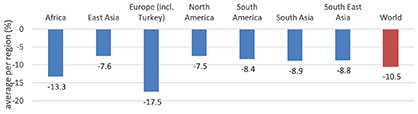
Corona-pandemic's impact on turnover / Source: ITMF Survey (March 13-25, 2020)


It is important to note that two factors playedan important role in the survey thatare also interconnected with each other. These are geography and time. Those companies and country organisations that had replied early (between March 13-16) and reported about additional orders were not (yet) directly or indirectly effected by the Corona-pandemic. With other words, these companies and organisations were neither affected by a Corona-epidemic in their own country, nor were their customers (mainly in Europe and North America). The later replies were received (from March 17onwards), the more negative were the answers across all regions. It can be assumed that the fact that after March 16 more and more governments in Europe and North America introduced almost daily new regulations that were restricting public and business life (e.g. closing of kindergartens, schools, universities, shops, bars, cinemas, museums, sport facilities, ski resorts, borders, etc.) was crucial. With all these restrictions in place ‘offline’ consumption of textiles and apparel in retail shops, departments stores, outlets stores, etc. dropped dramatically. This seems to have led brands and retailers across the board to cancel and/or postpone orders significantly.

Challenges: Safety, lack of supply or demandand liquidity – Opportunities: Medical textile products

On the question of the main challenges companies are facing, companies around the world highlighted the following.

  • safety and health of the workers and staff; disrupted supply chains, especially in connection with supplies from China;
  • lack or delay in supply in the apparel industry;
  • lack of demand or the fear that demand will drop significantly;
  • lack of liquidity.


With regard to opportunities, companies also mentioned:

  • streamlining their internal processes during the crisis will make them emerge stronger;
  • companies producing fibres, yarns, fabrics and end-products with health care and protection function will see new opportunities.

The results of the second survey for the period March 28 until April 3 on the impact of the Corona-pandemic on the global textile industry will be released on April 6.

2nd ITMF-Survey about the Impact of the Corona-Pandemic on the Global Textile Industry

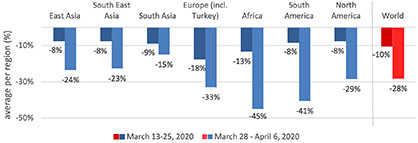
Between March 28-April 6, 2020, ITMF has conducted a second survey among ITMF Members and affiliated companies and associations about the impact the Corona-pandemic on the global textile value chain, especially on current orders and expected turnover in 2020. In total 700 companies from around the world participated.

Worldwide, current orders are down by -31%on average

The results show that companies in all regions of the world suffered significant numbers of cancellations and/or postponements of orders. Globally, currentorders dropped by -31%on average. The severity of the decrease ranges from -20.0% in EastAsiato -41% in South America. 
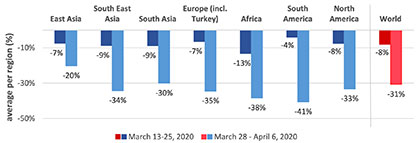
Corona-Pandemic's Impact on Orders / Source: ITMF Survey (March 28-April 6, 2020)


Worldwide, expected turnover 2020 vs. 2019 is down by -28% on average

The results show that companies in all regions of the world are expecting their turnovers in 2020 to be significantly lower than in 2019. On world average, the turnover in 2020 is expected tobe -28% lower than in 2019. While in South Asia the expected turnover will fall by-15%, companies in Africaare expecting a drop of -45%.
Corona-pandemic's impact on turnover / Source: ITMF Survey (March 13-25, 2020)


Only three weeks ago, some regions were not fully affected by the Corona-pandemic. The new numbers on orders and turn over reveal the dramatic extent this demand shock has onthe textile industry around the world.

The uncertainty about the duration of the crisis weighs heavily on the industry.

Challenges: Lack of demand and liquidity – Opportunities: Medical textile products Companies around the world highlighted the following main challenges:

  • lack of current demand and/or fear that future demand will drop significantly
  • lack of liquidity

They mentioned the following main opportunities:

  • companies producing fibres, yarns, fabrics and end-products with health care and protection functions will see new opportunities.

The results of the 3rd ITMF Corona-Survey about the impact of the Corona-pandemicon the global textile industry will be released on April 23rd, 2020.


More News from International Textile Manufacturers Federation (ITMF)

#Associations

Results of the 38th ITMF Global Textile Industry Survey

The global textile industry appears to be turning a corner, but this is more likely a fragile and possibly temporary improvement than the start of a durable recovery. According to the 38th ITMF Global Textile Industry Survey, conducted worldwide during the second half of May 2026, business sentiment, order intake, order backlogs and capacity utilization all improved versus March — yet every indicator remains weak by historical standards, and rising costs cast doubt on how long the upturn can last.

#Associations

Results of the 37th ITMF Global Textile Industry Survey

The International Textile Manufacturers Federation (ITMF) released findings from its 37th Global Textile Industry Survey (GTIS), conducted in March sharing how regions and segments are impacted by the latest geopolitical disruptions.

#Associations

Azerbaijan Textile Association (ATA) becomes member of ITMF

The Azerbaijan Textile Association (ATA) has officially become a Member Association of the International Textile Manufacturers Federation (ITMF), further strengthening Azerbaijan’s integration into the global textile value chain.

#Associations

SIMTA joins ITMF as Corporate Member

In the past two decades SIMTA has established itself as producer of specialized machinery for the textile industry. In short period of time, SIMTA became an important supplier of precise rollers for top OEMs. Afterwards SIMTA started manufacturing overhead cleaners, bobbin transport systems, and other textile ancillaries. In the meantime, SIMTA is a leader in this space in collaboration with the German automation technology partner Jacobi.

More News on Associations

#Associations

Towards pragmatic and harmonised labelling in the EU

EDANA, alongside 14 European associations, urges the European Commission and Member States to adopt a pragmatic approach for the future harmonised packaging labels, in line with the EU’s agenda for the EU Single Market, simplification and competitiveness. The system should rely on text-free pictograms, available in achromatic or monochromatic versions matching the packaging palette, with the possibility of using digital labelling as a core element. Our associations represent manufacturers of consumer goods across Europe.

#Associations

Textile PRO Forum calls for greater harmonisation of textile EPR systems across Europe

The Textile PRO Forum has published a new analysis highlighting the need for greater harmonisation of textile Extended Producer Responsibility systems across Europe. The document, Toward harmonised Textile EPR Systems in Europe: analysis and recommendations, presents the results of work carried out by Workstream 1 of the Textile PRO Forum, led by Dr. Eng. Viola Corbellini, Strategic Development and Innovation Expert at Erion Textiles, and Eng. Luca Campadello, General Director at Erion Textiles. The workstream focused on reducing administrative burden for textile producers by identifying areas where procedures could be better aligned across countries.

#Associations

Mario Jorge Machado re-elected President of EURATEX

The EURATEX General Assembly has re-elected Mario Jorge Machado as President of EURATEX, renewing its confidence in his leadership at a crucial moment for the European textile and clothing industry. The sector is facing rising costs, global competitive pressure and an increasingly challenging transition towards sustainability and digitalisation.

#Associations

Keeping products moving with Swedish automation at FILTECH 2026

At FILTECH 2026, taking place in Cologne from June 30th to July 2nd, members of TMAS – the Swedish textile machinery association – will highlight how the country’s engineering expertise is enabling filtration manufacturers to increase productivity, improve traceability and reduce dependence on labour-intensive manual processes.

Latest News

#Research & Development

GenuTrace client advisory: Is your cotton supply chain UFLPA ready?

U.S. Customs and Border Protection has released updated operational guidance (CBP Publication No. 5560-0526) expanding its forced labor enforcement framework. The guidance supersedes the original 2022 UFLPA Operational Guidance and now covers all forced labor enforcement authorities — UFLPA, CAATSA, and WROs/Findings — in a single unified document. For cotton importers, the enforcement posture has not softened. It has become more structured, more documented, and more demanding. Learn more about UFLPA.

#Carpets

DOMOTEX Hannover 2028 off to a strong start with expanded portfolio

Preparations for DOMOTEX 2028 are already gaining strong momentum. Following its successful repositioning as the Home of Flooring & Interior Finishing, around 100 international manufacturers have already secured their place during the initial registration phase.

#Knitting & Hosiery

STOLL: Agreement signed for the divestiture of selected assets

In early 2025, KARL MAYER announced its strategic decision to focus on its core business areas of WARP KNITTING, WARP PREPARATION, and TECHNICAL TEXTILES. As part of this move, the flat knitting machine business under the STOLL brand was discontinued and the production site in Reutlingen was closed in October 2025.

#Research & Development

TERNAfil wins first place at PitchMiUp Night 2026 in Minden

The RWTH spin-off TERNAfil has developed MAXCarbon, a new high-performance hybrid fibre that combines the mechanical performance of carbon with the temperature and corrosion resistance of ceramic materials. For this development, TERNAfil was awarded first prize at the PitchMiUp Night in Minden on 21 May 2026.

TOP