[pageLogInLogOut]

#Associations

In March 2025 global textile industry struggled but kept resilient optimism

The International Textile Manufacturers Federation (ITMF), has released the results of its Global Textile Industry Survey (GTIS) for March 2025. This survey, conducted regularly across all key regions and segments of the textile value chain, revealed a complex picture of a deteriorated business situation, cautious optimism, regional divergence, and ongoing structural challenges.


Results of the 31st ITMF Global Textile Industry Survey

After a slow but steady recovery since November 2023, the global business situation in the textile industry has slightly deteriorated in March 2025. While East Asia and North & Central America reported modest improvements, they remain at rather low levels. Garment producers continued to show the most stable performance across the value chain. Despite the current challenges, expectations for the 4th quarter of 2025 remained positive. Optimism was highest in Africa and the Americas, while East Asia stood out with a more pessimistic outlook. Producers of garments, fibers, and finished fabrics were the most hopeful, in contrast to technical and home textiles, where expectations remained subdued.
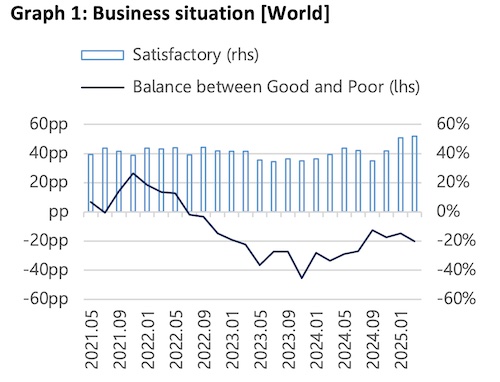
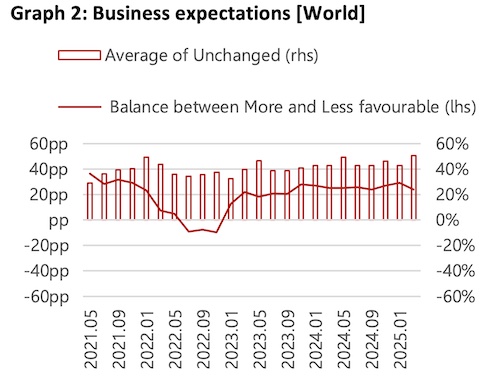
Source: 8th-31st ITMF Global Textile Industry Survey (31st: 17-26.03.2025) – last data point = March 2025 © 2025 ITMF


The prior recovery in order intake had also lost momentum, with declines in East Asia and Europe, while South-East Asia remained relatively stable. Garment producers continued to outperform other segments in maintaining order levels. Order backlogs slightly declined to a global average of 2.2 months, with Europe leading due to the strong presence of textile manufacturers. Capacity utilization held firm at 73%, driven by relatively higher rates in Asia. Meanwhile, textile inventories were showing signs of increases, led by yarn producers, while garment makers continued to keep stock levels low amid ongoing market caution.

The survey also revealed that concerns around demand and geopolitics were still growing. Weak demand remained the most pressing issue, cited by 62% of respondents, followed by geopolitical tensions (41%). Although worries over energy and raw material costs had slightly eased, concerns around interest rates and new sustainability regulations were on the rise.

For more information, please see www.itmf.org


More News from International Textile Manufacturers Federation (ITMF)

#Associations

SIMTA joins ITMF as Corporate Member

In the past two decades SIMTA has established itself as producer of specialized machinery for the textile industry. In short period of time, SIMTA became an important supplier of precise rollers for top OEMs. Afterwards SIMTA started manufacturing overhead cleaners, bobbin transport systems, and other textile ancillaries. In the meantime, SIMTA is a leader in this space in collaboration with the German automation technology partner Jacobi.

#Associations

Mr. Juan Parès (Spain) elected as new ITMF President

On October 24th, 2025, during the ITMF Annual Conference & IAF World Fashion Convention 2025 in Yogyakarta, Indonesia, the Committee of Management of the ITMF elected the members of the ITMF Board for the period 2025-2027.

#Associations

ITMF and IAF conclude successful Joint Convention 2025 in Yogyakarta, Indonesia

The International Textile Manufacturers Federation (ITMF) and the International Apparel Federation (IAF) have successfully concluded their second joint convention, held this year in Yogyakarta, Indonesia. In close collaboration with the host Indonesian Textile Association (API), the event gathered over 400 delegates from around the world from across the entire textile and apparel value chain.

#Associations

Winners of the ITMF International Collaboration Award 2025

The winners of the ITMF International Collaboration Awards 2025 will present their project at the upcoming ITMF & IAF Conference 2025 which will be held from 24 - 25 October in Yogyakarta, Indonesia and will be co-hosted by Indonesia Textile Industry Association (API).

More News on Associations

#Associations

European Business Coalition welcomes provisional application of EU–Mercosur Agreement and calls for Swift and full implementation

With the European Commission’s decision to provisionally apply the EU–Mercosur Interim Trade Agreement, a process spanning more than 25 years now moves decisively into its implementation phase.

#Associations

EDANA joins industry coalition urging a strong internal market legal basis for the New Circular Economy Act

EDANA has joined 67 European industry associations in a joint industry statement calling on the European Commission and co-legislators to anchor the forthcoming New Circular Economy Act (CEA) in the Internal Market legal basis (Article 114 TFEU).

#Associations

EDANA warns of consequences of misclassification of PET spunbond imports

EDANA would like to remind its members and industry stakeholders of the legal requirement to comply with the EU rules on customs classification when importing nonwovens from third countries outside the EU. In this regard, it was recently discovered that there appears to be a high level of customs misclassification occurring in our industry. This could have dangerous and costly consequences for importers.

#Associations

Engineering depth and diversity for composites

Airbond is the latest member of the British Textile Machinery Association (BTMA) to receive recognition for contributions to the composites industry. The engineering firm based in Pontypool, South Wales, has just received the Make UK Energy and Sustainability Award for its Lattice 3D Printing project.

Latest News

#Techtextil 2026

DIENES at Techtextil 2026: Flexible pilot lines for bio-based fiber development

The growing relevance of bio-based materials in technical textiles is accompanied by increasing demands for reproducibility, high-quality data, and scalable process routes. Especially when working with cellulose and its derivatives, chitosan, lignin-based approaches, or bio-based PAN as a carbon-fiber precursor, R&D teams face variable feedstock quality, tighter process windows, and the need for reliable comparability across trials. This calls for flexible, data-driven experimental setups that can be reconfigured efficiently when recipes, solvents, and raw-material batches change.

#Texprocess 2026

Gunold showcases embroidery product range and services at Texprocess

At Texprocess 2026, GUNOLD will present numerous hands-on examples related to embroidery in Hall 8, Booth E20. The focus is on creative embroidery designs as well as the extensive product range of threads, nonwovens, and accessories for embroidery and embellishment. “Trade visitors can once again look forward to many new and creative embroidery designs. Of course, we will also showcase the matching products required to bring these ideas to life,” announces Marketing Manager Stephan Gunold.

#Nonwovens

EDANA and more than 70 industry organisations call for consistent exemptions in EU packaging regulation

EDANA, together with more than 70 industry associations and organisations, has issued a joint statement commenting on the European Commission’s Delegated Act under Article 29 of the Packaging and Packaging Waste Regulation (PPWR).

#Raw Materials

A Powerful Opening: Global thought leaders launch the International Cotton Conference Bremen

The International Cotton Conference Bremen will open on 25 March 2026 in the Parliament building of the Free Hanseatic City of Bremen with a keynote session of exceptional calibre. Distinguished international experts will set the stage for the conference by offering incisive perspectives on the most pressing challenges and the defining trends shaping the future of the global cotton trade. Their insights will span a broad spectrum — from geopolitically driven disruptions affecting global supply chains to the opportunities emerging from innovation-led agriculture capable of supporting a growing world population. Together, these opening keynotes will frame the dialogue of the conference, highlighting both the complexity of today’s market environment and the pathways toward a resilient and forward-looking cotton sector.

TOP