[pageLogInLogOut]

#Yarn & Fiber

Textile Exchange releases second annual Preferred Fiber and Materials Report

Textile Exchange today released the 2014 Preferred Fiber and Materials Report. The report is a collection of data about raw materials that are used to create textiles such as apparel, sheets and towels. Textile Exchange is an international nonprofit organization nonprofit committed to a more sustainable textile industry.
Preferred fibers outpace the growth of conventional fibers The intent of the report is to educate the textile industry about more sustainable material choices and resources. Preferred materials include recycled polyester, lyocell, organic cotton, and more. The Preferred Fiber and Materials Report showcases an increase in the use of preferred fibers and materials, both through survey results as well as textile industry reports that demonstrate how preferred fibers are outpacing the growth of conventional fibers (such as cotton).

The report is designed as a tool to help brands, retailers, educators, nonprofit organizations and the entire textile supply chain understand the Preferred Fiber & Materials (PFM) market. The long-term goal is to support the growth and development of the PFM supply chain from fiber to finished product and on to the consumer. Providing this support is essential to Textile Exchange as it will lead to fulfilling our vision of a global textile industry that protects and restores the environment and enhances lives.

According to Tricia Carey, Textile Exchange Board Vice-Chair and Director of Business Development for Denim at Lenzing, “In an evolving marketplace, the Textile Exchange Preferred Fibers Report provides pertinent information for the global supply chain. This report builds upon the series of data from previous years to monitor progression.”

The report also challenges the textile community to address today’s market use of synthetics and encourages them to adopt more sustainable options. Textile Exchange works on a global scale to support the transition to more sustainable fiber and material options. Textile Exchange is an industry leader for sustainable materials, focusing on research, and integrity development for the global textile supply chain.

The report congratulates the Top 10 users of Recycled Polyester*: NIKE Inc., The North Face, Target, H&M, PUMA, Williams Sonoma, G-Star Raw, Mountain Equipment Co-op, Volcom and Prana.

Congratulations also go out to the Top 5 users of Lyocell*: Inditex, H&M, Target, G-Star Raw and Eileen Fisher.

*Top users from results of Textile Exchange survey respondents.
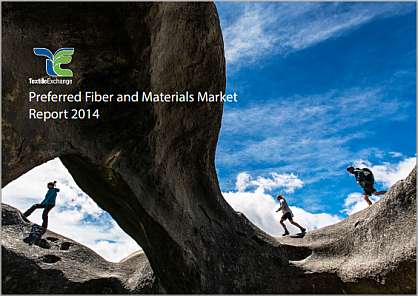
Access the Report

The Preferred Fiber and Materials Market Report is produced on an annual basis and is complimentary to Textile Exchange Members. Non-Members have the option to purchase the full report http://textileexchange.org/resource-center/reports-and-publications/2014-preferred-fiber-and-materials-market-report

as well as download a complimentary report overview. http://textileexchange.org/resource-center/reports-and-publications/2014-organic-cotton-Report

Complimentary Report on Organic Cotton (released June 3, 2015) Textile Exchange also produces an annual report focused on organic cotton. Access it via the links below: Download the Complimentary Overview for 2014 Organic Cotton Market Report http://textileexchange.org/resource-center/reports-and-publications/2014-organic-cotton-Report
Purchase the full 2014 Organic Cotton Market Report http://textileexchange.org/resource-center/reports-and-publications/2014-organic-cotton-Report
More News from Textile Exchange

#Raw Materials

Textile Exchange publishes cotton Life Cycle Assessment study to strengthen impact data

Textile Exchange has published the first in a series of seven Life Cycle Assessment (LCA) studies designed to improve the quality and robustness of environmental impact data for raw material production across the fashion, textile, and apparel industry. The first LCA study focuses on cotton and addresses critical data gaps and methodology variability through new high-quality data across key producing countries. The study includes organic, regenerative, recycled, and country averages for conventional cotton production systems, providing a clearer picture of the associated environmental impact.

#Sustainability

Textile Exchange unveils commitment-based pathway for members to accelerate responsible raw material production

Textile Exchange has unveiled further details about its new membership structure, designed to guide the fashion, textile, and apparel industry in a collective course of action toward preferred production systems for raw materials and fibers.

#Yarns

Textile Exchange publishes the final criteria for its new Materials Matter Standard, marking a pivotal shift in connecting certification to impact

Textile Exchange has published the final criteria for its Materials Matter Standard—a major milestone in the organization’s multi-year transition toward a unified, impact-driven standards system for raw material production and primary processing. 

#Sustainability

Textile Exchange evolves its membership structure to unlock the next stage of collective action for climate and nature

Textile Exchange is excited to announce that it is evolving its membership structure to a more action-oriented, impact-driven model designed to provide clearly defined pathways that help organizations respond to the climate and nature crisis.

More News on Yarn & Fiber

#Yarns

Yarn Expo Spring 2026 concludes, connecting buyers with innovative selection of sustainable yarns and fibres

Yarn Expo Spring 2026 wrapped up successfully on 13 March, as a record-high of over 600 exhibitors from 12 countries and regions welcomed more than 25,000 visitors from 113 countries and regions. Held across 27,000 sqm in Hall 8.2 of the National Exhibition and Convention Center (Shanghai), the fair highlighted the textile industry’s accelerating shift toward a lower-impact, more functional future. Exhibitors presented eco-friendly organic, regenerated and recycled yarns and fibres, alongside innovative options such as sweat-resistant and high-performance materials. A comprehensive fringe programme further enriched the event, offering practical market insights and new networking opportunities.

#Man-Made Fibers

Lenzing advances its transformation: Higher EBITDA, stronger free cash flow and more than EUR 200 million in cost savings

The business performance of the Lenzing Group in 2025 was affected particularly in the second half of the year by external factors such as international tariff measures, subdued demand and declining market prices. As a result, revenue decreased slightly by 2.3 percent to EUR 2.6 billion, primarily due to lower fiber sales volumes and lower prices for fibers and pulp, which were further negatively impacted by currency developments. Nevertheless, thanks to the comprehensive Performance Program, Lenzing was able to improve its operating performance and key financial indicators compared with the previous year.

#Man-Made Fibers

“Lead Transformation – Generate Impact”: Lenzing presents its 2025 Annual and Sustainability Report

The Lenzing Group has published its 2025 Annual and Sustainability Report, entitled LEAD TRANSFORMATION – GENERATE IMPACT. The report shows how Lenzing is actively shaping change in the industry and making a lasting impact: economically, ecologically, and socially. Lenzing is consistently focused on the future: with targeted investments in premiumization, excellence, innovation, and sustainability, the company is strengthening its position as a leading provider of sustainable, cellulose-based premium fibers. The combined report is available in digital format.

#Raw Materials

Lenzing Group positions bio‑based materials as a strategic asset for Europe’s economic security

The Lenzing Group, a leading supplier of regenerated cellulose fibers for the textile and nonwovens industries, hosted a high‑level roundtable in Brussels to discuss how bio‑based materials can strengthen Europe’s economic security and support the shift toward a fossil‑free future. Organized in cooperation with Euractiv, the event brought together representatives of the European Commission, the UK Mission to the EU, academia, civil society, and industry.

Latest News

#Raw Materials

New study shows low environmental impact by Cotton made in Africa Organic Cotton from Tanzania

Today, the Aid by Trade Foundation (AbTF) is announcing the results of a comprehensive life-cycle analysis (LCA) for cotton produced in Tanzania under the Cotton made in Africa Organic (CmiA Organic) standard. The study emphasises the small ecological footprint of CmiA Organic verified cotton. This can largely be traced back to the absence of synthetic pesticides, artificial fertilisers, and artificial irrigation. Consequently, CmiA Organic cotton can help the textile industry meet regulatory requirements as well as science-based targets. The results also show that the consequences of climate change threaten the livelihoods of these cotton farmers, even though the type of agriculture they practise barely contributes to climate change.

#Raw Materials

Better Cotton Initiative strengthens regenerative focus in standard update

The Better Cotton Initiative (BCI) has strengthened the regenerative focus of its field-level standard with the launch of a new version of its Principles & Criteria (P&C), which marks the next step in the organisation’s journey to becoming a regenerative standards system.

#Man-Made Fibers

Selenis and Kintra Fibers partner to scale 100% bio-based synthetic fiber technology

Selenis, a leading global specialty polyester manufacturer, today announced a strategic manufacturing partnership with materials science company Kintra Fibers to scale Kintra’s patented fiber-grade PBS resin - a 100% bio-based and biodegradable material designed for textile applications.

#Functional Fabrics

PERFORMANCE DAYS proves its relevance as the industry’s key meeting point

Held on March 18–19, 2026, PERFORMANCE DAYS once again confirmed its position as a leading international platform for functional textiles. A total of 3.366 trade visitors and around 560 exhibitors gathered in Munich, with the event already kicking off successfully on DAY 0, which received highly positive feedback for its interactive format. Despite challenging conditions caused by the public transport strike in Munich, the event saw strong attendance and a consistently high level of activity across both exhibition days.

TOP