[pageLogInLogOut]

#Yarn & Fiber

Gebr. Otto expands near-shoring portfolio: yarns with ‘EU-COTTON’ certification now in the programme
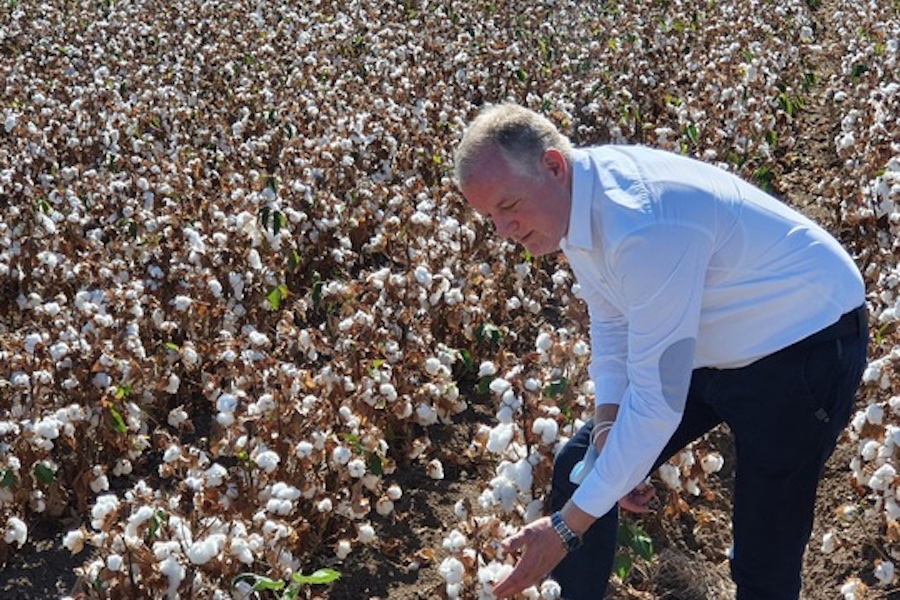
Since this spring, Gebr. Otto has cotton yarns with the ‘EUCOTTON’ certification in its programme. The fibres for these yarns come from Greece and Spain, both countries with a long tradition in cotton production and extensive know-how. For Gebr. Otto, the EUCOTTON yarns are an ideal addition to the product portfolio, which focuses on sustainable and innovative yarns. Short distances and regional partners, both in procurement and in further processing, are also part of the strategy of the traditional textile company with spinning, twisting and dyeing mills.
Gebr. Otto attaches great importance to a transparent and responsible supply chain. Gebr. Otto sources cotton fibres from Andalusia for its ‘Cotton since 1901’ brand. Picture: © 2025 Gebr. Otto


Apart from that, the local approach is becoming increasingly important for Gebr. Otto in view of the latest developments in customs policy.

‘We are pleased that we at Gebr. Otto can now also offer EUCOTTON yarns,’ says Andreas Merkel, managing director of the Upper Swabian textile company Gebr. Otto. ’The EUCOTTON initiative is timely and forward-looking for many reasons.’

Small market share, high quality

The European appetite for new textiles is considerable, but the possibilities for tracing the origin of the textiles are limited. In addition, the fibres ‘grown in Europe’ are of exceptionally high quality, and demand worldwide is high.

European raw cotton comes from Spain and Greece. So far, a quarter of these fibres have also been processed in Europe. The rest is exported, sometimes via long detours to Southeast Asia, before returning to the EU as textile end products. ‘This makes little sense for ecological reasons alone,’ says Otto CEO Merkel. In view of the increasing trade restrictions and problems in global supply chains, European sourcing must be prioritised. ‘It should be our aim to process the majority of European cotton in Europe, especially since it is of exceptionally high quality.’

Advantages of European cotton growing

The high quality of EUCOTTON yarns is based on advanced production methods, including exclusively mechanical harvesting. The careful harvesting methods ensure that the fibres are almost free of impurities, for example from foreign fibres. The latest technology is also used for cleaning and ginning.

Cotton fibres from the Spanish and Greek harvests are exceptionally uniform in terms of fibre length, strength and thickness. ‘All of this contributes to the spinnability of the fibres,’ says Andreas Merkel. ‘They can also be processed in an enormous variety of ways.’

Responsibility grown

Beyond the technical advantages of the raw material, EUCOTTON offers important benefits in terms of ecological and social responsibility: the GMO-free seeds protect the ecosystem and natural resources. The same goal is pursued by water management: cotton growing is water-intensive and measures such as drip irrigation and precision farming can reduce the impact. The principle of minimisation also applies to the use of pesticides and insecticides.

‘If we source our cotton from Europe, we can be sure that the legal framework, for example with regard to working hours and occupational safety, is being adhered to,’ adds Andreas Merkel.

Short distances create reliability

In addition to transparency and high quality, reliable and fast availability are another argument in favour of EUCOTTON. ‘Of course, high-quality cotton also grows elsewhere in the world, for example in Peru or the USA. However, it then has to endure a six- to eight-week sea voyage before it arrives in Germany.’ From Spain, the raw cotton reliably travels by truck to the doorstep of the processor in just five days.

EUCOTTON captures the spirit of the times

‘At Gebr. Otto, we have long placed great value on short, reliable and transparent supply chains,‘ explains Andreas Merkel. “Although we do not fall under the Supply Chain Act due to the size of our company, we meet its requirements, for example with cotton yarns from our brand ”Cotton since 1901: Made in Germany’’. For these ultra-fine cotton yarns, Gebr. Otto processes extra-long-staple cotton fibres from Andalusia in southern Spain.

The company has had very good experiences with this approach: ‘We are increasingly aware of our customers’ desire to offer transparency to the end customer.’ Gebr. Otto's experiences with the new EUCOTTON addition are correspondingly positive: “High-quality European brand manufacturers are very interested in yarns with this label,” says Merkel.
More News from Gebr. Otto Baumwollfeinzwirnerei GmbH + Co. KG

More News on Yarn & Fiber

#Yarns

January 2026 marks Asahi Kasei’s restart of Bemberg production in restored sections of the Nobeoka facility

Beginning January 2026, production at the Asahi Kasei Nobeoka facility – Bemberg’s only production site – will gradually resume, marking a new chapter following the partial shutdown caused by the April 2022 incident. This progress is the result of significant investments and continuous work toreinforce safety measures, restore full operational capacity, and establish long- term stability.

#Yarns

Acelon introduces new functional yarns for fire safety and comfort applications

Acelon has presented two new functional yarn developments, AceXflame® and MistX®, aimed at expanding performance options for home textiles, industrial applications, and apparel.

#Yarns

Durak Tekstil enters 2026 with positive momentum, strengthens its global market focus

Durak Tekstil, maintaining its profitability and turnover levels in 2025 compared to the previous year, prioritizes growth through its export-oriented sales strategy. Increasing both its capacity and utilization rate, the company anticipates further gains in 2026 through expansion in global markets.

#Weaving

Vandewiele Group: Innovation across the textile value chain at ICFE Istanbul 2026

At the 2026 Istanbul Carpet & Flooring Expo (ICFE), Vandewiele Group presents its latest advancements spanning the entire textile value chain. From spinning and weaving to tufting, carpet manufacturing and digital finishing, the Group demonstrates how integrated innovation can boost performance, efficiency and sustainability across all stages of production. As a global technology leader, Vandewiele continues to develop solutions that strengthen processes, enhance product quality and enable smarter, greener manufacturing.

Latest News

#Research & Development

Innovation center for textile circular economy inaugurated

Just over eight months after the foundation stone was laid, the new Innovation Center for Textile Circular Economy was officially inaugurated today at TITK Rudolstadt. Thuringia's Minister President Mario Voigt, TITK Director Benjamin Redlingshöfer, and other guests of honor cut the ribbon to the modern building complex and viewed the premises, which are now ready for occupancy. The “DICE – Demonstration and Innovation Center for Textile Circular Economy” is TITK's largest single investment to date. The Free State of Thuringia supported the total cost of €11.5 million with €8 million in GRW and FTI funding.

#Research & Development

Sustainable design of Geosynthetics and roof underlayments made from recyclates

Is it possible to recover plastic recyclates from previously unused waste streams in order to produce high-quality fibers and films? How can bio-based polymer fibers be manufactured so as to allow adjustable biodegradability? These are the questions being addressed by researchers from the Fraunhofer Cluster of Excellence Circular Plastics Economy CCPE in the Zirk-Tex project.

#Associations

Waste2Fashion: FTTH Committed to advancing Circular Fashion in the Mediterranean

As an official partner of the Waste2Fashion project, the Tunisian Federation of Textile and Apparel (FTTH) participated in the Kick-off Meeting held on 10–11 December in Spain. The event brought together project partners from across the Mediterranean, including Spain, Italy, Egypt, Lebanon, and Tunisia, to align on a shared vision and initiate the first implementation steps.

#Associations

AATCC announces 2025 Herman & Myrtle Goldstein Graduate Student Paper Competition winners

The American Association of Textile Chemists and Colorists (AATCC) recognized the winners of the 2025 Herman & Myrtle Goldstein Graduate Student Paper Competition. Founded in 1982 to give student members the chance to conduct and present original research, the competition was renamed in 1994 in honor of Herman and Myrtle Goldstein, following their US$60,000 endowment. Their gift is a lasting remembrance of their dedication to young people in the textile industry.

TOP