[pageLogInLogOut]

#Research & Development

Innovation center for textile circular economy inaugurated
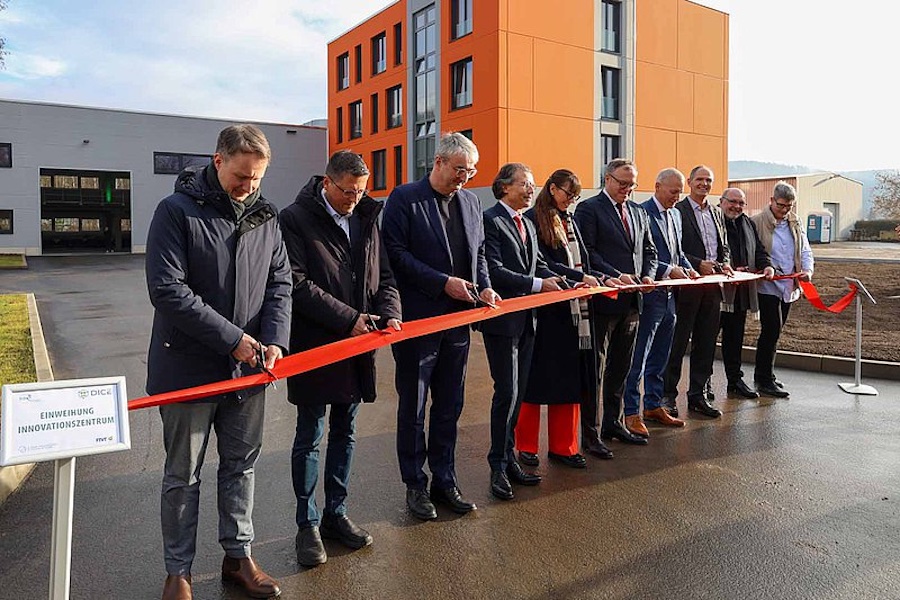
Official ribbon cutting for the new innovation center with (from left to right): State Parliament member Andreas Bühl, State Parliament member Maik Kowalleck, District Administrator Marko Wolfram, State Secretary for Economic Affairs Mario Suckert, Member of the Bundestag Diana Herbstreuth, Minister President Mario Voigt, TITK Director Benjamin Redlingshöfer, Zuse President Martin Bastian, Mayor Jörg Reichl, and TITK Department Head Ute Schubert. (Image rights: TITK / Steffen Beikirch)
Just over eight months after the foundation stone was laid, the new Innovation Center for Textile Circular Economy was officially inaugurated today at TITK Rudolstadt. Thuringia's Minister President Mario Voigt, TITK Director Benjamin Redlingshöfer, and other guests of honor cut the ribbon to the modern building complex and viewed the premises, which are now ready for occupancy. The “DICE – Demonstration and Innovation Center for Textile Circular Economy” is TITK's largest single investment to date. The Free State of Thuringia supported the total cost of €11.5 million with €8 million in GRW and FTI funding.

The rapid progress of construction on the institute's grounds has been a source of amazement for the employees of the TITK Group since spring. “We were always on schedule and within budget,” says TITK Director Benjamin Redlingshöfer. His announcement shortly after the laying of the foundation stone on March 31 that invitations to the inauguration would be sent out before the end of the year initially elicited skeptical smiles from some. But the promise was kept: “That was real ‘Thuringia speed,’” says Redlingshöfer proudly. The construction project was carried out by companies from the Free State.

Minister President Mario Voigt says: "The DICE is a strong signal for Thuringia's innovative strength: research is put into practice here, ideas become industrial solutions. In just eight months, visions have been turned into a center for visions. The rapid implementation shows that we in Thuringia not only have commitment and expertise, but also set a clear direction for the future with speed and efficiency. Innovative, sustainable, and competitive. The Free State of Thuringia has deliberately provided significant support for this forward-looking project because we want to further strengthen Thuringia as a location for research and development. I would like to express my sincere thanks to all those involved—the construction workers, the planners, those responsible at TITK, and all funding and project partners—who made this success possible. They have all set out to further advance the Green Heart of Germany and make it future-proof for the citizens of our state." 

The result is a four-story laboratory and office building and a test hall, each with a floor space of around 1,000 square meters. The barrier-free new building will house a biology laboratory and a pulp laboratory, among other things. The hall will focus on two main areas: polyester recycling and cotton recycling. In addition, research and testing of alternative pulp suppliers will also be a focus. Thanks to DICE, the TITK Group will have its own pulp cooking system in the future. This plant is currently still under construction in Saxony and is scheduled to go into operation in 2026.

The TITK director is convinced: “DICE will be the leading national and international innovation and demonstration center for research and development of environmentally friendly processes for the production of chemical pulp, the production of sustainable cellulose fibers, and the development of the necessary solution spinning technologies.” Redlingshöfer sees this as further proof that Thuringia is increasingly setting the pace for the German innovation landscape. “We have nothing to hide here.” 
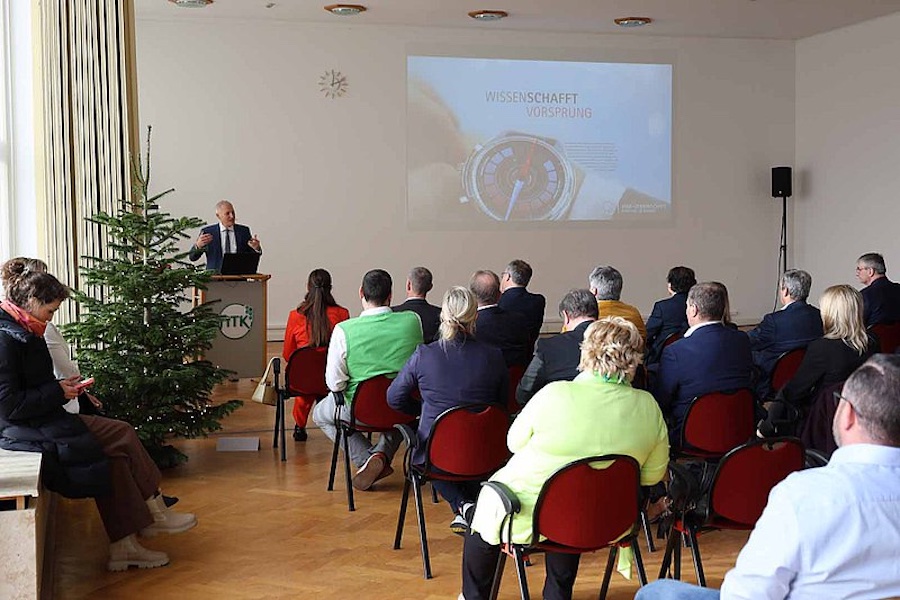
TITK Director Benjamin Redlingshöfer welcomed around 60 guests from politics, business, and research to the inauguration ceremony. (Image rights: TITK / Steffen Beikirch)


Important contribution to the transformation of the textile value chain

For more than 30 years, TITK has been dedicated to sustainable cellulose-based textile fibers. These Lyocell fibers have already undergone significant further development: they no longer use only wood pulp, but also, for example, fast-growing hemp, which consumes few resources. This year, the institute has taken a major step forward in developing innovative solutions for practical and holistic textile recycling: at the World Expo in Osaka (Japan), Redlingshöfer personally presented the world's first polo shirt made from triple-recycled hemp Lyocell fiber (Lyohemp®). 

The Rudolstadt-based institute aims to make an important contribution to the transformation of the textile value chain. The recycling of mixed textiles in particular is a key challenge that the new DICE innovation center will address. “Closed regional material cycles are our goal,” says Redlingshöfer. “But they must be ecologically and economically viable in order to guarantee market success.” The focus of the innovation center does not end with sustainable fibers for clothing textiles, but also explicitly includes technical textiles for high-performance applications in the automotive, aerospace, and defense sectors, for example. “Here, regionality also represents a resilience factor,” says the institute director. 

To date, 63 partners have agreed to cooperate with DICE, including well-known companies such as Adidas, Vaude, Continental, and Head, as well as other research institutions, associations, and networks.
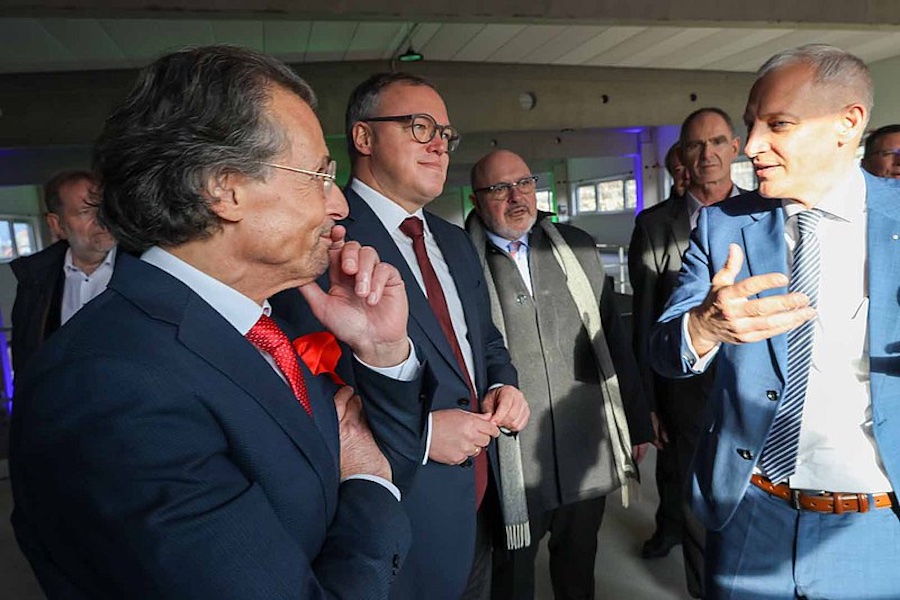
During a tour of the new test hall: TITK Director Benjamin Redlingshöfer (right) explains further plans to guests. From left: State Secretary for Economic Affairs Mario Suckert, Minister President Mario Voigt, Mayor Jörg Reichl, and Martin Bastian, President of the Zuse Association. (Image rights: TITK / Steffen Beikirch)


More News from TITK Rudolstadt ( Thüringisches Institut für Textil- und Kunststoff-Forschung Rudolstadt e.V. )

More News on Research & Development

#Research & Development

Pellet press enables thermomechanical textile recycling on a pilot scale at ITA

Since the end of 2025, the technical centre of the Institut für Textiltechnik (ITA) of RWTH Aachen University has been equipped with a pellet press from the manufacturer Amandus Kahl GmbH & Co. KG, Reinbek, Germany. This press can efficiently compact shredded synthetic textiles at a throughput of up to 25 kg/h and process them into pellets with a diameter of 4 mm.

#Composites

STFI at JEC

The Sächsisches Textilforschungsinstitut e.V. (STFI) will present composites for aviation made from recycled carbon fibres and natural fibres, as well as printed lightweight elements for surface heating in electric vehicles at JEC World in Paris.

#Research & Development

Fabolose: Fabricating vegan and circular leather alternatives from bio-tech-derived cellulose

Fabulose is an EU funded project coordinated by the German Institutes of Textile and Fiber Research (DITF). Its consortium consists of leading research institutes, biotech innovators, and industry stakeholders who aim to create high-performance, biobased and recyclable leather-like fabrics, using efficient biotech production routes for bacterial cellulose, cyanophycin and bacterial pigments

#Research & Development

New DIN SPEC assesses environmental impact of textile fragments in soil

Textile products made from synthetic fibres, finished fabrics or dyed materials release fibre fragments into the environment at every stage of their life cycle. With the new DIN SPEC 19296, Hohenstein has developed a standardised testing method to analyse how these fragments behave in soil under natural conditions. Until now, little was known about their environmental behaviour or potential ecological effects once released.

Latest News

#Composites

JEC World 2026 returns with an unprecedented content program

Recognized worldwide as the leading trade exhibition for composite materials and their applications, JEC World returns on March 10-12, 2026, at Paris Nord Villepinte as the most ambitious edition to date, in line with its motto “Pushing the limits”. As the must-attend event for the composites industry, JEC World will offer an unprecedented program, blending conferences, markets insights, technical sessions, awards, and above all, a unique experience and invaluable connections.

#Raw Materials

Beyond the wardrobe – innovative cotton takes the spotlight

Cotton can do more – a lot more. Cutting-edge textiles and high-tech products made from 100% cotton prove just how powerfully performance and sustainability can come together. That very surge of innovation is front and centre at the 38th Bremen Cotton Conference, taking place March 25–27, 2026, at Bremen’s Parliament on the historic market square – culminating in a bold and dedicated closing session on Friday. In the spotlight: performance upgrades for pure cotton, smart strategies for circular textile waste solutions, and pioneering concepts for demanding technical applications. From natural fibre–reinforced composites to highly effective flame-retardant solutions, cotton steps out of the closet and shows the future potential woven into every fibre.

#Digital Printing

Keeping print inclusive: Empowering women in the print industry

Across all industries, cultivating a diverse and inclusive workplace is increasingly recognised as valuable and essential to long-term success. However, despite the print industry’s significant advancements in technology and innovation, visible representation of women remains limited. As the sector grapples with low recruitment, it’s important to challenge outdated perceptions. Creating real change, however, requires collective effort - no single company can do it alone.

#Texprocess 2026

Texprocess 2026: market overview for strategic future investments

At Texprocess 2026, 200 exhibitors from 28 countries will be represented. In a challenging market environment, the leading trade fair is a constant and reflects progress in textile processing – driven by automation, digitalisation and AI. In addition, international start-ups present their ideas and meet partners from industry and research. Techtextil takes place in parallel with an optimised hall layout.

TOP