[pageLogInLogOut]

#Yarn & Fiber

Teijin Frontier develops seamless knitwear using special bulky fancy yarn providing both thermal comfort and high functionality
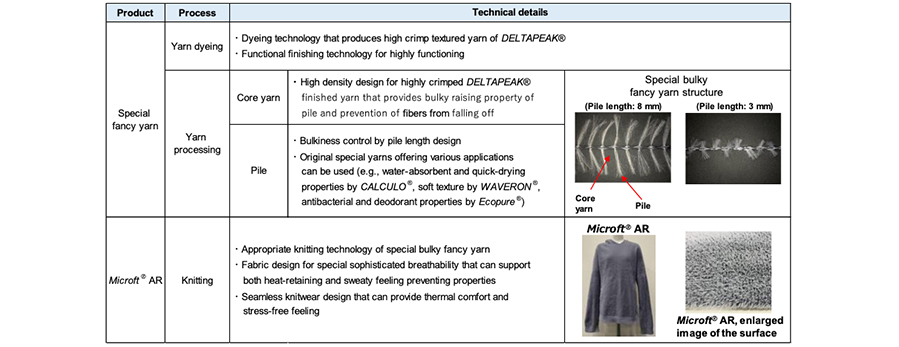
Technical features of Microft???? AR © 2023 Teijin
Teijin Frontier Co., Ltd., the Teijin Group’s fibers and products converting company, today announced the development of Microft® AR, a seamless knitwear for outdoor sports, featuring warmth that gently envelops and innovative stress-free comfort combined with a high functionality. The innovative clothing is made of a bulky fancy yarn using Teijin Frontier’s newly-developed high-performance polyester filament.

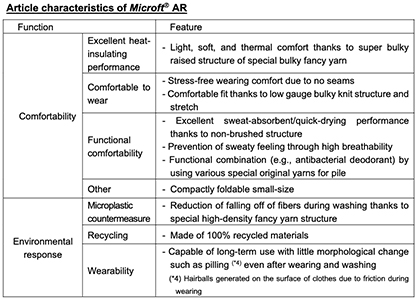
Microft® AR uses highly crimped (*1) DELTAPEAK® processed yarn as the core to create a high density loop structure to provide favorable raising and bulky heat-insulating performance while preventing fibers from falling off. Also, Teijin Frontier’s proprietary polyester filament is used for pile to provide various functionalities. Low gauge seamless knitwear (*2) made of the fancy yarn enables Microft® AR to offer unique sense of fit such as stress-free and soft, lightweight, and warmth that gently envelops with wear comfortability such as sweat-absorbency and quick-drying, high breathability.

Also, it can be compactly foldable in small-size. Furthermore, Microft® AR is an environmentally compatible product as it is made of 100% recycled polyester and features limited appearance changes after repeated washing and wearing, long-term use, and a reduced amount of falling-off fibers that are degraded to microplastics. 


Recently, outdoor clothing and sportswear are required to have a premium look and feel, further wear comfortability (high water-absorbent/quick-drying and stress-free properties), and eco-friendliness are desired in addition to excellent heat retaining property. Light and thermal fleece materials are popular, nevertheless, it has some issues such as poor sweat-absorbent and quick-drying functions, bulkiness and appearance change after washing and wearing due to brushed fabrics. Teijin Frontier focused on the structure of chenille yarn (*3) to assure heat retention and functionality without brushing. However, conventional chenille yarns have been mainly used for fashionable clothing with the focus on textures such as soft feeling and airy appearance, lacking the functionality required for outdoor uses. 

(*3) Chenille yarn: Fancy yarn consists of core threads, pile, etc. Knitwear created with chenille yarn is generally considered high-pile and good in touch.

Teijin Frontier will begin promoting Microft® AR for the 2025 autumn and winter outdoor clothing and sportswear collections, thereafter, expanding globally for functional clothes such as casual wear and uniforms. It expects Microft® AR sales to reach 100,000 pieces during fiscal 2026.



More News from TEXDATA International

#ITM 2026

ITM 2026: The new geography of textile production

New production hubs are emerging across North Africa and Central Asia, while Türkiye is accelerating its transformation toward higher-value, technology-driven and more sustainable textile manufacturing.

#Research & Development

“Production is a product”

From technical textiles and AI-driven robotics to the limitations of textile circularity: Professor Dr Thomas Gries looks back on more than two decades of development at ITA Aachen. In the interview, he explains why production technology remains a decisive success factor, discusses international collaborations and innovation ecosystems, and shares his views on the transformation of production landscapes and the challenges facing an increasingly regulated industry.

#Knitting & Hosiery

“We need to move away from the price trap and return to a value-driven mindset.”

With its new Textile Innovation Center, KARL MAYER is sending a strong signal for innovation, collaboration, and the future of textile applications. In this interview, Karl Josef Mayer discusses new opportunities in warp knitting, the processing of staple fibres, recycling, the changing role of machinery manufacturers, and why the textile industry must once again focus more strongly on the value of textiles. by Oliver Schmidt

#Associations

“Innovation, resilience and international experience remain the great strengths of the Swiss textile machinery industry”

Geopolitical uncertainty, growing competitive pressure from China, new free trade agreements and the shift towards a circular economy are currently reshaping the global textile industry. In this interview, Cornelia Buchwalder discusses the current mood within the Swiss textile machinery sector, the industry’s distinctive innovative strength, new market opportunities in India and Asia, and the technological trends that could shape the upcoming trade fair cycle leading up to ITMA 2027.

More News on Yarn & Fiber

#Yarns

Yarns and technologies in symbiosis: Biella Yarn presents Fall/Winter 2027/2028 collection “New Romance_”

Biella Yarn, the flat knitting brand of Suedwolle Group, launches new Fall/Winter 2027/2028 collection, inspired by the symbiosis of yarns and technologies – elements that blend, adapt and evolve together, forming something new without losing their origin. The name “Neu Romance_” reflects the emotional and neurological dimension of the yarns: a connection that engages the senses, experienced through material, touch and interaction. The collection is further brought to life through design collaborations, featuring selected yarns used in different design approaches.

#Recycling / Circular Economy

The textile industry in transition

Recycling, traceability, eco-design and digitalisation are among the key future challenges facing the European textile industry. The Erasmus+ project Skills4Circularity, involving 21 partners from twelve countries, is investigating the skills required to address these challenges. As the German industry partner, the Industry Association for Finishing – Yarns – Fabrics – Technical Textiles (IVGT) is bringing the industry’s perspective to the project.

#Research & Development

GenuTrace client advisory: Is your cotton supply chain UFLPA ready?

U.S. Customs and Border Protection has released updated operational guidance (CBP Publication No. 5560-0526) expanding its forced labor enforcement framework. The guidance supersedes the original 2022 UFLPA Operational Guidance and now covers all forced labor enforcement authorities — UFLPA, CAATSA, and WROs/Findings — in a single unified document. For cotton importers, the enforcement posture has not softened. It has become more structured, more documented, and more demanding. Learn more about UFLPA.

#Spinning

"We will become a recycling powerhouse"

The textile industry is now in its fourth consecutive year of crisis, while automation, artificial intelligence and recycling are reshaping the rules of the game. In this interview, Rieter CEO Thomas Oetterli discusses the first signs of a market recovery, reflects on his first three years at the helm of the company, explains the integration of Barmag, outlines Rieter’s vision of the fully automated spinning mill and highlights the strategic importance of recycling. In doing so, he explains why the new Rieter Group aims to play a leading role in transforming the textile value chain into a circular economy.

Latest News

#Research & Development

2026 general meeting of the Friends and Supporters of RWTH Aachen at ITA

The Friends and Supporters of RWTH Aachen e. V. (proRWTH) looked back on a successful year of support at their 2026 general meeting. The meeting took place at Institut für Textiltechnik (ITA) of RWTH Aachen and was combined with a joint session of the Executive Board and the Administrative Board. Before the general meeting began, participants were given a guided tour of ITA, providing them with fascinating insights into current research and development topics in textile engineering.

#Natural Fibers

Cotton ConneXions Insight to Impact brings supply chain leaders together around cotton innovation

Cotton Incorporated’s Cotton ConneXions Insight to Impact brought together more than 300 industry leaders from 140 companies across 10 countries, including more than 45 top global brands and sourcing organizations, underscoring strong global interest in cotton-rich product development, sourcing and supply chain collaboration.

#Knitting & Hosiery

Footwear innovation enabled by warp knitting technology– insights from New Balance

The future of the athletic shoe is increasingly being shaped on warp knitting machines. For KARL MAYER, the footwear industry is one of the most important growth markets – and one of the sectors where innovative textiles can realize their full potential. In his keynote address at the opening of KARL MAYER’s TEXTILE INNOVATION CENTER in Obertshausen in April, Vishnu Prakash Muthusamy, Senior Textile and Materials Engineer at New Balance, explained the opportunities that warp knitting technology opens up for performance, sustainability, and faster development processes, and why textile manufacturers are transitioning from suppliers to development partners.

#Natural Fibers

Cashmere specialist joins AbTF Board of Trustees

The Aid by Trade Foundation (AbTF) is pleased to welcome Brian Yu, the chief executive officer of the Artwell Group, to its board of trustees. As CEO, Brian Yu developed Artwell into the world’s largest supplier of responsibly produced cashmere knitwear.

TOP