[pageLogInLogOut]

#Yarn & Fiber

Solvay to collaborate with Trillium on bio-based acrylonitrile for carbon fiber applications

New agreement with Trillium Renewable Chemicals will enable Solvay's development of sustainable, bio-carbon fiber for use in various applications.

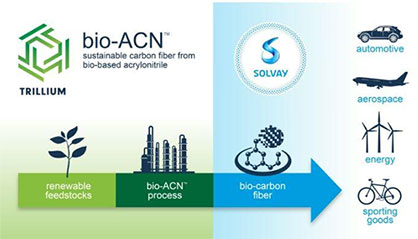
Solvay and Trillium Renewable Chemicals have signed a letter of intent to develop the supply chain for bio-based acrylonitrile (bio-ACN). Trillium will supply Solvay with bio-ACN from Trillium’s planned commercial asset, and Solvay will evaluate bio-ACN for carbon fiber manufacturing as part of its long-term commitment to developing sustainable solutions from bio-based or recycled sources. The aim of this partnership is to produce carbon fiber for use in various applications such as aerospace, automotive, energy, and consumer goods. 

Acrylonitrile is a chemical intermediate typically made from petroleum-based feedstocks like propylene and is the primary raw material used in the production of carbon fiber. Trillium’s Bio-ACNTM process delivers acrylonitrile from plant-based feedstocks like glycerol with a lower carbon footprint.

“We are thrilled to be partnering with Trillium which aligns well with our Solvay One Planet commitment to more than double our revenue based on renewable or recycled materials by 2030,” comments Stephen Heinz, head of composite research & innovation, Solvay.

Innovation partnerships such as this are driven by a desire to make a real-world sustainability impact. Bio-based feedstocks are a key part of Solvay’s sustainability strategy, and we look forward to being a consumer of bio-ACN from Trillium’s first bio-based acrylonitrile plant.

Stephen Heinz, head of composite research & innovation, Solvay.


“Trillium’s bio-ACN process technology enables bio-carbon fiber,” explains Corey Tyree, CEO of Trillium. “We are excited to continue our partnership with Solvay, who have supported the bio-ACN process technology development since 2014. Solvay is a leader in the most rapidly-growing acrylonitrile segment (carbon fiber) and are market leaders in bio-carbon fiber and sustainable development.”




More News from TEXDATA International

#Techtextil 2026

Performance Apparels: Functional textiles drive innovation at Techtextil 2026

From high-performance fibres and advanced membranes to smart textiles and sustainable material concepts – functional apparel is becoming one of the most dynamic innovation fields in technical textiles. At Techtextil 2026, exhibitors demonstrate how new materials, finishing technologies and digital functions are shaping the next generation of protective, workwear and outdoor systems.

#Texprocess 2026

Texprocess 2026: Automation, digitalisation and AI reshape textile processing

Investment decisions in textile processing have become increasingly complex. Rising energy prices, labour shortages and geopolitical uncertainties are forcing companies to prioritise technologies that deliver measurable improvements in efficiency and process stability. This applies not only to apparel production, but also to the processing of technical textiles and high-performance materials. Modernisation projects are therefore being evaluated more selectively – but the pressure to upgrade production systems continues to grow. Texprocess 2026 reflects this tension between cautious investment behaviour and increasing technological demand.

#Techtextil 2026

Textile Chemicals & Dyes: Innovation in Textile Chemistry moves into focus at Techtextil 2026

From PFAS-free finishes and water-saving dyeing technologies to advanced coatings and recycling-compatible formulations, innovation in textile chemistry is accelerating across the industry. Reflecting this development, Techtextil 2026 introduces Textile Chemicals & Dyes as a dedicated product segment, highlighting the growing role of chemical solutions in shaping the next generation of technical textiles.

#Recycling / Circular Economy

textile.4U publishes special edition “Top 100 Textile Recycling Companies 2025”

With a comprehensive 176-page special edition, textile.4U is dedicating its latest issue entirely to one of the most dynamic and influential topics in today’s textile industry: textile recycling. The new issue, published exclusively in high-quality print, presents the Top 100 textile recycling companies researched and selected by TexData – organizations that already play a key role in the transition to circular textiles or are expected to have a significant impact in the near future.

More News on Yarn & Fiber

#Yarns

Yarn Expo Spring 2026 concludes, connecting buyers with innovative selection of sustainable yarns and fibres

Yarn Expo Spring 2026 wrapped up successfully on 13 March, as a record-high of over 600 exhibitors from 12 countries and regions welcomed more than 25,000 visitors from 113 countries and regions. Held across 27,000 sqm in Hall 8.2 of the National Exhibition and Convention Center (Shanghai), the fair highlighted the textile industry’s accelerating shift toward a lower-impact, more functional future. Exhibitors presented eco-friendly organic, regenerated and recycled yarns and fibres, alongside innovative options such as sweat-resistant and high-performance materials. A comprehensive fringe programme further enriched the event, offering practical market insights and new networking opportunities.

#Man-Made Fibers

Lenzing advances its transformation: Higher EBITDA, stronger free cash flow and more than EUR 200 million in cost savings

The business performance of the Lenzing Group in 2025 was affected particularly in the second half of the year by external factors such as international tariff measures, subdued demand and declining market prices. As a result, revenue decreased slightly by 2.3 percent to EUR 2.6 billion, primarily due to lower fiber sales volumes and lower prices for fibers and pulp, which were further negatively impacted by currency developments. Nevertheless, thanks to the comprehensive Performance Program, Lenzing was able to improve its operating performance and key financial indicators compared with the previous year.

#Man-Made Fibers

“Lead Transformation – Generate Impact”: Lenzing presents its 2025 Annual and Sustainability Report

The Lenzing Group has published its 2025 Annual and Sustainability Report, entitled LEAD TRANSFORMATION – GENERATE IMPACT. The report shows how Lenzing is actively shaping change in the industry and making a lasting impact: economically, ecologically, and socially. Lenzing is consistently focused on the future: with targeted investments in premiumization, excellence, innovation, and sustainability, the company is strengthening its position as a leading provider of sustainable, cellulose-based premium fibers. The combined report is available in digital format.

#Raw Materials

Lenzing Group positions bio‑based materials as a strategic asset for Europe’s economic security

The Lenzing Group, a leading supplier of regenerated cellulose fibers for the textile and nonwovens industries, hosted a high‑level roundtable in Brussels to discuss how bio‑based materials can strengthen Europe’s economic security and support the shift toward a fossil‑free future. Organized in cooperation with Euractiv, the event brought together representatives of the European Commission, the UK Mission to the EU, academia, civil society, and industry.

Latest News

#Digital Printing

Mimaki takes DTF performance to the next level with TxF300-75Plus

Mimaki Europe, a leading manufacturer of industrial inkjet printers and cutting plotters, announces the TxF300-75Plus, an upgraded model within its high-productivity direct-to-film (DTF) printing portfolio. Following on from the success of the original TxF300-75, this enhanced version reflects Mimaki’s commitment to continuously evolving its solutions to meet the changing demands of the market.

#Textile chemistry

A flagship for chemical production: BASF inaugurates world-scale Verbund site in China

BASF today (March 26, 2026) celebrated the official inauguration of its newly built, world-scale Verbund site in Zhanjiang, Guangdong Province in southern China. Covering an area of around four square kilometers, it is more than a major BASF project in the chemical growth market of China. “Zhanjiang shows what the future of chemistry looks like: efficient, digital and sustainable by design. The site showcases a smart integrated Verbund structure on an industrial scale,” said Dr. Markus Kamieth, CEO of BASF, at the ceremony attended by representatives from government, customers, business partners and employees.

#Nonwovens

VEOCEL™ Lyocell production expands to Asia – Launching a new chapter for nonwovens in the region

VEOCEL™, Lenzing's flagship specialty nonwovens brand, expands production at its Thai plant in Prachinburi. This is the first-ever production of its nonwoven-grade lyocell fibers in Asia. Built in 2022 with a 100,000-ton annual production capacity, the facility - previously focused on fibers for textile applications - now can directly meet the demand for VEOCEL™’s biodegradable¹, wood-based lyocell fibers for nonwovens products. These fibers are an essential ingredient for high-quality nonwovens products, ranging from baby wipes to facial sheet masks and everyday personal hygiene items.

#Research & Development

Hof University develops sustainable textile coating for the fashion of tomorrow from mushrooms

Clothing is often treated as disposable: T-shirts for events, general merchandise, or short-term campaigns frequently end up in the trash after only a few uses. This is particularly problematic given that their production still largely relies on fossil-based materials. This is precisely where a new research project at Hof University of Applied Sciences comes in.

TOP