[pageLogInLogOut]

#Yarn & Fiber

Hygiene Austria’s production of mouth-nose protective masks gets off to a flying start
(c) 2020 Lenzing
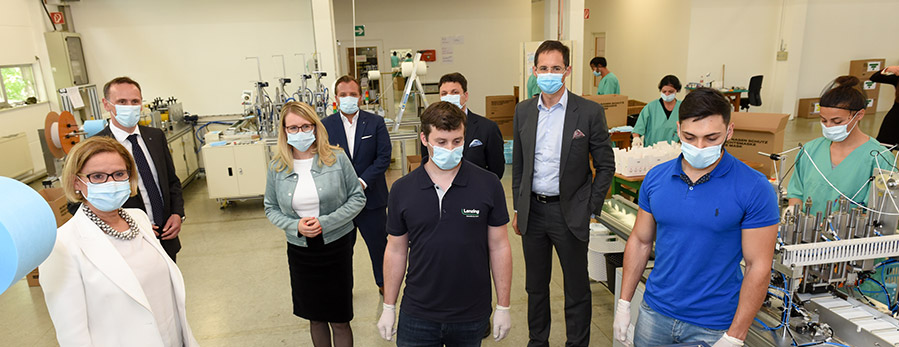
Just two weeks ago the newly-established company Hygiene Austria LP GmbH announced the production of mouth-nose protective masks in Wiener Neudorf within the context of a joint venture of Lenzing AG and Palmers Textil AG. Now the product portfolio will be expanded to include FFP2 masks.

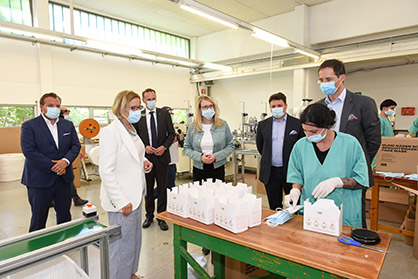
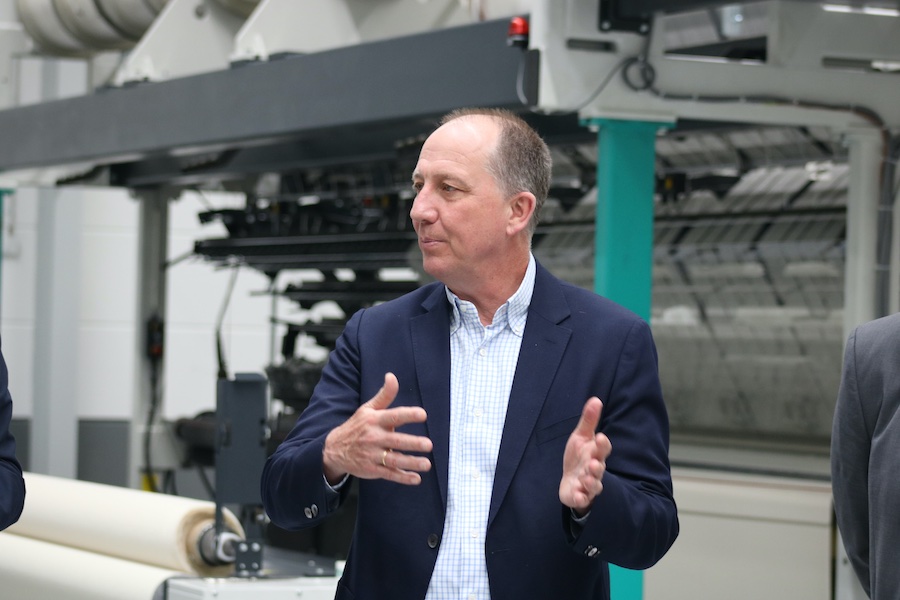
The managing directors of Hygiene Austria gave an initial positive assessment during a plant visit by Margarete Schramböck, Federal Minister for Digital and Economic Affairs, Johanna Mikl-Leitner, Governor of the Federal State of Lower Austria, Jochen Danninger, Lower Austrian State Minister of Economic Affairs and Herbert Janschka, Mayor of Wiener Neudorf.

“The coronavirus crisis was a necessary wake-up call for us to once again focus more on domestic manufacturing. Hygiene Austria identified the need and not only offered quick help by founding the Austrian company, but also strengthened Austria as a business location”, said Minister Margarete Schramböck, pleased with the domestic production of mouth-nose protective masks in Lower Austria. 
(c) 2020 Lenzing
(c) 2020 Lenzing


Enormous media response

“The media response was enormous. Numerous companies contacted us within just a few hours to place orders worth millions of euros”, reported Stefan Doboczky, CEO of Lenzing AG. The machinery serves as the basis for producing 12 million mouth-nose protective masks per month. This capacity will be increased to about 25 million pieces in a further expansion phase. Additional machines were put into production as a result of the good level of demand. “Current delivery time is just a few days, and availability is ensured at all times due to the high level of daily production”, stated Tino Wieser, Member of the Board of Palmers Textil AG.

Expansion of production to include half masks (FFP2 masks)

Hygiene Austria originally commenced operations by producing medical mouth-nose protective face masks (e.g. surgical protective masks). In a further step, an additional machine was acquired to enable the firm to manufacture particle-filtering half masks (FFP2 masks). This machine is currently on its way to the production facility. Accordingly, the production of FFP2 masks will begin in the middle of May.

“The difference between a mouth-nose mask and an FFP2 mask is that the latter can filter particles from the air and is primarily used in the healthcare sector as personal protective equipment. FFP2 masks are subject to legal regulations and have to fulfill special testing criteria”, commented Luca Wieser, Member of the Board of Palmers Textil AG.

Matvei Hutman, Member of the Board of Palmers Textil AG, added: “The mouth-nose masks are for private use and serve as a mechanical barrier. They are designed to protect against infection from droplet transmission through speaking, sneezing and coughing.”


Capacities and additional machinery

Delivery times may deviate due to the different requirements and testing criteria of the masks. “We are striving to quickly increase our capacities and are working full steam ahead to acquire additional machines”, Lenzing AG CEO Stefan Doboczky explained.
(c) 2020 Lenzing
(c) 2020 Lenzing


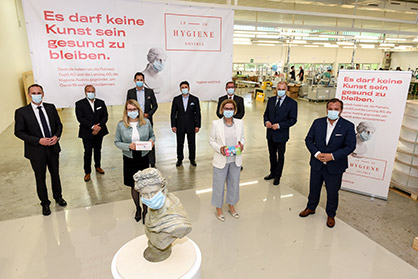
“Naturally it was a very important goal and we are delighted to have succeeded in attracting the production of high-quality protective masks to Lower Austria. On behalf of the Federal State of Lower Austria, we tried very hard in the project implementation phase to ensure that production could already be ramped up at record speed starting in May. Particularly in a time of crisis, the expansion of Hygiene Austria’s product range creates another roughly 100 jobs in Lower Austria and also represents an important contribution to health care services”, emphasized Johanna Mikl-Leitner, Governor of the Federal State of Lower Austria, expressing her satisfaction with this positive development during her visit to the production site.

“At the present time there is an enormous shortage of high-quality medical face masks. I therefore would like to thank the cooperation partners Lenzing AG and Palmers Textil AG for selecting the site in Lower Austria for their face mask production. In this way, Austria could rapidly free itself from its dependence on the global market and set up its own production operations. For this reason, we at the Federal State of Lower Austria provided extensive support to the project from the very beginning”, commented Jochen Danninger, Lower Austrian State Minister of Economic Affairs.

Two experienced companies joined together to set up an innovative company in spite of difficult economic conditions triggered by the coronavirus crisis and to thus give a resounding and trailblazing go-ahead to the new “Eco-Park” business park. “Nothing better or more important could have happened to Wiener Neudorf in this time and in the current situation”, said Mayor Herbert Janschka, proud of the successful development of Hygiene Austria and the related high added value to society generated in his municipality.
More News from TEXDATA International

#ITM 2026

ITM 2026: The new geography of textile production

New production hubs are emerging across North Africa and Central Asia, while Türkiye is accelerating its transformation toward higher-value, technology-driven and more sustainable textile manufacturing.

#Research & Development

“Production is a product”

From technical textiles and AI-driven robotics to the limitations of textile circularity: Professor Dr Thomas Gries looks back on more than two decades of development at ITA Aachen. In the interview, he explains why production technology remains a decisive success factor, discusses international collaborations and innovation ecosystems, and shares his views on the transformation of production landscapes and the challenges facing an increasingly regulated industry.

#Knitting & Hosiery

“We need to move away from the price trap and return to a value-driven mindset.”

With its new Textile Innovation Center, KARL MAYER is sending a strong signal for innovation, collaboration, and the future of textile applications. In this interview, Karl Josef Mayer discusses new opportunities in warp knitting, the processing of staple fibres, recycling, the changing role of machinery manufacturers, and why the textile industry must once again focus more strongly on the value of textiles. by Oliver Schmidt

#Associations

“Innovation, resilience and international experience remain the great strengths of the Swiss textile machinery industry”

Geopolitical uncertainty, growing competitive pressure from China, new free trade agreements and the shift towards a circular economy are currently reshaping the global textile industry. In this interview, Cornelia Buchwalder discusses the current mood within the Swiss textile machinery sector, the industry’s distinctive innovative strength, new market opportunities in India and Asia, and the technological trends that could shape the upcoming trade fair cycle leading up to ITMA 2027.

More News on Yarn & Fiber

#Man-Made Fibers

Ministry of Industry Delegation visits NatureWorks’ second global manufacturing site at Nakhon Sawan Biocomplex

NatureWorks Asia Pacific Limited welcomed a high-level delegation led by Mr. Varawut Silpa-archa, Minister of Industry, to its manufacturing site at the Nakhon Sawan Biocomplex (NBC). The visit follows the successful inauguration of the site on April 29, 2026, and highlights the role of public-private collaboration in advancing Thailand’s sustainable industrial development and bioeconomy ambitions.

#Man-Made Fibers

Sorona® and WGSN announce top bio-based material trends of 2027

Sorona®, the partially bio-based polymer from Covation Biomaterials (CovationBio™), and global trend forecasting authority WGSN today release the material trends shaping the textile industry through 2027 and beyond following a comprehensive examination of bio-based functional fiber applications and global data.

#Sustainability

The first widely accessible Life Cycle Assessment study for cashmere production published by Textile Exchange.

Crucial new data to better understand, measure, and address the impacts of cashmere production has been made available to the fashion, textile, and apparel industry through a new Life Cycle Assessment (LCA) published by Textile Exchange.

#Yarn & Fiber

R-Evenge chooses Q-NOVA® yarn by Fulgar for its line of technical socks dedicated to wellness

Q-NOVA®, Fulgar’s sustainable polyamide 6.6 yarn, has been selected by R-Evenge for the development of its collection of technical socks dedicated to wellness, fitness, and water-based activities.

Latest News

#Recycling / Circular Economy

Indorama Ventures advances circularity tthrough PETValue Philippines' “Zero Waste to Landfill Partnership” with Republic Cement

Indorama Ventures Public Company Limited, a global sustainable chemical company, is advancing the circular economy through a new Zero Waste to Landfill initiative at its recycling site PETValue Philippines, further demonstrating how collaboration across industries can maximize resource efficiency and reduce waste.

#Associations

IVGT membership: expertise that pays off

For energy-intensive textile companies, government compensation mechanisms are an important economic factor. The IVGT successfully supports its member companies in applying for state aid and thereby regularly contributes to significant financial relief.

#Research & Development

Networking Day 2026: Industry stakeholders unite around textile recycling

In 2026, the Industry Research Group (IRG) Polymer Recycling once again brought together some of the key stakeholders in textile recycling for its annual Networking Day. This year, the event took place at EREMA’s premises in Ansfelden, Austria. It brought together key players from across the textile recycling value chain for a day of structured exchange and in-depth discussions.

#Knitting & Hosiery

The new RDJ 7/3 defines the design footprint of modern athletic shoes

Stylish, functional, and efficient to produce – spacer fabrics are the all-arounders among textile materials. These versatile fabrics are particularly in demand in the sports and casual footwear sector, as they combine comfort, breathability, and design freedom. At the same time, this industry is trend-driven, dynamic, and price-sensitive like few others. Innovations are therefore a decisive factor for success. With the RDJ 7/3, KARL MAYER offers a solution specifically tailored to these requirements. The particular strength of the new double raschel machine: its exceptional flexibility, thanks to its three jacquard bars.

TOP