[pageLogInLogOut]

#Research & Development

From smart jackets to laser technology: Mona Neubaur explores Textile Factory 7.0
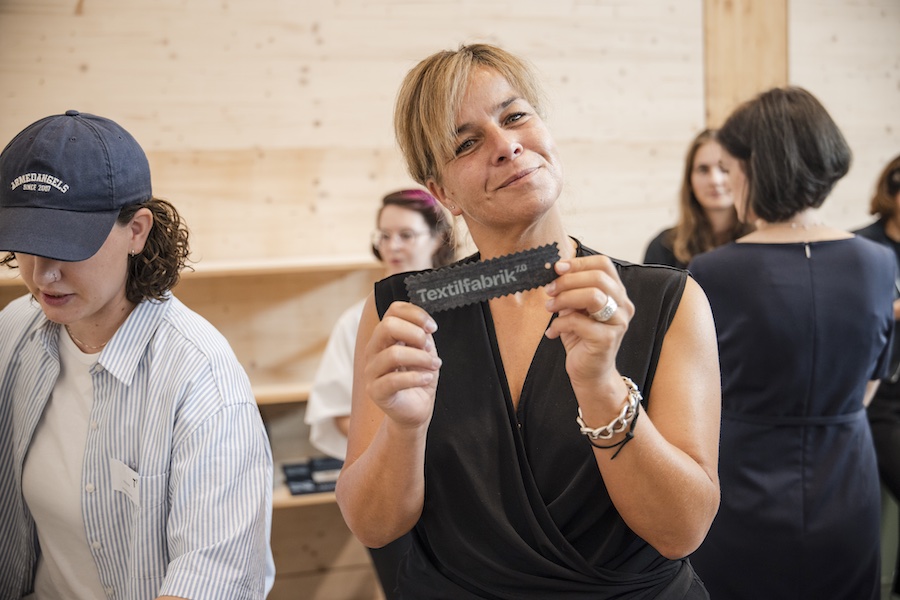
North Rhine-Westphalia’s Minister for Economic Affairs and Climate Action, Mona Neubaur, presents the Textilfabrik 7.0 label during her visit to Mönchengladbach © Tomas Rodriguez
As part of her summer tour, North Rhine-Westphalia’s Minister for Economic Affairs and Climate Action, Mona Neubaur, visited Textilfabrik 7.0 in Mönchengladbach to experience the project’s innovations first-hand. Under the motto “smart and clean”, the visit focused on innovative technologies and sustainable alternatives for textile production - from smart jackets to the decolourisation of textiles using fungal cultures.

Researchers from the Research Institute for Textile and Clothing (FTB) of the Hochschule Niederrhein and the Institut für Textiltechnik (ITA) of RWTH Aachen University presented Minister Neubaur, Mönchengladbach Mayor Felix Heinrichs and representatives of state politics with innovative technologies and processes developed as part of T7.

Textilfabrik 7.0 is being established in the Monforts Quartier as a real-world laboratory where innovative technologies and production processes are developed, tested under real-world conditions and further advanced for industrial application. The goal is to foster economically viable, CO₂-neutral and circular textile production in the Rhenish Mining Area. The halls of the T7-Factory in the Monforts Quartier are currently being equipped with machinery. The innovations already developed were presented to the visitors at the Technology Centre for Textile Finishing at Hochschule Niederrhein.

Smart: Making textile production intelligent and digital

Under the motto “smart”, the Minister explored a range of innovative technologies. She tested one of the project‘s smart jackets which recorded her movements and body data and visualised them via an app. Integrating sensors into textiles opens up new fields of application, particularly in the healthcare sector. Smart jackets, for example, can be used during physiotherapy exercises to digitally track movement patterns and provide targeted feedback.

At an embroidery machine, the visitors were also shown how conductive yarn can be integrated into textile structures. AI applications were demonstrated as well: artificial intelligence can be used to analyse natural fibres and, for example, determine material compositions more quickly and accurately. Project staff also presented digital manufacturing processes such as laser printing.

The Rhenish Mining Area is already shaping the future with innovative and sustainable solutions for industry and the people who live and work here. Digital applications, artificial intelligence and sustainable processes are not merely being demonstrated here; they are being further developed and tested. The focus is on products that are closely aligned with users’ needs. When smart jackets made from intelligent textile fabrics measure vital data, they can provide tangible support to help people stay healthy or regain their health. This benefits not only people, but also creates tangible opportunities for a competitive and sustainable textile industry,” said Mona Neubaur, Minister for Economic Affairs, Industry, Climate Action and Energy of the State of North Rhine-Westphalia.

Clean: Sustainable alternatives for textile processes

Under the motto “clean”, the project partners presented approaches for dyeing textiles using natural dyes, for example from tea or pomegranate peels. Alternative processes for decolourising and bleaching textiles are also being developed. Visitors were shown how a pair of jeans can be decolourised using either laser technology or fungal cultures. The resulting substance can even be used to produce vegan leather alternatives. The visitors also had the opportunity to view a set-up for detecting fibrous microplastics in wastewater from washing machines.

Mönchengladbach Mayor Felix Heinrichs said: “Today’s tour impressively demonstrated just how much textile expertise and innovative strength exists in Mönchengladbach and the surrounding region. A wide range of technologies and applications can already be experienced and tested here in practice. This highlights the potential that lies in bringing together science, industry and Mönchengladbach’s long-standing textile tradition, and the opportunities this creates for sustainable growth and prosperity in the future.
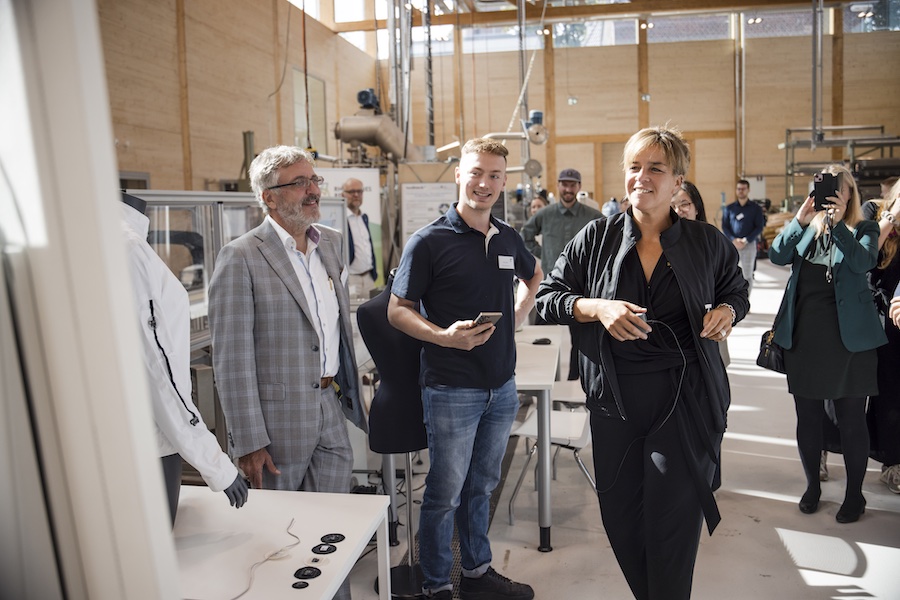
Testing a smart jacket as part of the Textile Factory 7.0 project with Mona Neubaur © Tomas Rodriguez<br />
Testing a smart jacket as part of the Textile Factory 7.0 project with Mona Neubaur © Tomas Rodriguez


A clear shared vision for the future

The visit clearly showed: innovation does not solely happen in the laboratory. The crucial step is translating research into practical applications. This is what the researchers at Textilfabrik 7.0 are doing.

With its four core areas - On-Demand Manufacturing, MicroFactory Engineering, Digital Textiles and Biosphere - T7 combines technological innovation with sustainability and creates a platform for the textile production of tomorrow. At its heart is one shared question: How can textile production become smarter, cleaner and economically viable at the same time?

Prof. Dr. Rabe (Hochschule Niederrhein) and Prof. Dr. Gries (RWTH Aachen University) emphasised to the Minister that the motto “smart and clean” is not an abstract vision. It can already be experienced and tested in practice today and is ready for application.

More News from Institut für Textiltechnik of RWTH Aachen University (ITA)

#Research & Development

Networking Day 2026: Industry stakeholders unite around textile recycling

In 2026, the Industry Research Group (IRG) Polymer Recycling once again brought together some of the key stakeholders in textile recycling for its annual Networking Day. This year, the event took place at EREMA’s premises in Ansfelden, Austria. It brought together key players from across the textile recycling value chain for a day of structured exchange and in-depth discussions.

#Research & Development

2026 general meeting of the Friends and Supporters of RWTH Aachen at ITA

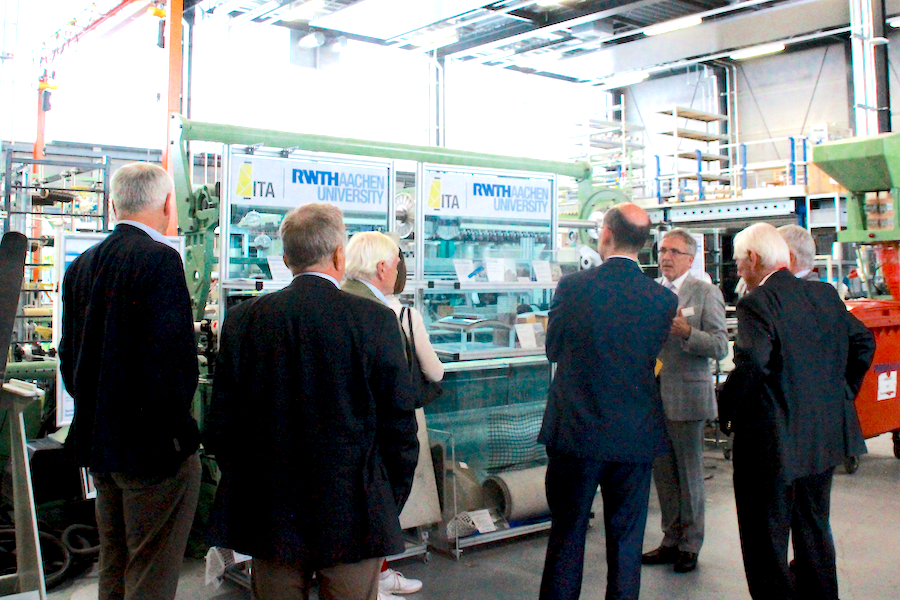
The Friends and Supporters of RWTH Aachen e. V. (proRWTH) looked back on a successful year of support at their 2026 general meeting. The meeting took place at Institut für Textiltechnik (ITA) of RWTH Aachen and was combined with a joint session of the Executive Board and the Administrative Board. Before the general meeting began, participants were given a guided tour of ITA, providing them with fascinating insights into current research and development topics in textile engineering.

#Research & Development

TERNAfil wins first place at PitchMiUp Night 2026 in Minden

The RWTH spin-off TERNAfil has developed MAXCarbon, a new high-performance hybrid fibre that combines the mechanical performance of carbon with the temperature and corrosion resistance of ceramic materials. For this development, TERNAfil was awarded first prize at the PitchMiUp Night in Minden on 21 May 2026.

#Research & Development

Carbon-ceramic hybrid fibre proves its worth – NRW Minister for Science Mona Neubaur congratulates ITA start-up TERNAfil

MAXCarbon technology, a novel carbon-ceramic hybrid fibre developed by ITA spin-off TERNAfil, secured third place at the HIGH-TECH.NRW Demo Day on the TÜV NORD campus in Essen. The technology combines the strength of carbon fibres with the temperature and corrosion resistance of ceramic materials. Mona Neubaur, Minister for Science in North Rhine-Westphalia, congratulated the team on their success and on winning prize money of 4,000 euros.

More News on Research & Development

#Research & Development

MELANGE starts with a co-creative design workshop at Aalto University to shape the visual identity of this new project transforming colouration in textiles

Over the next three years, MELANGE will lower the environmental impact of interior textile production by moving colour design to the beginning of the manufacturing process. This Horizon Europe project officially started on 1 August 2026, and will be publicly launched on 27 August 2026.

#Research & Development

Outdoor Industry Association completes Clean Heat CoLab initiative

The Outdoor Industry Association (OIA) has completed its multi-year Clean Heat CoLab initiative, bringing together outdoor brands and technology experts to accelerate the adoption of electrified process heating in textile manufacturing. The collaboration focused on reducing emissions from thermal processes such as dyeing, washing and finishing, which remain among the most carbon-intensive stages of textile production.

#Research & Development

Europe is committed to recycling end-of-life wind turbine blades

Starting in 2026, Europe’s wind energy industry has committed itself to ensuring that wind turbine blades do not end up in landfills once they reach the end of their service life. The EU-funded research project REWIND is exploring ways to reuse this composite waste. The German Institutes of Textile and Fiber Research Denkendorf (DITF) are one of 13 project partners from seven countries.

#Research & Development

ADD-ITC 2026 publishes preliminary conference program

The organizers of the Aachen-Dresden-Denkendorf International Textile Conference (ADD-ITC) 2026 have released the preliminary program for this year's event, which will take place on November 26–27, 2026, at the International Congress Center Dresden. The conference is expected to attract between 500 and 700 participants from industry, research, and academia.

Latest News

#CINTE Techtextil China 2026

Cinte Techtextil China 2026 has opened today, bringing global innovations and resources to Shanghai

As Asia’s premier platform catering to the evolving needs in technical textiles and nonwovens, Cinte Techtextil China has opened today at the Shanghai New International Expo Centre, gathering over 300 exhibitors from 15 countries and regions. Across Halls W3 to W5, this edition will create chances for fast-growing sectors and emerging trends – such as Mobiltech, Medtech & Protech, Indutech and more. The curated zones, pavilions, and fringe programme are designed to better connect exhibitors with targeted buyers from across China, Asia-Pacific, and further afield. Meanwhile, the Association Village will gather international industry associations to foster even more global collaboration.

#Textiles & Apparel / Garment

Texworld Apparel Sourcing Paris opens with focus on AI, circularity and new sourcing regions

More than 1,000 exhibitors from around the world are gathering at Paris-Le Bourget as Texworld Apparel Sourcing Paris opens its doors from August 31 to September 2. With around 500 textile manufacturers and a similar number of apparel and accessories suppliers, the trade fair reflects the ongoing transformation of global sourcing and the growing diversification of supply regions.

#Raw Materials

Brazil sets new cotton export record and consolidates global leadership

Brazil ended the 2025/26 commercial year with a new record, consolidating its position as the world’s largest cotton exporter. Between August 2025 and July 2026, the country shipped 3,373,941 tonnes of the fiber, 19% more than in the previous cycle, and reached record revenue of US$5.3 billion. The result represents a milestone in Brazil’s expansion in the international market and reinforces the country’s role as a strategic supplier to the global textile industry.

#Raw Materials

Better Cotton Initiative partners with Avalo in AI plant breeding for climate-resilient cotton

The Better Cotton Initiative (BCI) has partnered with agriculture solutions company Avalo, whose platform accelerates the speed at which plants with key resiliency traits may be developed.

TOP