[pageLogInLogOut]

#ITMA 2019

Environmentally-aware and efficient: DORNIER to present its newest “Green Machines” and an expanded service offering at the ITMA
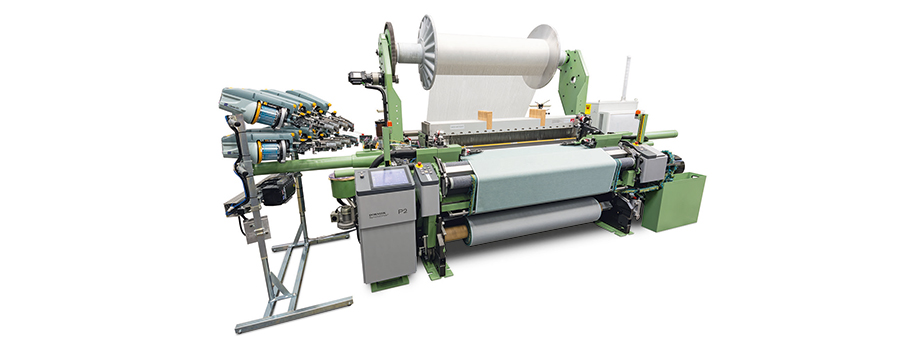
A milestone in rapier weaving technology: The new P2 from DORNIER give modern weavers the exibility demanded by rapidly changing markets DORNIER rapier weaving machine P2, Type TKN 8/S G24 with a nominal width of 190 cm (c) 2019 Lindauer DORNIER
The modern weaver faces many challenges: Digitalization is advancing deeper and deeper into the fabric of the production chain, sustainability requirements are growing more demanding, new employees and experienced technicians are thin on the ground. Flexibility in manufacturing is turning into an existential question. At the upcoming ITMA, DORNIER will present answers to these trends – in the form of the latest weaving machines and weaving solutions.

When the subject of sustainability is raised, businesses are often called upon to take the lead. Lindauer DORNIER is doing precisely that, as enshrined in one of our seven guiding principles: “We strive to design and manufacture our products so that they are as safe and environmentally compatible as possible.” This commitment was formulated by the company founder, Peter Dornier over three decades ago.

Our presence at the upcoming ITMA exhibition – the International Textile Machinery Exhibition – is further proof that sustaina- bility is not just a passing fashion at DORNIER, but rather the foundation and result of a long-term corporate strategy. At this event, under the banner theme of “The Green Machine” we will present the latest machines and lines, “Made in Germany” for the sustainable, efficient manufacture of clothing, home textiles and technical fabrics and flexible, economical production of high-quality composite semi-finished materials.

World premiere of the new rapier weaving machine P2

Highlights include the new rapier weaving machine P2, which will be presented in its standard configuration for the first time in Barcelona. It combines the strengths of the P1 All-rounder with many innovations to equip the weaver optimally for the future. “We didn’t reinvent rapier weaving, but we improved every major aspect of the process”, says Thomas Laukamp, DORNIER’s Head of Advanced Technology Development Weaving Machines. Accordingly, with improved shed geometry and a more rigid frame, greater productivity, maintenance-free operation and optimized positive center transfer movement, the P2 rapier weaving machine offers the highest flexibility and process reliability available on the world market.

The new machine structure with clearly defined primary and auxiliary modules represents a further advance. “The modular design and clear interfaces between the machine modules make conversion and expansion work simpler”, explains Laukamp. He adds that this translates to greater investment security for the weaver, because the P2 can easily be adapted for proces- sing different yarns for clothing, domestic and technical textiles as well as high-quality composite semi-finished materials. So the weaver can respond faster to unpredictable market developments. “Who knows what orders weavers will have to deal with in five years” said Laukamp, who sees DORNIER as a solution provider.

Besides, the P2 was the perfect example of a technology approach conceived for total sustainability: Not only did the ultrafine precision fabrics it produced keep air and water clean or lter exhaust gases, the machine itself was designed for sustainability: “The resource-saving operating principle and long service life of the P2 make it a truly ‘Green Machine’”, says Head of Advanced Technology Development Laukamp.
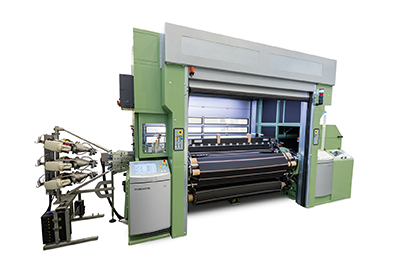


From wool to glass in one weaving workshop: The future-oriented encapsulated air-jet weaving machine brings different, individually controllable climate zones into the production workshop for the  rst time<br />
DORNIER air-jet weaving machine, Type AWS 6/S G16 with a nominal width of 210 cm Nennbreite (c) 2019 Lindauer DORNIER
From wool to glass in one weaving workshop: The future-oriented encapsulated air-jet weaving machine brings different, individually controllable climate zones into the production workshop for the rst time DORNIER air-jet weaving machine, Type AWS 6/S G16 with a nominal width of 210 cm Nennbreite (c) 2019 Lindauer DORNIER


 Future-oriented: The encapsulated air-jet weaving machine

On the subject of air-jet weaving, DORNIER will exhibit an encapsulated air-jet weaving machine. This solution is designed to bring different, individually controllable climate zones into the production workshop for the first time: This means that each weaving machine can be run in its own climate, adjusted to create the ideal conditions for the respective manufacturing process, regardless of the heat and humidity in the rest of the production workshop.

This approach too makes for the greatest possible flexibility in accepting and completing orders, since it is then possible to process different fibers ranging from wool to glass simultaneously in the same workshop. The lower levels of noise, dirt and mechanical vibration that prevail as a result of the encapsulation also make the fabric manufacturing workstations safer and more comfortable - a convincing argument for recruiting young employees and experienced technicians.

24/7 online shop for original parts: The new myDoX® customer portal

The new myDoX® customer portal will also be presented at the ITMA. Based on the latest database technology, the portal adds digital order management to the personalized technical, installation and maintenance service for which DORNIER is known. It will provide an online shop with permanent availability for original parts (DoXPOS – Parts Order System) for all product lines. Remote maintenance and networking of weaving machines – to improve run characteristics, for example – will also be possible in future via myDoX®.

More ITMA highlights from DORNIER: The new color selector and feed system DORNIER DisCoS (DCS) for rapier weaving machines, enabling more efficient processing of up to eight colors; the DORNIER Weft Saver (DWS) weft saving device which enables weaving without a left catch selvedge, reducing weft; the double weft rapier heads DORNIER DoPPIO with free color transfer and parallel weft insertion.
More News from Lindauer DORNIER GmbH

#Weaving

Lindauer Dornier announces leadership transition in weaving machine business

After more than ten successful years at Lindauer DORNIER GmbH, Mr Wolfgang Schöffl will leave the family-owned company at the end of the year to enter well-deserved retirement.

#ITMA Asia + CITME Singapore 2025

DORNIER celebrates its anniversary at ITMA Asia + CITME

To mark its 75th anniversary, machine and plant manufacturer Lindauer DORNIER will be presenting the latest developments in its rapier and air-jet weaving machines at ITMA Asia + CITME in Singapore (Hall 2, Stand B401) from 28 to 31 October 2025. The focus will be on energy-efficient weaving technologies, new IoT solutions for networked textile production and systems for the series production of modern fibre composite components.

#Weaving

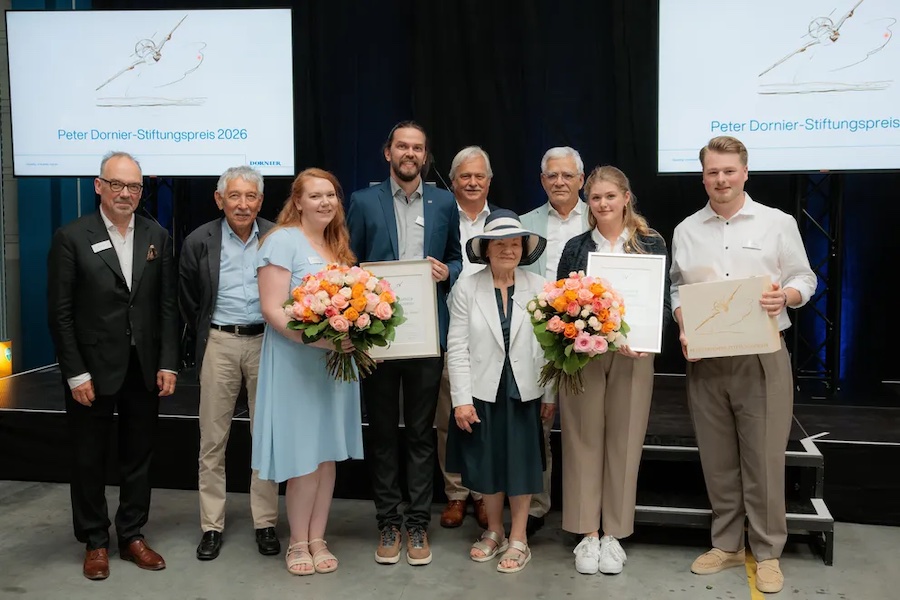
From the Venus flytrap to foldable aircraft wings: Peter Dornier Foundation Prize 2025 honours bionic research on 3D weaving technology

Long wings with foldable tips have the potential to reduce aircraft fuel consumption and make aviation more sustainable. An interdisciplinary research team has now developed a new solution based on the Venus flytrap: Freely movable wingtips made of fibre composites which are produced using innovative 3D weaving technology. For this pioneering combination of textile technology, aviation and bionics, researchers Patrick Meyer (TU Braunschweig) and Michael Vorhof (TU Dresden) were awarded the Peter Dornier Foundation Prize 2025 in mid-July.

#Weaving

Pattern-controlled “pic-a-pic” setting of rapier release timing on right-hand side

DORNIER PIRO enables the operator to set the timing of the rapier release on the right-hand side of the machine “pic-a-pic” and pattern-controlled. For applications with weft yarns of different fineness or elasticity, the optimum timing can be set for each weft channel. This offers great potential for reducing weft waste on the right-hand side.

More News on ITMA 2019

Latest News

#People

Happy Holidays!

Dear reader, the year 2025 is drawing to a close. We are entering what we hope will be a peaceful holiday season, spending time with our families and taking a moment to pause and reflect. We hope we have been able to support you once again this year with relevant news and articles, and we look forward to surprising you with many innovations in the coming year. Enjoy the festive season, stay healthy, and we wish you a happy and joyful holiday season.

#Heimtextil 2026

Texpertise Focus AI: Messe Frankfurt puts Artificial Intelligence centre stage at its international textile and apparel trade fairs

Under the banner 'Texpertise Focus AI, Messe Frankfurt will place a strong emphasis on Artificial Intelligence (AI) across its international textile and apparel trade fairs from 2026 onwards, setting a future-shaping signal for the industry. The initiative highlights the responsible use of AI along the entire textile value chain, from fibre production to the point of sale. The programme will launch at Heimtextil in Frankfurt in January 2026.

#Technical Textiles

Autoneum and Polestar set new benchmarks for passenger experience and sustainability

As the global market leader in sustainable acoustic and thermal management, Autoneum is a key supplier of interior and exterior components for the highly anticipated Polestar 5 model. The successful collaboration between Autoneum and Polestar marks a significant milestone in sustainable automotive engineering: the electric grand tourer sports car features several innovations in lightweight, fully recyclable polyester-based components that ensure a superior driving experience. Polestar 5 was revealed at the IAA Mobility 2025 in Munich and is available in 24 markets.

#Natural Fibers

Cashmere producers stress the importance of The Good Cashmere Standard®

At the invitation of the Aid by Trade Foundation (AbTF), over 70 experts from the cashmere production and supply chain, as well as other specialists, met at the GCS Unit Meeting in Shanghai, China to discuss the progress and new objectives of The Good Cashmere Standard (GCS). The meeting focused on implementation and verification of the standard, important aspects of animal welfare and the importance of the standard in the global textile market.

TOP