[pageLogInLogOut]

#Yarn & Fiber

Covestro and Genomatica produce important chemical raw material using biotechnology
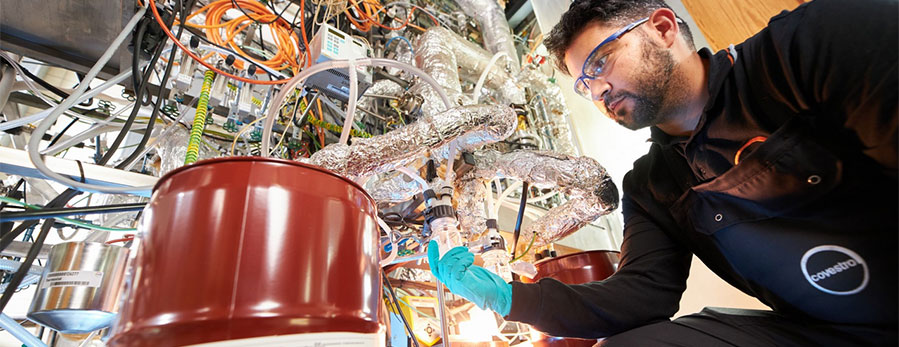
Covestro employee Mario Lopes in the pilot plant where Covestro produced significant quantities of the bio-based raw material HMDA for the first time. © Covestro
Breakthrough for HMDA, widely-used ingredient, paves the way for more sustainable coatings, apparel, adhesives and plastics

Material manufacturer Covestro and biotechnology pioneer Genomatica announced an important industry milestone to advance sustainability resulting from their partnership. The two companies have teamed to be the first to successfully produce significant volumes of a plant-based version of the chemical raw material HMDA (hexamethylene diamine).
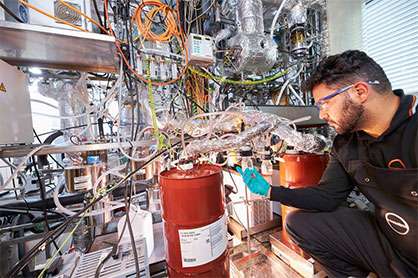
Covestro and Genomatica have teamed to be the first to successfully produce significant volumes of a plant-based version of the chemical raw material HMDA (hexamethylenediamine). © Covestro


HMDA, with a worldwide market of 2 million tons per year, is a key ingredient for a widely-used type of nylon (nylon-6,6), as well as an important component for raw materials for coatings and adhesives from Covestro. Up to now, HMDA has been manufactured from fossil feedstocks. Coatings and adhesives can be produced more sustainably thanks to bio-based HMDA, made from renewable feedstocks. Areas of application include automotive, construction, furniture, textiles and fibers.

Teams from Genomatica and Covestro have been working together to develop a commercial process technology for bio-based HMDA. The companies expect to produce ton quantities of high-quality material over the course of multiple production campaigns. Both partners are already processing and testing material from their initial production campaigns, and the resulting bio-HMDA is of high purity and quality. The companies plan to advance the program to full commercial scale, and Covestro has secured an option from Genomatica to license the resulting integrated GENO™ HMD process technology for commercial production.
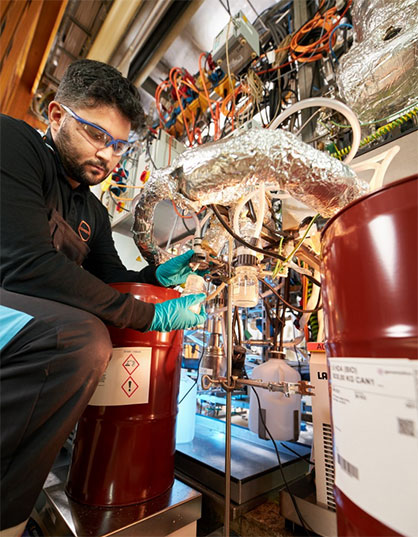
The breakthrough for the production of a biobased HMDA paves the way for more sustainable coatings, apparel, adhesives and plastics. © Covestro


Genomatica develops widely-used ingredients and materials using biotechnology and renewable, plant-based feedstocks rather than fossil feedstocks and their associated extractive processing methods. These materials are used by brands and their suppliers in popular goods ranging from apparel to cosmetics. Covestro brings extensive know-how in the field of research, chemical process technology and application development. The cooperation for the development of alternative raw materials based on biotechnology advances Covestro’s global program to achieve the circular economy.

Covestro established an R&D Competence Center for biotechnology to further strengthen its overall know-how in this field. Bio-based raw materials and biotechnology have also been identified as one of five focus areas at Covestro´s Venture Capital (COVeC) approach.

"The increased use of alternative raw materials, including the utilization of biotechnology, is an important pillar of our approach to fully embrace the circular economy and help make it a global guiding principle," says Covestro CEO Dr. Markus Steilemann. "Our program with Genomatica, which complements our internal R&D, is one of our largest external funding of biotechnology R&D to date, and underscores both the field’s importance to Covestro and the results it can deliver."

Replacing fossil-based raw materials

"This program is of great importance to us, because markets are increasingly asking for more environmentally compliant products based on renewable raw materials, which are just as powerful as their fossil-based alternatives," says Dr. Thorsten Dreier, global head of the Covestro business entity Coatings & Adhesives. "We can reduce this dependence on fossil feedstocks with innovative technology and our partnership. With a purely plant-based HMDA, we can significantly advance our corporate objective of CO2-neutral production."

A sample of the bio-based HMDA. The raw material is of a high quality and purity. © Covestro


"Genomatica is committed to delivering a portfolio of sustainable materials that can help any brand reduce the carbon footprint of its products while maintaining the performance customers count on," said Christophe Schilling, Genomatica CEO. "Covestro is a valued partner that is playing a leading role in improving the environmental impact of many of today’s most prevalent materials. Together, we are taking an important step to reduce greenhouse gas emissions for a broad range of products we use in daily life."



More News from Covestro AG

#Technical Textiles

Covestro showcases monomaterial concept in autonomous SUE People Mover

UE | STUDIOS has unveiled the fully autonomous electric minibus “Self-driving Urban E-Shuttle” (SUE), placing strong emphasis on sustainable material design. Developed within a project funded by the Federal Ministry for Economic Affairs and Energy (BMWE) and the European Union, the vehicle will begin public road testing this year. At the core of the concept is the consistent use of recyclable monomaterials to improve circularity at end of life.

#Textile chemistry

Covestro and Heraeus Precious Metals collaborate to enable safer, more sustainable antimicrobial textile coatings

Laboratory tests reveal that AGXX antimicrobial surface technology from Heraeus Precious Metals is fully compatible with Impranil® PU dispersions which are part of the waterborne INSQIN® textile coating technology from Covestro, paving the way for more sustainable antimicrobial textile coatings. This discovery comes at a key moment for the textile coatings industry. As the sharing economy continues to grow, more people are coming into regular contact with high-use surfaces, creating ideal conditions for bacteria, viruses, and other microorganisms to thrive.

#Textile chemistry

Covestro celebrates decade of innovation and sustainable growth

Covestro celebrates its 10-year anniversary today. Since its carve-out from Bayer in 2015, the company has developed into a global leader in high-performance polymer materials and a pioneer in circular economy solutions. With a strong focus on innovation and sustainability, Covestro’s materials are now embedded in countless applications worldwide – from mobility and construction to electronics, healthcare, and consumer goods.

#Textile chemistry

Covestro extends contract with CTO Dr. Thorsten Dreier ahead of schedule until 2031

Dr. Thorsten Dreier will remain Chief Technology Officer of Covestro for a further five years. The Supervisory Board has extended his contract, which runs until June 2026, ahead of schedule from July 1, 2026 to June 30, 2031.

More News on Yarn & Fiber

#Man-Made Fibers

Lenzing advances its transformation: Higher EBITDA, stronger free cash flow and more than EUR 200 million in cost savings

The business performance of the Lenzing Group in 2025 was affected particularly in the second half of the year by external factors such as international tariff measures, subdued demand and declining market prices. As a result, revenue decreased slightly by 2.3 percent to EUR 2.6 billion, primarily due to lower fiber sales volumes and lower prices for fibers and pulp, which were further negatively impacted by currency developments. Nevertheless, thanks to the comprehensive Performance Program, Lenzing was able to improve its operating performance and key financial indicators compared with the previous year.

#Man-Made Fibers

“Lead Transformation – Generate Impact”: Lenzing presents its 2025 Annual and Sustainability Report

The Lenzing Group has published its 2025 Annual and Sustainability Report, entitled LEAD TRANSFORMATION – GENERATE IMPACT. The report shows how Lenzing is actively shaping change in the industry and making a lasting impact: economically, ecologically, and socially. Lenzing is consistently focused on the future: with targeted investments in premiumization, excellence, innovation, and sustainability, the company is strengthening its position as a leading provider of sustainable, cellulose-based premium fibers. The combined report is available in digital format.

#Raw Materials

Lenzing Group positions bio‑based materials as a strategic asset for Europe’s economic security

The Lenzing Group, a leading supplier of regenerated cellulose fibers for the textile and nonwovens industries, hosted a high‑level roundtable in Brussels to discuss how bio‑based materials can strengthen Europe’s economic security and support the shift toward a fossil‑free future. Organized in cooperation with Euractiv, the event brought together representatives of the European Commission, the UK Mission to the EU, academia, civil society, and industry.

#Yarn & Fiber

Teijin Carbon strengthens high‑end sports offering with advanced prepreg and resin technologies for next‑generation bicycle performance

High‑end bicycle manufacturers are entering a new era in which modern frames and components must be lighter, stiffer, tougher and more sustainable – all while enabling fast, repeatable and cost‑efficient production. To support this shift, Teijin Carbon is expanding its portfolio of advanced prepreg systems developed specifically for premium road, gravel and mountain bike applications.

Latest News

#Techtextil 2026

Gebr. Otto highlights versatility at Techtextil with regional supply chains, yarn innovations and new hygiene segment

At this year’s Techtextil, Gebr. Otto places its versatility at the center of its presentation. In addition to spinning, twisting and dyeing – traditionally focused on fine cotton – textile processors will also find a competent development partner for technical specialty solutions. The Dietenheim-based spinning mill has now built up a decade of experience in the production of technical yarns, particularly from aramids. A new hygiene segment has also been established, where yarns for medical and hygiene products are currently being produced. In the future, this department could also develop textile products for the food sector. Gebr. Otto will once again be present at the BW-i joint stand, booth D81, hall 12.1. What is wound onto the spool is determined by the customer: Gebr. Otto develops according to specific customer requirements and transforms its own ideas into yarn innovations.

#Europe

Commission presents proposal for EU Inc. - unlocking the full potential of the Single Market for Europe's entrepreneurs

Today, the European Commission presented its proposal for EU Inc., a new single set of corporate rules, building the cornerstone and starting point for the EU's 28th regime. EU Inc. is an optional, digital-by-default European corporate framework. It will make it easier for businesses to start, operate and grow across the EU – incentivising them to stay in Europe, and encourage those who once looked elsewhere to return.

#Man-Made Fibers

OnceMore® from Södra brings end-to-end traceability for circular Man-made Cellulosic Fibers (MMCF) using TextileGenesis

OnceMore® from Södra, the world’s first large-scale process for recycling blended fabrics into high‐quality dissolving pulp, will begin using TextileGenesis, a Lectra company, to strengthen traceability from raw material to retail across the value chain. OnceMore® produces dissolving pulp made from blended textile waste and wood sourced from responsibly managed Swedish forests. By integrating TextileGenesis, OnceMore® supports the growing need for verified data and secure, transparent tracking throughout increasingly complex supply chain.

#Sustainability

Experts publish APAC policy priorities

Cascale today announced the publication of its APAC Policy Priorities Paper, developed by the Asia-Pacific (APAC) Policy Member Expert Team (MET) to identify key regional sustainability challenges and provide practical, aligned recommendations for policymakers and industry stakeholders across Asia-Pacific.

TOP