[pageLogInLogOut]

#Sustainability

Pioneering open-source framework shows how early innovation drives a just and net-zero fashion future

Since 2015, its flagship initiative, the Global Change Award, has supported 56 teams from 23 countries with 10 million euros in grants, paving the way for circular and decarbonised business models across the textile value chain.
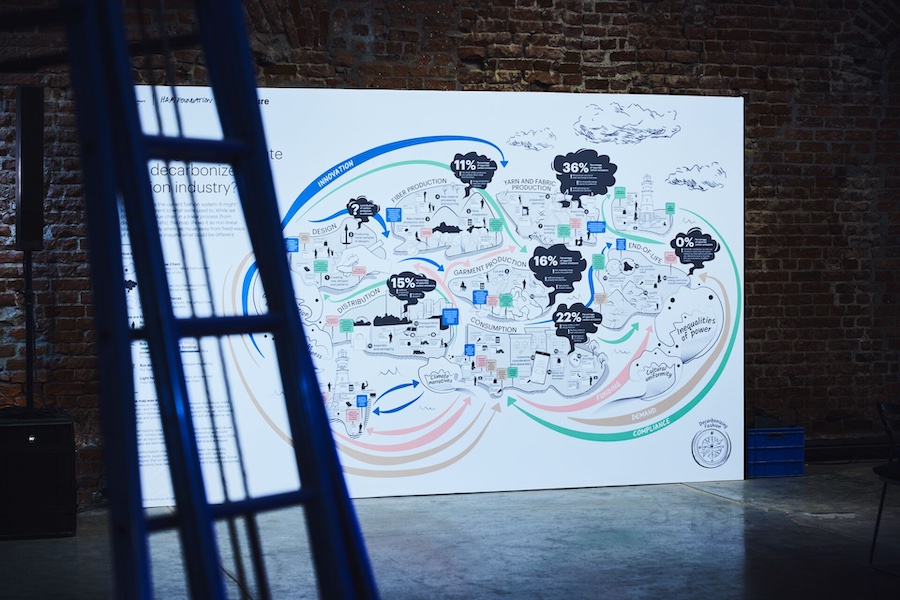
The non-profit H&M Foundation, in collaboration with Accenture, has unveiled From Signals to Systems Change, an insight report calling on the fashion industry to rethink its role in transformation. At its core is the Reimagined System Map, a pioneering open-source framework that visualises how early-stage innovation could drive a just and net-zero textile future.

Grounded in insights from innovation, philanthropy and systems thinking, From Signals to Systems Change explores how early ideas can become a catalyst for a just and decarbonised textile future. It maps the key forces reshaping fashion, from AI and geopolitics to resource scarcity and biodiversity loss, and calls on industry leaders, investors and policymakers to recognise their place in an interconnected system.

“By looking at the fashion system as it is today and reimagining what it could become, we visualised how scaling early-stage innovations might ripple across the industry“, says Annie Lindmark, Programme Director, Innovation at the H&M Foundation. Our hope is that different stakeholders will explore the System Map and ask themselves where in the system they have the most power to influence change, and in doing so, ignite new sparks of transformation.”


Annie Lindmark, Programme Director Innovation © 2025 H&M


A glimpse of a reimagined fashion system

To understand what early-stage innovation can achieve at scale, Accenture applied its 360-degree value approach to estimate the potential impact of four Global Change Award 2025 winners: Loom, PulpaTronics, Renasens and The Revival Circularity Lab. The findings show that small ideas, when supported early, can deliver outsized returns for both climate and communities. By 2050, their innovations could:

+++ Save 570,000 tonnes of CO2 annually, equal to the life-cycle emissions of 170 million cotton T-shirts.

+++ Save 160 billion litres of water, enough for the annual drinking needs of 200 million people.

+++ Create 30,000 designer jobs and reduce 3,000 tonnes of e-waste each year.

Philanthropy as a catalyst for systems change

As an independent, privately funded philanthropic organisation, the H&M Foundation uses philanthropy as risk capital, funding early ideas, breakthrough research and collaborations often considered too early or too uncertain. Since 2015, its flagship initiative, the Global Change Award, has supported 56 teams from 23 countries with 10 million euros in grants, paving the way for circular and decarbonised business models across the textile value chain.

From Signals to Systems Change builds on that mission by showing how early-stage ideas could unlock systemic opportunities and accelerate transformation across the industry. When changemakers thrive, systems change follows. The report is part of the Foundation’s ongoing work to support the textile industry in halving its greenhouse gas emissions every decade while promoting a just transition for both people and planet.

An open invitation

The report closes with a challenge to every actor in the system, from brands and suppliers to investors and citizens:

+++ Where in the system do you have the most power to influence change?

+++ Who must you collaborate with to turn ideas into action?

+++ What decision can you make today that signals real commitment to transformation?

From Signals to Systems Change is not just a report. It is an open invitation to imagine, collaborate and act.

Explore the report here:

https://hmfoundation.com/wp-content/uploads/2025/10/GCA-2025-Insight-Report.pdf


More News from H&M Group

#Sustainability

H&M Foundation funds pioneering initiative to build the factories of the future

The H&M Foundation is committing SEK 53 million (approx. EUR 5 million) towards Future Forward Factories, a five-year initiative led by Fashion for Good, to address fashion’s most polluting stage: tier 2 textile processing.

#Textiles & Apparel / Garment

Global Change Award 2026: Nominations now open

On 1 September, the H&M Foundation launched the nomination round for the Global Change Award 2026. The international innovation challenge is looking for early-stage ideas that can drive the textile and fashion industry towards circularity and climate neutrality.

#Sustainability

Ten bold ideas to decarbonise fashion: Meet the winners of Global Change Award 2025

The H&M Foundation has revealed the ten winners of the Global Change Award 2025 – spotlighting groundbreaking ideas aimed at decarbonising the fashion industry in a just way. Each winner will receive a €200,000 grant and take part in the yearlong GCA Changemaker Programme – one of the few programmes of its kind focused on early-stage fashion innovation. Designed to accelerate the industry’s journey toward net-zero, the programme offers a mix of innovation support, systems thinking and personal growth.

#Recycling / Circular Economy

H&M Foundation launches new round of Global Change Award with a mission to accelerate innovation for a net-zero textile industry by 2050

The H&M Foundation today announces a significant shift in its overall strategic direction, with a new mission of promoting just and fair climate solutions for the textile industry, with the innovation challenge Global Change Award (GCA) being the first initiative to reflect this shift.

More News on Sustainability

#Research & Development

The region of renewable raw materials: Central German Alliance for Bioplastics

The development of sustainable plastic solutions is rapidly gaining importance in light of global environ- mental pollution, dwindling fossil resources and ambitious climate protection targets. As part of the re- gional alliance RUBIO, which brings together 18 partners from central Germany and the Berlin-Branden- burg area, the bio-based and biodegradable plastic polybutylene succinate (PBS) was comprehensively investigated, starting with the raw material, through the manufacturing process, to industrial application.

#Textile chemistry

Archroma funds development of sustainable textile laboratory at Mumbai’s Institute of Chemical Technology

Archroma, a global leader in specialty chemicals focused on sustainable solutions, has supported the Institute of Chemical Technology (ICT), Mumbai, India in the renovation and development of a sustainable laboratory facility as part of its Corporate Social Responsibility (CSR) program.

#Sustainability

Peak Sustainability Ventures & Arvind launch India’s first industrial-scale cotton-stalk torrefaction project, decarbonizing textile manufacturing in Gujarat

Arvind Limited, one of India’s leading textile-to-retail conglomerates, and Peak Sustainability Ventures, a Mumbai-based global climate investment firm, have entered into a partnership to build a large-scale cotton stalk torrefaction plant in Gujarat, with a capacity of 40,000+ tonnes per year, to accelerate Arvind’s decarbonization goals and promote torrefaction at scale in India.

#Sustainability

Textile Exchange evolves its membership structure to unlock the next stage of collective action for climate and nature

Textile Exchange is excited to announce that it is evolving its membership structure to a more action-oriented, impact-driven model designed to provide clearly defined pathways that help organizations respond to the climate and nature crisis.

Latest News

#Recycling / Circular Economy

Advanced Recycling Conference 2025 fuels innovation across key waste streams

The Advanced Recycling Conference (ARC) 2025 brought together nearly 220 experts from 28 countries to spotlight pioneering advancements and foster industry collaboration in recycling across diverse waste streams including plastics, textiles, automotive and other materials.

#Dyeing, Drying, Finishing

Navis TubeTex announces U.S. partnership with Icomatex

Navis TubeTex, a global leader in advanced dyeing and finishing machinery solutions, is pleased to announce a new partnership with Icomatex (www.icomatex.com), a respected European manufacturer of high-quality stenters and textile finishing equipment. Under this agreement, Navis TubeTex will exclusively represent the Icomatex stenter line in the United States.

#Recycling / Circular Economy

ADVANSA launches ADVA®tex: A new step toward textile-to-textile recycling

ADVANSA has introduced ADVA®tex, a new filling fibre made entirely from recycled pre-consumer textile waste, positioning the material as a significant step forward in textile-to-textile (T2T) recycling. The fibre is designed for use in duvets, pillows, mattresses, and furniture applications and is available in three versions.

#Knitting & Hosiery

KARL MAYER celebrates 35 years of EL pattern drive

KARL MAYER is celebrating an anniversary this year: on 30 November 1990, the first warp knitting machine with electronic guide bar control, the KS 4 EL, was delivered – another milestone for patterning. As early as 1980, the SU gearbox with the MRS42SU had initiated the transition from mechanical chains to digital data.

TOP