[pageLogInLogOut]

#Sustainability

Jeanologia celebrates World Water Day with a milestone: 20 million m³ of polluted water saved from the planet
The company presents its Ecological Profit and Loss Account with record-breaking figures that support the viability of a more eco-efficient industrial model in the textile sector.
“The future of fashion depends on a greater integration of circular and efficient solutions,” says Enrique Silla, CEO of Jeanologia © 2025 Jeanologia

On the occasion of World Water Day, Jeanologia reaffirms its commitment to dehydrating and detoxifying the textile industry by presenting its Ecological Profit and Loss Account—a pioneering report that quantifies the positive impact of its innovative solutions in terms of water savings and emissions reduction.

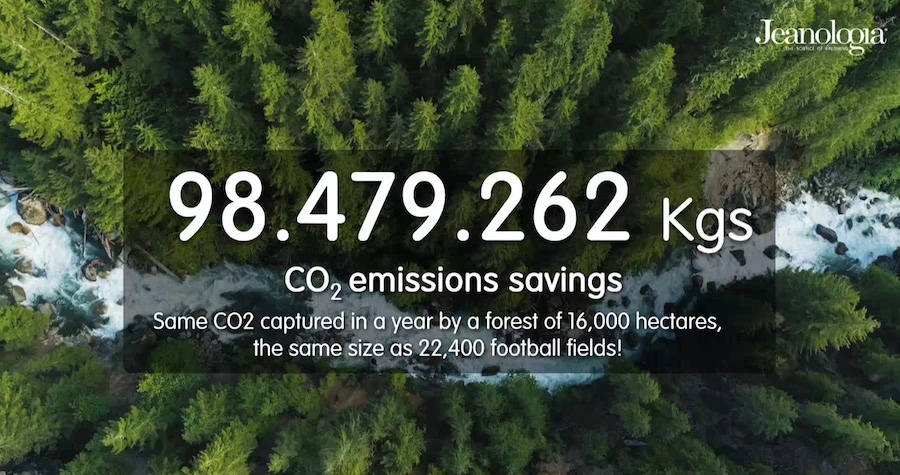
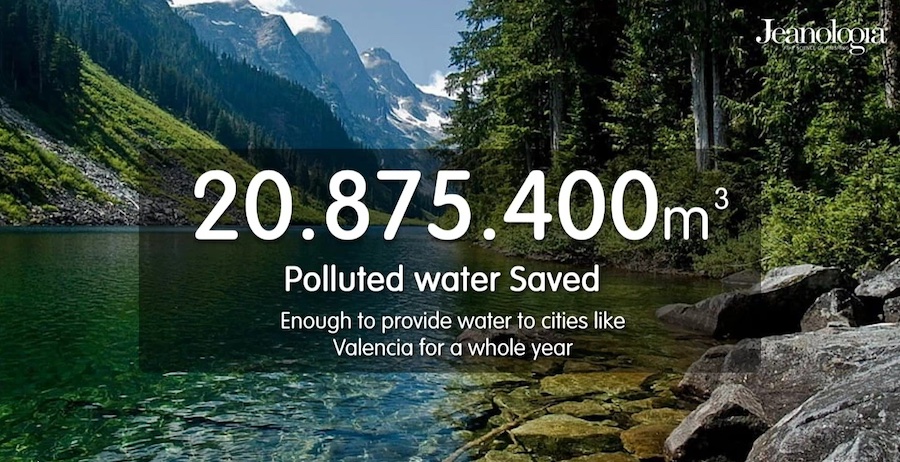
The figures for 2024 speak for themselves: 20,875,400 cubic meters of polluted water saved and a reduction of 98,4 million kilograms of CO? emissions—a contribution equivalent to the annual water consumption of a city the size of Valencia and the carbon capture in a year by a forest of 16,000 hectares, the same size as 22,400 football fields. This means millions of liters of wastewater have been prevented from reaching rivers and seas, and millions of kilograms of CO? from polluting the atmosphere.

Water scarcity: the textile industry’s challenge and the urgency to act

The fashion industry, one of the most water-intensive and waste-generating sectors, faces a critical challenge. Each year, it is estimated to use 93 billion cubic meters of water and generate 20% of the world’s wastewater, mostly due to processes like dyeing and garment finishing. This scenario highlights the urgent need for transformation.

The global water crisis demands concrete solutions. Jeanologia has proven that it is possible to produce fashion responsibly, significantly reducing environmental impact without compromising quality, authenticity, creativity, or profitability.

As Enrique Silla, CEO of Jeanologia, points out, “The textile industry faces a historic opportunity to reinvent itself and prove that fashion can be produced without harming the planet.” He adds, “The future of the sector relies on the deeper integration of circular and efficient solutions,” underlining the need to adopt technologies that enable a shift towards more sustainable production.

Eco-efficient technologies: the key to zero-discharge production

The denim revolution is driven by innovation. Since its founding three decades ago, Jeanologia has developed a integrated ecosystem of technologies that enable zero discharge and minimal water usage. Among its specialized solutions for the denim industry are:

+ Laser: A pioneering technology that replaces traditional abrasion methods, eliminating the use of water and harmful chemicals.

+ eFlow: Uses nanobubbles to transport chemicals precisely to fabrics, minimizing water usage and ensuring zero discharge.

+ Airwash Tech (G2 Indra): Replaces conventional water-based garment washing with air, significantly reducing both water and chemical consumption.

+ H2Zero: A closed-loop water recycling system that recovers up to 95% of water used during production.

Jeanologia has implemented these technologies in over 80 countries, working with leading global manufacturers to completely transform how jeans are made. Sustainability in the textile sector is no longer a promise—it’s a measurable reality.

“There’s no innovation without implementation. Every cubic meter of water we save from pollution, every kilogram of CO? we prevent, proves that the industry can—and must—be part of the solution,” says Silla.

Jeanologia as a driver of change: a call to the industry

Jeanologia has established itself as a strategic partner to brands, retailers, and manufacturers seeking to align fashion and sustainability in a genuine way. Its Mission Zero initiative continues moving forward with a clear goal: textile production with no excessive water use and no pollutant discharge.

“The challenge is global, and the response must be collective. We invite the industry to join this real transformation, where innovation and sustainability go hand in hand,” Silla concludes.

This World Water Day, Jeanologia presents not just data, but a clear message: change is possible—and it’s already happening.
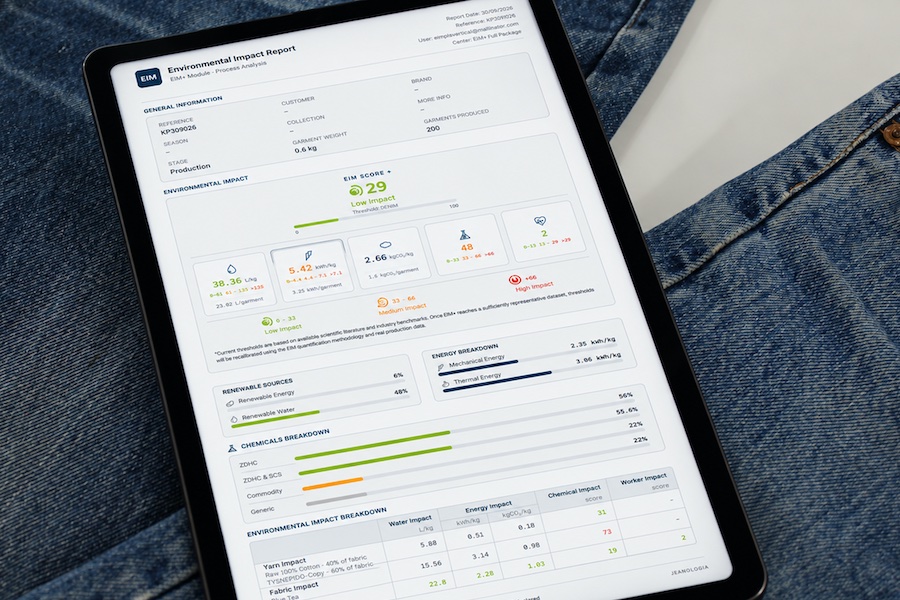
Jeanologia has proven that it is possible to manufacture fashion responsibly without compromising the planet © 2025 Jeanologia


More News from JEANOLOGIA S.L.

#Textile processing

Jeanologia showcases the future of product development

Jeanologia is showcasing how software is transforming product development in the fashion industry at PI Apparel Europe: The Fashion Technology Show, taking place on March 30–31 in London.

#Denim

Jeanologia launches Billy

The new AI extracts precise laser designs from a garment image in minutes, transforming how vintage denim is recreated for production. If Jeanologia’s laser changed the way jeans were made at the end of the last century, its AI now takes the next step: moving from reproducing wear to designing it. / archive photo © 2026 Jeanologia

#Textile chemistry

Jeanologia urges industry to accelerate PP Spray phase-out following ZDHC Watchlist update

Potassium permanganate has officially entered the Chemical Watchlist of the ZDHC Foundation, signaling increased scrutiny and potential phase-out of one of the most hazardous chemicals still used in denim finishing. The inclusion confirms an industry shift that Jeanologia anticipated more than a decade ago.

#Denim

Jeanologia celebrates its 30th anniversary transforming how jeans are produced worldwide

Jeanologia celebrates its 30th anniversary reaffirming the mission it was born with in 1994, to transform the textile industry into a more sustainable, efficient, and human-centered sector. Three decades later, that vision has become a global reality. Today, more than 40 percent of all jeans produced worldwide are made using technologies developed by the Valencia-based company.

More News on Sustainability

#Sustainability

Number of GOTS-certified facilities grow 15% globally as demand for credible sustainability standards continues to strengthen

Global Organic Textile Standard (GOTS) certification continued to grow in 2025, with nearly 18,000 certified facilities worldwide, despite ongoing geopolitical uncertainty and rapidly evolving regulatory requirements across global textile supply chains.

#Sustainability

bluesign technologies introduces bluepass

bluesign technologies ag (www.bluesign.com) today announces the launch of bluepass, a new certification mark and product labeling system created to deliver clear, substantiated, and verifiable sustainability claims at scale.

#Research & Development

Hohenstein publishes 2025 Sustainability Report

The testing and research service provider Hohenstein has published its latest sustainability report, outlining key progress and strategic initiatives. The report focuses on ambitious CO₂ reduction targets, the company’s new mission statement and the systematic expansion of sustainable services for customers worldwide.

#Natural Fibers

Global Standard gGmbH launches second public consultation for GRTS Draft 2 for the textile industry (1–30 April 2026)

Global Standard gGmbH is pleased to announce the release of Draft 2 of the Global Responsible Textile Standard (GRTS) for its second public consultation. The consultation will be open from 1 April 2026 to 30 April 2026, inviting stakeholders across the textile and apparel value chain to provide input and contribute to the further development of this new Standard.

Latest News

#Raw Materials

ECCO introduces first shoe featuring innovative protein-based fibre

ECCO, in partnership with Spinnova, announces the launch of the limited edition ECCO BIOM® 720, a first-of-its-kind shoe utilising an often overlooked leather by-product, transformed into a protein-based fibre. The fibres are produced using patented technology that advances material innovation while reducing waste and supporting full resource use across the leather and textile industry.

#Man-Made Fibers

The LYCRA Company strengthens sustainability leadership, appoints Alistair Williamson as VP of Product Sustainability

The LYCRA Company has appointed longtime executive Alistair Williamson as vice president of product sustainability, reaffirming its commitment to developing sustainable solutions for apparel and personal care products. In this role, he will guide the company’s next chapter of sustainability strategy and oversee all initiatives aimed at reducing environmental impact across products, operations, and innovation platforms.

#Raw Materials

Kraig Biocraft Laboratories reports major progress converting record-setting spider silk cocoon production into reeled silk

Kraig Biocraft Laboratories, Inc. (OTCQB: KBLB) (“the Company”, “Kraig Labs”, or “Kraig’s”), a world leader in spider silk technology*, today announced significant progress in the processing of its recently produced recombinant spider silk cocoons into reeled silk.

#Textile processing

trinamiX mobile NIR spectroscopy: New applications for the footwear and textile industry

trinamiX GmbH expands its solution portfolio for the circular economy, now enabling the identification of materials used in the footwear and textile industries. With its mobile near-infrared (NIR) spectroscopy solutions, trinamiX supports manufacturers, sorters, recyclers, and brand owners in reliably identifying materials and improving transparency across increasingly complex value chains.

TOP