[pageLogInLogOut]

#Sustainability

SABIC highlights its innovative actions to combat climate change at Saudi Green Initiative Forum

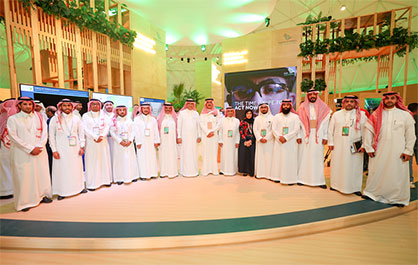
SABIC, a global leader in diversified chemicals, highlighted its innovative actions supporting the Kingdom’s ambition to realize circularity in alignment with the Saudi Green Initiative (SGI) during its participation at the second editions of the SGI Forum and Middle East Green Initiative (MGI) Summit in tandem with the 27th United Nations climate change conference (COP27) in Sharm El-Sheikh, Egypt, from November 7 to 18.

SABIC presented best practices in the circular carbon economy, climate change, renewable energy, recycling, combating desertification at the two green forums.

This year’s SGI Forum under the theme, ‘From ambition to action,’ brought together global leaders, CEO, investors, experts, and academics to collaborate toward collective and concrete actions for climate change, reverse land degradation, protect marine life and preserve biodiversity.
© 2022 SABIC
© 2022 SABIC


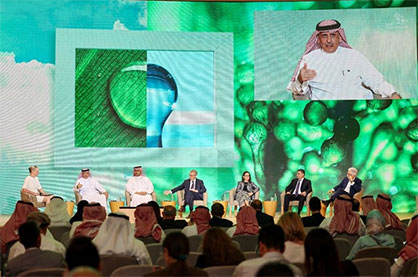
Addressing a panel discussion, Abdulrahman Al-Fageeh, SABIC CEO (A), said, “We’ve taken concrete actions to combat climate change through our innovative technologies. SABIC has made significant progress toward net-zero emissions.. In 2021, we achieved a 10% reduction in our carbon emissions (Scope 1&2) compared to 2018 baseline. That’s halfway to our interim 2030 target.

As part of the SGI Forum, SABIC emphasized its commitment with various initiatives.

SABIC will work with the Alliance to End Plastic Waste and other partners to conduct baseline studies of the Red Sea and Arabian Gulf as a prelude to address plastic marine pollution there. The intention is not only to clean up existing plastic waste locations but also to prevent any more plastic waste from reaching those bodies of water.

For the circular economy, a cooperative project was carried out between SABIC, Diryah Governance and King Saud University. The Diriyah Palm Waste Recycle project is helping the community of Diriyah turn palm waste into more valuable products rather than burning it. The project has helped in achieving the values of Diriyah Health city. SABIC is now exploring upscaling this successful concept into other areas of the kingdom.

Leveraging its previous success in building and operating the world’s largest CO2 purification and liquefaction plant of its kind, SABIC kicked off a study to capture two million tons of CO2 from its assets in Jubail as part of the Kingdom’s carbon capture, utilization and storage program that will be operational by 2027.


SABIC, Aramco, and Saudi Aramco Total Refining and Petrochemical Company (SATORP) have completed ISCC plus certification. This achievement is a great milestone toward creating Circular Economy in KSA in which Mixed Plastic Waste is being utilized to produce circular polymers product in KSA and the Middle East. This process is considered as the first in kind in the region.

Tree-plantation project with the National Center for Vegetation Cover. SABIC intends to plant 5 million native trees in four national parks in the Kingdom. The trees will stop desertification, help restore biodiversity and even remove some CO2 from the atmosphere as they grow.
© 2022 SABIC
© 2022 SABIC


SABIC, which is a member of the Kingdom’s Energy and Climate Change as well as Environment committees, displayed a model of its CO2 capture and utilization plant and showcased an ocean plastic mouse, the exterior shell of which contains 20% recycled ocean plastic, a unique case of collaboration with Microsoft.

20221113-SABIC highlights its innovative actions to combat climate change at Saudi Green Initiative Forum 2



More News from SABIC

More News on Sustainability

#Sustainability

GOTS version 8.0 released: advanced supply chain accountability, from fibre to finished product

Global Standard is pleased to announce the release of GOTS Version 8.0, the latest update to the world's leading processing standard for organic textiles. The updated Standard strengthens requirements for air emissions and waste management, as well as criteria for product safety. It introduces new provisions on circularity, microfibre management and updates in residue testing. Version 8.0 also elevates due diligence obligations and formalises governance requirements, including ESG disclosure, anti-corruption policies and conflict-of-interest safeguards, to support credible, responsible business conduct.

#Sustainability

The nova-Institute establishes new Renewable Feedstock Department to lay the groundwork for industrial defossilisation

The transition from fossil-based to renewable carbon – sourced from biomass, CO₂ utilisation and recycling – is the cornerstone of a climate-neutral chemical industry. The nova-Institute’s new department is dedicated to providing the essential data, analyses and strategic roadmaps required to secure a reliable future feedstock supply and make this transition a commercial and ecological reality.

#Sustainability

Textile Exchange unveils commitment-based pathway for members to accelerate responsible raw material production

Textile Exchange has unveiled further details about its new membership structure, designed to guide the fashion, textile, and apparel industry in a collective course of action toward preferred production systems for raw materials and fibers.

#Textile chemistry

Jeanologia urges industry to accelerate PP Spray phase-out following ZDHC Watchlist update

Potassium permanganate has officially entered the Chemical Watchlist of the ZDHC Foundation, signaling increased scrutiny and potential phase-out of one of the most hazardous chemicals still used in denim finishing. The inclusion confirms an industry shift that Jeanologia anticipated more than a decade ago.

Latest News

#INDEX 2026

EDANA unveils nominees for INDEX™26 Awards: Highlighting the next generation of nonwoven excellence

EDANA is proud to unveil the highly anticipated nominees for the INDEX™26 Awards, the nonwoven industry’s highest accolade for technical and sustainable excellence. Out of a record-breaking field of entries, these finalists represent the cutting edge of material science—from bio-based hygiene fibers and PFAS-free protective textiles to revolutionary water-filtration machinery. Each nominee has been selected by a jury of industry experts for their ability to solve critical global challenges, including the transition to a circular economy and the pursuit of enhanced consumer performance.

#Raw Materials

Lenzing Group positions bio‑based materials as a strategic asset for Europe’s economic security

The Lenzing Group, a leading supplier of regenerated cellulose fibers for the textile and nonwovens industries, hosted a high‑level roundtable in Brussels to discuss how bio‑based materials can strengthen Europe’s economic security and support the shift toward a fossil‑free future. Organized in cooperation with Euractiv, the event brought together representatives of the European Commission, the UK Mission to the EU, academia, civil society, and industry.

#Natural Fibers

Beyond Cotton: Natural Fibres in the Spotlight at the Bremen Cotton Conference - Branded by DNFI

Climate targets, fragile supply chains, and rising regulatory requirements are fundamentally changing the perspective of the textile industry - the focus is increasingly shifting toward the base material. Not only cotton, but natural fibres are gaining significant importance: they stand out not only because of their outstanding functional properties, but also because they make a valuable contribution to the bioeconomy and responsible product development.

#Textiles & Apparel / Garment

Coats to showcase innovative reinforcement and filler materials for leather goods and accessories at APLF 2026

Coats, a world-class Tier 2 manufacturer and trusted partner for the apparel and footwear industries, will be promoting four advanced materials from its ‘Lifestyle Solutions’ portfolio at APLF 2026 in Hong Kong in March. Each innovation has been specifically engineered to help luxury and premium brands elevate the craft, durability, sustainability and creative expression required in the manufacturing of handbags, purses, and other high-end designer accessories.

TOP



