[pageLogInLogOut]

#Spinning

Oerlikon publishes Sustainability Report 2021

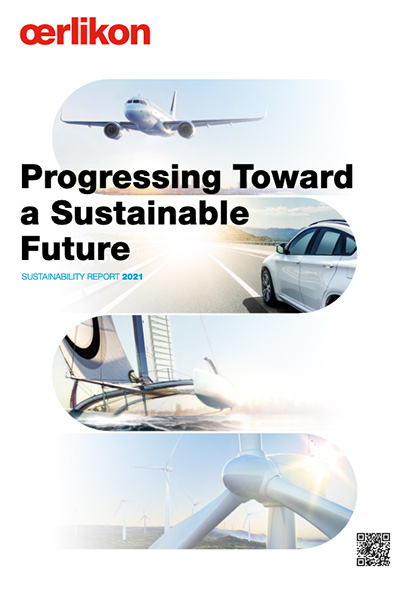
Oerlikon has published today its Sustainability Report 2021, outlining the progress and achievements of the company in environmental, social and governance topics.
  • Implemented Energy Management Systems (EnMS) at 12 additional sites, bringing the total to 30 sites, equaling 54% of the Group’s total energy consumption.
  • 22% of electricity consumed was from renewable sources.
  • Reduced disposed waste to 31% of total waste by increasing recycling and reuse.
  • Around 72% of our R&D investment covers the sustainability criteria.
  • Improved regional diversity in upper management to 21%.
  • Reduced total accident frequency rate (TAFR) by 18%.
  • Increased completion of Code of Conduct e-training to 97%.


Progressing Toward a Sustainable Future

“Sustainability is an inherent part of our strategy and technologies, which is reflected in our solutions for customers and in our own operations,” said Georg Stausberg, Chief Sustainability Officer and CEO of Oerlikon’s Polymer Processing Solutions Division. “On our journey toward our 2030 targets, I am very pleased that we have made excellent progress in our sustainability achievements, initiatives and processes in 2021, especially against the challenging COVID-19 pandemic backdrop.”

In 2021, Oerlikon demonstrated that it was well equipped to respond swiftly and effectively to the pandemic to ensure the safety, health and wellbeing of its employees, customers, vendors and communities, and with minimal disruption to its operations and business.


In Oerlikon’s approach to sustainable innovation, collaboration remains a hallmark as the company remains focused on extending tool life, reducing fuel consumption in cars and airplanes, improving textile machinery efficiency, increasing recycling of fibers and materials and pioneering future technologies. In the report, there are many case studies and examples of how Oerlikon continues to help customers with cost-effective and climate-friendly solutions and services to build their business in key markets.

“We will continue to engineer solutions that contribute to a more sustainable planet, and further work on our environmental, social and governance performance in our operations in pursuit of the 2030 targets we have set for ourselves,” added Georg Stausberg. “We recognize the need to implement improvements on an ongoing basis – that sustainability is not a sprint toward the finish line but a continuum on our journey to make Oerlikon a more sustainable and responsible company for all our stakeholders.”

Please find the online and PDF (download) version of the report on Oerlikon’s website: http://oerlikon.com/sustainabilityreport-2021


More News from Barmag GmbH & Co. KG

#Nonwovens / Technical Textiles

Crimper repair workshop begins operations

Since the beginning of the year, Oerlikon Textile Inc. has been offering a crimper repair service, making it the company's first location worldwide to do so. The workshop in Charlotte specializes primarily in Fleissner and Neumag crimpers.

#Spinning

Oerlikon Manmade Fibers Solutions hosted successful Technology Day 2025 in India

Oerlikon Manmade Fibers Solutions recently hosted its highly anticipated Innovation and Technology Day at the Deltin Hotel in Daman by end of January 2025. The event attracted over 300 participants, including industry experts, partners, and stakeholders, who gathered to explore the latest advancements and trends in the manmade fibers industry in India.

#Spinning

Industrial yarn producer sees growth potential in tire cord sector

The Chinese Junma Group has expanded its HMLS capacities by 20 positions, hence becoming one of the largest tire cord manufacturers in China. At present, the company has 64 positions of HMLS systems, all of which are from Oerlikon Barmag.

#Spinning

Oerlikon reports third quarter 2024 results, highlights strong execution in a challenging market landscape

In the third quarter of 2024, Oerlikon reported a stable operational Group EBITDA margin, despite challenging market conditions, thanks to a focus on pricing, cost management, and efficiency across both divisions. Group order intake saw a 4% year-over-year decline at constant FX, attributed to temporary market softness in Surface Solutions, while orders in Polymer Processing Solutions showed signs of stabilization.

More News on Spinning

#Spinning

Ibrahim Fibres and Trützschler: A strong partnership enters its next phase with the TC 30Si

For more than two decades, Ibrahim Fibres and Trützschler have grown side by side, driven by a shared ambition to continuously improve spinning performance, strengthen technology leadership and set new benchmarks in the textile industry. Today, Ibrahim Fibres is a leading yarn and polyester staple fiber manufacturer in Pakistan. The company operates the largest number of Trützschler cards in the country, with more than 200 machines running across its mills in Faisalabad, and plays an important role in one of Asia’s largest textile industries.

#Spinning

Object Carpet tests production of rPET BCF yarn on Neumag BCF line

In a joint project with Object Carpet GmbH, Denkendorf; the Institute for Textile Technology (ITA), Augsburg; and Next Generation Recyclingmaschinen GmbH (NGR), Feldkirchen, Austria, Barmag investigated the processing of recycled polyester for BCF yarn. The goal was to evaluate the fundamental suitability of 100% recycled carpet material for reuse in carpet yarn production to create a closed-loop system in carpet manufacturing. To date, commercial rPET BCF processes have been based solely on rPET from bottle pellets.

#Spinning

New spinning package with two-step filtration for recycled yarns and more

At the ITM in Istanbul, BB Engineering unveiled its new, patented ValuePack spinning package for the first time, which features a two-stage filtration system. This is particularly beneficial for re-cycling processes. Until now, spinning packs have used either metal powder (“sand”) or filter candles as filter media. Both options are suitable for differ-ent applications, and each has its own specific advantages and dis-advantages.

#Research & Development

GenuTrace client advisory: Is your cotton supply chain UFLPA ready?

U.S. Customs and Border Protection has released updated operational guidance (CBP Publication No. 5560-0526) expanding its forced labor enforcement framework. The guidance supersedes the original 2022 UFLPA Operational Guidance and now covers all forced labor enforcement authorities — UFLPA, CAATSA, and WROs/Findings — in a single unified document. For cotton importers, the enforcement posture has not softened. It has become more structured, more documented, and more demanding. Learn more about UFLPA.

Latest News

#Recycling / Circular Economy

Ence and ShareTex begin initial testing of the ATENEA innovation project to promote textile recycling in Spain

Ence and ShareTex are making progress on the Atenea R&D project, which aims to develop a complete value chain for textile recycling in Spain. Specifically, the goal of the ATENEA project—which is funded by the Center for Technological Development and Innovation (CDTI)—is to connect all the necessary stages for the recovery of textile waste, from collection and management, through recycling and transformation into new raw materials, to their incorporation into new textile products.

#Recycling / Circular Economy

DePoly Inaugurates its Showcase Plant in Monthey Switzerland

What if used plastic bottles, PET packaging material and polyester textiles could become raw materials just as high performing as virgin resources? That is the ambition of DePoly, a circular materials company based in Sion, Switzerland which inaugurated its Showcase Plant in Monthey on July 6th & 7th. The first depolymerization facility of its kind and scale in Switzerland, this industrial Showcase Plant represents a major milestone in the company's growth and its journey toward commercialization.

#Recycling / Circular Economy

Commission clarifies rules on plastic bottles recycling

The European Commission today adopted new rules on recycling of single-use plastic beverage bottles made primarily of polyethylene terephthalate (PET bottles). These rules establish, for the first time, a methodology to calculate, verify and report chemically recycled content. This is part of the Commission’s December 2025 plastics package.

#Sustainability

Global Standards establishes new non-profit foundation to strengthen governance

Global Standards gGmbH, the nonprofit organisation behind the globally recognised Global Organic Textile Standard (GOTS), announced a new governance structure designed to support its long-term mission and reinforce organisational autonomy of its Voluntary Sustainability Standards and programmes.

TOP