[pageLogInLogOut]

#Sustainability

H&M Group at Copenhagen Fashion Summit

Helena Helmersson and Johan Rockström © 2020 H&M
For this year’s Copenhagen Fashion Summit, our CEO Helena Helmersson sat down with Professor Johan Rockström, director at the Potsdam Institute for Climate Impact Research to discuss accelerating circularity and securing financial resilience, all while running on limited time.

Both have extensive experience of working with the topic of sustainability. Prior to becoming CEO of H&M Group, Helena has been one of the driving forces behind H&M Group’s sustainability transformation. Johan Rockström is best known for the development of the Planetary Boundaries framework, which has since become a standard of sustainability science.

During the session the two discussed, among other things, how the linear business model creates a problematic downstream, how to determine true net profit by including natural resources and why we simply can’t sit around, waiting for the industry to wake up and secure circularity on every level:

“We can’t really wait for everybody´s awareness, because there’s just so much more urgency in this question. How can we be a part of influencing customer behavior, which is also a responsibility we have because of our size” Helena Helmersson, CEO H&M Group

Helena Helmersson, CEO H&M Group © 2020 H&M


"We need to define growth in a way that internalizes all the natural capital. (...) All the resources that you are taking out of the biosphere have to be valued in a way that gives you a better sense of where you are in terms of true net profit." Johan Rockström, director at the Potsdam Institute for Climate Impact Research
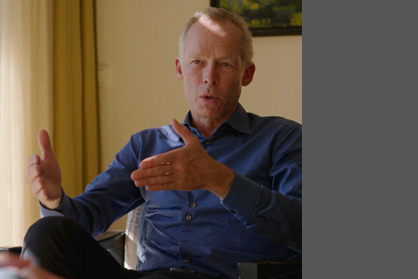
Johan Rockström © 2020 H&M


Other H&M Group acitivties at CFS+

The H&M B2B initiative Treadler, was present at Copenhagen Fashion Summit, together with its partner Tarasima. There they shared learnings from their journey on achieving sustainable change in the supply chain by moving beyond compliance:

“We see a gap between current sustainability efforts, where basic compliance many times is both the floor and the ceiling for buyers, and where our industry needs to be to achieve true change - while also being successful within the planetary boundaries. The journey takes time and we want to help garment and textile companies overcome some of the initial business barriers by sharing learnings from H&M Group’s journey” Gustaf Asp, Managing Director Treadler

As another contribution at the summit on the topic of Transparency, H&M’s Head of Sustainability Pascal Brun showcased the results of a series of customer-facing, on-product-transparency tests performed by H&M this summer, together with Sustainable Apparel Coalition (SAC). The tests looked at how customers reacted to the presentation of Higg sustainability performance scores on over 7000 hm.com product pages which resulted in over 7million customer interactions. Higg scores were linked to the environmental sustainability performance of the factory that each product was made in. The main test findings indicated that including Higg scores on products, didn’t impact customers short term purchasing habits, but rather the purpose of sharing the scores is to increase customer awareness, perception and trust.

„We empower customers with the tools to make informed choices, drive change and understand the impact of their purchases on the environment and society.” Pascal Brun, Head of Sustainability at H&M.

More News from TEXDATA International

#Texprocess 2026

Texprocess 2026: Automation, digitalisation and AI reshape textile processing

Investment decisions in textile processing have become increasingly complex. Rising energy prices, labour shortages and geopolitical uncertainties are forcing companies to prioritise technologies that deliver measurable improvements in efficiency and process stability. This applies not only to apparel production, but also to the processing of technical textiles and high-performance materials. Modernisation projects are therefore being evaluated more selectively – but the pressure to upgrade production systems continues to grow. Texprocess 2026 reflects this tension between cautious investment behaviour and increasing technological demand.

#Techtextil 2026

Textile Chemicals & Dyes: Innovation in Textile Chemistry moves into focus at Techtextil 2026

From PFAS-free finishes and water-saving dyeing technologies to advanced coatings and recycling-compatible formulations, innovation in textile chemistry is accelerating across the industry. Reflecting this development, Techtextil 2026 introduces Textile Chemicals & Dyes as a dedicated product segment, highlighting the growing role of chemical solutions in shaping the next generation of technical textiles.

#Recycling / Circular Economy

textile.4U publishes special edition “Top 100 Textile Recycling Companies 2025”

With a comprehensive 176-page special edition, textile.4U is dedicating its latest issue entirely to one of the most dynamic and influential topics in today’s textile industry: textile recycling. The new issue, published exclusively in high-quality print, presents the Top 100 textile recycling companies researched and selected by TexData – organizations that already play a key role in the transition to circular textiles or are expected to have a significant impact in the near future.

#Recycling / Circular Economy

Responsible Textile Recovery Act of 2024 signed by Governor

Senator Josh Newman (D-Fullerton) is proud to announce that Senate Bill 707 (SB 707), the Responsible Textile Recovery Act of 2024, has been signed into law by the Governor of California, Gavin Newsom. This groundbreaking legislation establishes the country’s first Extended Producer Responsibility (EPR) textile recycling program, marking a significant step forward in the state’s efforts to combat waste and promote sustainability.

More News on Sustainability

#Sustainability

Experts publish APAC policy priorities

Cascale today announced the publication of its APAC Policy Priorities Paper, developed by the Asia-Pacific (APAC) Policy Member Expert Team (MET) to identify key regional sustainability challenges and provide practical, aligned recommendations for policymakers and industry stakeholders across Asia-Pacific.

#Sustainability

GOTS version 8.0 released: advanced supply chain accountability, from fibre to finished product

Global Standard is pleased to announce the release of GOTS Version 8.0, the latest update to the world's leading processing standard for organic textiles. The updated Standard strengthens requirements for air emissions and waste management, as well as criteria for product safety. It introduces new provisions on circularity, microfibre management and updates in residue testing. Version 8.0 also elevates due diligence obligations and formalises governance requirements, including ESG disclosure, anti-corruption policies and conflict-of-interest safeguards, to support credible, responsible business conduct.

#Sustainability

The nova-Institute establishes new Renewable Feedstock Department to lay the groundwork for industrial defossilisation

The transition from fossil-based to renewable carbon – sourced from biomass, CO₂ utilisation and recycling – is the cornerstone of a climate-neutral chemical industry. The nova-Institute’s new department is dedicated to providing the essential data, analyses and strategic roadmaps required to secure a reliable future feedstock supply and make this transition a commercial and ecological reality.

#Sustainability

Textile Exchange unveils commitment-based pathway for members to accelerate responsible raw material production

Textile Exchange has unveiled further details about its new membership structure, designed to guide the fashion, textile, and apparel industry in a collective course of action toward preferred production systems for raw materials and fibers.

Latest News

#Techtextil 2026

Gebr. Otto highlights versatility at Techtextil with regional supply chains, yarn innovations and new hygiene segment

At this year’s Techtextil, Gebr. Otto places its versatility at the center of its presentation. In addition to spinning, twisting and dyeing – traditionally focused on fine cotton – textile processors will also find a competent development partner for technical specialty solutions. The Dietenheim-based spinning mill has now built up a decade of experience in the production of technical yarns, particularly from aramids. A new hygiene segment has also been established, where yarns for medical and hygiene products are currently being produced. In the future, this department could also develop textile products for the food sector. Gebr. Otto will once again be present at the BW-i joint stand, booth D81, hall 12.1. What is wound onto the spool is determined by the customer: Gebr. Otto develops according to specific customer requirements and transforms its own ideas into yarn innovations.

#Europe

Commission presents proposal for EU Inc. - unlocking the full potential of the Single Market for Europe's entrepreneurs

Today, the European Commission presented its proposal for EU Inc., a new single set of corporate rules, building the cornerstone and starting point for the EU's 28th regime. EU Inc. is an optional, digital-by-default European corporate framework. It will make it easier for businesses to start, operate and grow across the EU – incentivising them to stay in Europe, and encourage those who once looked elsewhere to return.

#Man-Made Fibers

OnceMore® from Södra brings end-to-end traceability for circular Man-made Cellulosic Fibers (MMCF) using TextileGenesis

OnceMore® from Södra, the world’s first large-scale process for recycling blended fabrics into high‐quality dissolving pulp, will begin using TextileGenesis, a Lectra company, to strengthen traceability from raw material to retail across the value chain. OnceMore® produces dissolving pulp made from blended textile waste and wood sourced from responsibly managed Swedish forests. By integrating TextileGenesis, OnceMore® supports the growing need for verified data and secure, transparent tracking throughout increasingly complex supply chain.

#Spinning

Temco launches a new DTY all-in-one solution

Temco introduces the DTY All-in-One Solution – a fully harmonized set of components engineered to give customers a highly stable, low maintenance and reproducible process environment. The solution reduces interruptions, extends component lifetimes and supports consistent yarn quality across all machine positions. All-in-One Solution – a fully harmonized set of components engineered to provide maintenance and reproducible process environment.

TOP