[pageLogInLogOut]

#Sustainability

Sustainable fashion: How are the leaders in fast fashion doing?
(c) 2020 Lectra
Brands are prepared for the new health protection rules and have reopened their stores. But aside from the direct impact of the COVID-19 epidemic, is the fashion market ready to respond to customers’ desire to act by changing their spendinghabits? Basedon analyses by Retviews, a recently acquiredstartup, Lectrahas produced a survey of sustainable fashion among the leading fast fashion brands. The main findings are explained here.

Post-COVID-19 survey

  • 10% of their offer is eco-responsible.
  • Sustainable cotton is a priorityfor retailers for the coming years.
  • Sustainable garments cheaper than standard garments.

The COVID-19 crisis has given many people the desire to live more meaningfully and to act more responsibly. The crisis period could be seen as the catalyst that forces the fashion industry to change the way it designs, produces and distributes its products. Since, for consumers, buying is a way of expressing a commitment and affirming their values, brands have an incentive to change their offer in preparationfor the future, by taking a more eco-responsible, authentic and transparent approach.

While these factors were apparent before the pandemic, they have now become the key to interacting with consumers wanting a more responsible offer. The era of the consumer activist, long heralded without actually becoming a reality, is now here, and brands must adapt in response.

Sustainable collections still a very small minority

The  proportion  of  sustainable  fashion  in  collections  varies  considerably  from  one  retailer  to  the  next.  For example, eco-friendly collections constitute only a small portion of the ranges offered by leading retailers Zara and H&M, which signedthe Fashion Pact during the G7 Summit in Biarritz.

Zara’s  Join  Life  collection  represents  14%  of  its  range,  whereas  C&A’s  #Wearthechange  represents  nearly 30%  of  its  total  collection.  The  Conscious  collection  at  H&M,  which  tops  the Fashion  Transparency  Index, created by Fashion Revolution, accounts for less than 10% of its total range. 
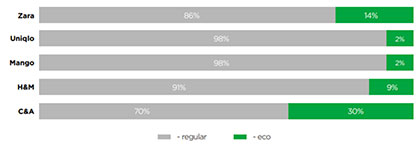
Eco vs regular collection, Retviews 2019-2020 (c) 2020 Lectra


Composition of products in eco-friendly collections

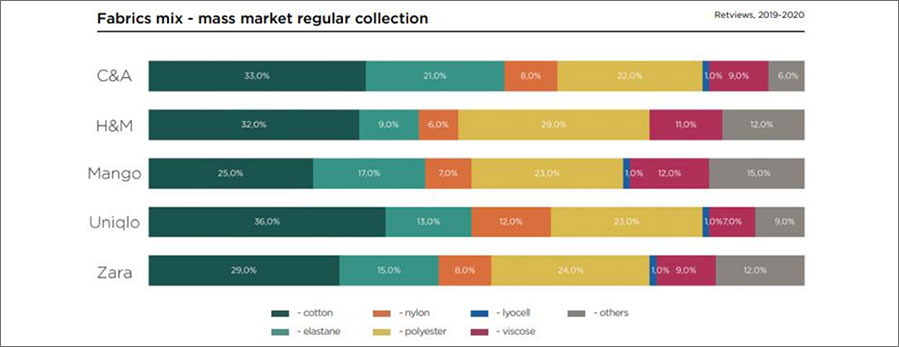
C&A, H&M and Inditex (Zara) are among the top four users of organic cotton. All the brands analyzed in the Retviews survey present their cotton as sustainable and consider it a priority for 2020 and beyond.


There  is  little  difference  between  the  fabrics  mostcommonly  usedin  the  mass  and  premium markets.  The same  is  true  for  eco-friendly  compared  to  standard  collections.  Cotton,  synthetic  fabrics  such  as  polyester, elastane and also viscose are the most widely offered and used fabrics. 

Are sustainable fabrics more expensive?

The assumption that sustainable and/or organic garments are more expensive is a misconception, according to  the  results  of  the  survey.  H&M’s  exclusive  sustainable  collection,  Conscious,  is  a  good  example.  The average price of a dress in the standard collection is €39.90, whereas in the Join Life collection it is €31.70.
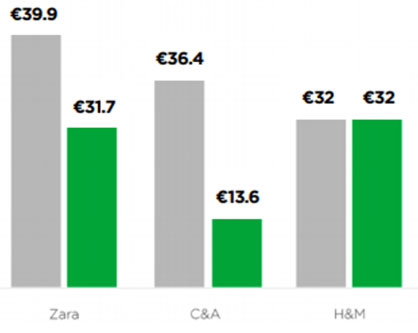
Average price dresses, Retviews woman dresses 2019-2020 (c) 2020 Lectra


The opportunities offered by sustainability are significant. It’s an issue attracting much greater interest from Generation Z, and retailers have listened to and taken on board these concerns. 90% of consumers say they are aware of the situation and are prepared to change their behavior to combat climate change*. This shows their  real  inclination  to  invest  in  eco-responsible  products.  In  view  of this  change,  brands  have  a  social responsibility to inform their customers, to be transparent about their progress in this area, and to share some of  the  challenges  they  face,  in  order  to  educate  their  communities.  There  are  currently  no  international regulations for apparel defining what can be described as sustainable. This means that there is still a long way to  go  before  the  standardization  of  sustainable  fashion  is  achieved.  ”explains  Quentin  Richelle,  Chief Marketing Officer, Retviews.

*European study on sustainable consumption by Oney-Februry2020

More News from Lectra Deutschland GmbH

#Industry 4.0 / Digitalization

Mango joins TextileGenesis pioneering traceability solution, a Lectra company, for a transparent value chain

Mango, one of the leading international fashion groups, has joined TextileGenesis, the pioneering traceability solution for the fashion and textile industries, to trace their natural and animal fibers, synthetics, man-made cellulosic fibers and leather. TextileGenesis, a Lectra company, offers a complete and secure cutting-edge technology with its six-dimensional (6D) offering and unique “fiber forwards” approach. Mango, has long been committed to maintaining a fully transparent supply chain, and TextileGenesis will reinforce this commitment.

#Textiles & Apparel / Garment

New Retviews study by Lectra: the luxury market in 2025, between margin protection strategies and new iconic pieces

After more than a decade of uninterrupted growth, the luxury fashion market is now experiencing a more pronounced slowdown. Global luxury goods sales have fallen from €369 billion in 2023 to €364 billion in 2024 (according to Bain & Co.), exposing the vulnerabilities of a model long supported by aggressive price increases.

#Recycling / Circular Economy

Recover and TextileGenesis collaborate to verify supply chain integrity of recycled materials

RecoverTM, a global producer of recycled cotton and cotton-blend fibers, has commenced a traceability collaboration with TextileGenesis, a Lectra company, to digitally track its recycled waste materials across the entire textile value chain.

#Industry 4.0 / Digitalization

Lectra launches the Observatory of innovation and transformation in the fashion, furniture and automotive markets

As a leader in technology solutions accelerating the transition of fashion, furniture and automotive companies to Industry 4.0, Lectra announces the launch of its Observatory to mark its 50th anniversary. The Observatory will focus on innovations and changes in the fashion, furniture and automotive markets, to help these sectors stay informed and adapt to new opportunities. The Lectra Observatory’s first white paper on the advent of Industry 4.0 is already available online.

More News on Sustainability

#Sustainability

YKK recognized with Top ‘A’ rating by CDP for climate change leadership for third consecutive year

YKK Corporation announced its achievement of the highest “A List” rating in the 2025 Climate Change survey conducted by the global environmental disclosure nonprofit, CDP . This marks the third consecutive year YKK has received this prestigious recognition.

#Weaving

Itema announces strategic partnership with Ivy Decarb to accelerate decarbonization in weaving process

Itema is pleased to announce the strategic partnership with Ivy Decarb, the digital platform helping textile companies measure and reduce their carbon footprint.

#Man-Made Fibers

Teijin Carbon Europe receives EcoVadis Silver status – ranked among the top 15% of evaluated companies

Teijin Carbon Europe (TCE) has been recognized for its sustainability performance and has been awarded the EcoVadis Silver Medal in the latest assessment. In its first-ever EcoVadis evaluation, the company achieved a notable 72 out of 100 points, ranking among the top 15% of all companies evaluated worldwide, within the “Manufacture of Man-Made Fibres” category.

#Research & Development

The region of renewable raw materials: Central German Alliance for Bioplastics

The development of sustainable plastic solutions is rapidly gaining importance in light of global environ- mental pollution, dwindling fossil resources and ambitious climate protection targets. As part of the re- gional alliance RUBIO, which brings together 18 partners from central Germany and the Berlin-Branden- burg area, the bio-based and biodegradable plastic polybutylene succinate (PBS) was comprehensively investigated, starting with the raw material, through the manufacturing process, to industrial application.

Latest News

#Spinning

First PA66 spinning plant with EvoQuench successfully commissioned

With the successful commissioning of a multi-digit PA66 spinning line for microfiber yarns, Chinese textile company Shandong Nanshan Fashion Technology Co., Ltd. has added yarn production to its textile value chain.

#Knitting & Hosiery

SHIMA SEIKI returns to ShanghaiTex

Leading flat knitting solutions provider SHIMA SEIKI MFG., LTD. of Wakayama, Japan, together with its Hong Kong and Chinese market subsidiary SHIMA SEIKI (HONG KONG) LTD., will exhibit at the ShanghaiTex 2025 exhibition (Booth No.: Hall N3, Booth A20) held in Shanghai, China this month. This marks the return of SHIMA SEIKI to ShanghaiTex after a 14-year hiatus, its last exhibit at the show having been in 2011.

#Research & Development

Fraunhofer CCPE presents the “Monomaterial Design Set” – Innovative solutions for circular product design

Composite materials made from different types of plastic often extend the lifetime of products but make recycling more difficult in the circular economy. That is why Fraunhofer CCPE has developed the “Monomaterial Design Set”. This new approach helps to reduce the variety of plastics used in durable products and offers circular solutions for designers and product developers.

#Man-Made Fibers

arena introduces renewable LYCRA® EcoMade fiber in its latest swimwear collection

Italian swimwear specialist arena has unveiled a new collection that brings sustainability and performance even closer together. Launched on December 4, the line features swimsuits made from recycled nylon and renewable LYCRA® EcoMade fiber — the first time the bio-based spandex has been used commercially in swimwear.

TOP