#Spinning
Rieter sees Barmag integration on track as orders and sales rise
In June 2026, Rieter entered into a strategic partnership with Recycling Powerhouse. The global textile industry is undergoing a fundamental transformation. Increasing amounts of textile waste and the steadily growing demand for sustainable products are increasing the need for scalable circular solutions. The aim of the partnership is to industrialize, standardize and scale the recycling of textiles. As part of this collaboration, Rieter is contributing its extensive know-how in the tearing of textile waste and spinning of short fibers and is creating the basis for innovative and sustainable recycling solutions in the textile industry.
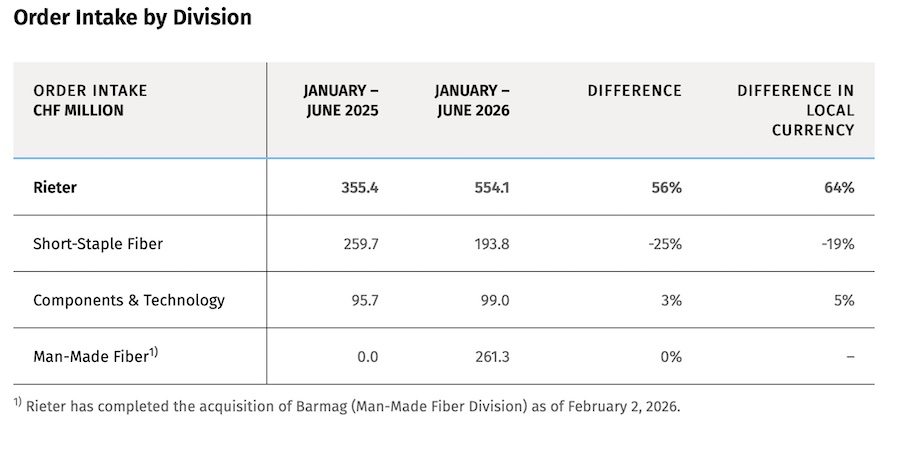
The first signs of a market recovery are emerging in the India region and the Components & Technology Division. The demand for consumables, wear & tear and spare parts has increased by 3%. This early indicator suggests a positive development in the capacity utilization of spinning mills and indicates that further investments may result from this.
Order intake
In the first half of 2026, Rieter recorded an order intake of CHF 554.1 million (first half of 2025: CHF 355.4 million). This represents a pleasing increase of around 56% compared to the previous year. The increase is mainly attributable to the first-time consolidation of Barmag as the Man-Made Fiber Division, which contributed to the growth with an order intake of CHF 261.3 million.
Sales
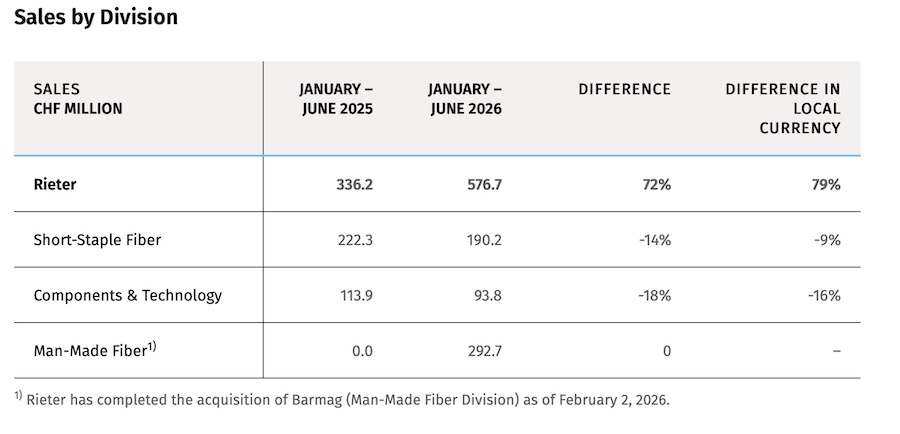
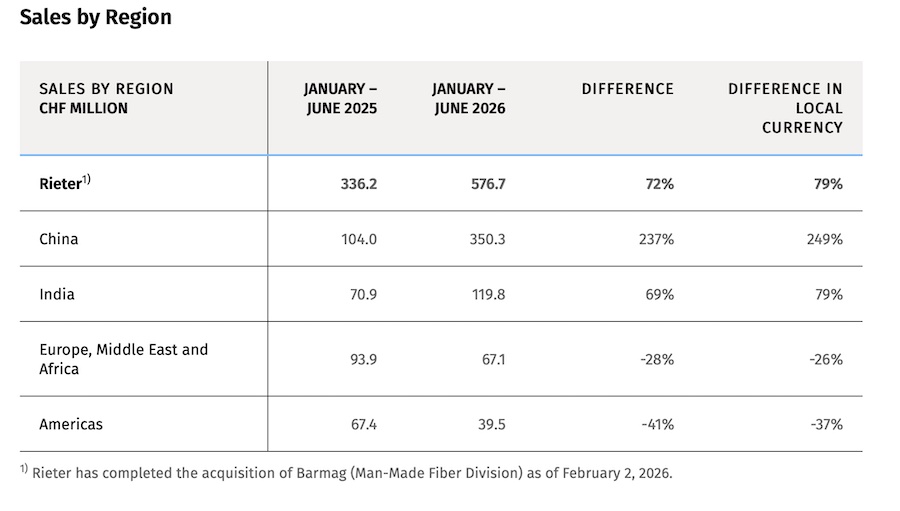
As already announced in March 2026, the first half of 2026 was challenging in terms of sales volume, but largely in line with expectations. Sales amounted to CHF 576.7 million, which was 72% higher than the prior-year period (first half of 2025: CHF 336.2 million) due to the first-time consolidation of Barmag.
Order backlog
As at June 30, 2026, the company had an order backlog of around CHF 760 million (first half of 2025: CHF 510 million).
Operating EBIT, net profit, free cash flow
Rieter achieved an operating EBIT (before restructuring costs, transaction costs and purchase price allocation effects) of CHF -6.3 million. Due to the existing capacity and the fixed cost structure, operating EBIT in the first half of 2026 was below the operating profit breakeven point. Rieter expects a higher sales level in the second half of 2026.
Rieter closed the first half of 2026 with a net loss of CHF 54.9 million (first half of 2025: CHF -20.0 million). The loss is attributable to the low sales level as well as higher interest costs and purchase price allocation effects.
Free cashflow amounted to CHF -96.3 million in the first half of 2026 (first half of 2025: CHF -36.7 million). This was the result of the net loss and the increase in net working capital for orders to be delivered in the second half of 2026.
Outlook for the full year 2026 confirmed
In 2026, a year of transition, Rieter expects sales in the range of CHF 1.3 to CHF 1.5 billion.
The outlook for 2026 reflects the integration of Barmag and the restructuring measures announced in 2025, which are yet to be fully implemented. As a result, a positive operating EBIT margin in the range of 0 to 3% is expected.
1) The comparative period (January – June 2025) has been adjusted retrospectively as a result of the reclassification of Alternative Performance Measures.
2) The comparative period has been adjusted retrospectively as a result of the change in presentation regarding interest on defined benefit plan assets and liabilities.
3) Rieter has completed the acquisition of Barmag (Man-Made Fiber Division) as of February 2, 2026.