[pageLogInLogOut]

#Spinning

Mini-Spinning, new lab-scale shredding machine & recycling in textiles

Given the announced community directives that will soon impose in many countries the reuse of resources and the reduction of waste, the circular economy and recycling are topics of very high interest nowadays, with increasingly widespread applications in all industries, but above all in the world of textiles.

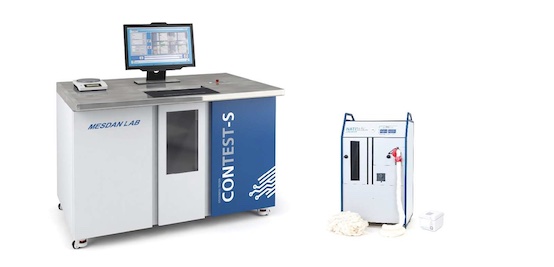
The Mesdan Mini-spinning line, in addition to its main function (teaching, R&D, sampling), is increasingly contemplated as an integral part of recycling projects: apparel manufacturers and famous brands, R&D laboratories and new startups are showing great interest in the Mesdan lines for either laboratory or small production purposes, for the recycling of old cloths, fabrics and yarn waste as well as the recovery of valuable waste fibers.

In recent years, various research institutes around the world have included the Mesdan Mini-spinning line in their textile recycling projects. The required equipment for this kind of assessment includes the card with the attached sliver web condenser, the drawing frame with the flyer for better resistance and uniformity of the roving and the ring spinning machine. Some have completed the line with the addition of machines for the production of twisted yarns (assembly winder, twisting machine) or a knitting machine, all in lab scale.


The novelty that Mesdan presented at the ITMA 2023 in Milan is the laboratory scale Shredding machine.

The machine is characterized by versatility, flexibility high performance, thanks to the possibility of customizing and saving the different settings, modifying the machine's working parameters (work cylinder rotation speed, product feeding speed and suction of the finished product).

A "standard" mechanical recycling process can be simplified as follows:

- selection and sanitization of the textile to be recycled,

- removal of non-textile parts (metal or plastic parts, such as buttons, zippers, etc),

- cutting of incoming material and Shredding,

- fiber mixing (with the possible addition of other non-recycled fibres) and carding,

- drawing plus spinning to obtain the final product (yarn with desired % composition, count and tpm)

With a production capacity of approximately 1kg/min (60kg/h), the laboratory Shredding machine is also contemplated with interest as a stand-alone recycling tool, by medium-small sized companies, for applications not necessarily aimed for reuse in spinning mills, but for different technical applications, such as non-woven, thermal/acoustic insulation materials, padding, etc.
More News from Mesdan S.p.A.

More News on Spinning

Latest News

#Functional Fabrics

“Action helps us change what we do!”

DAY 0 takes place deliberately before PERFORMANCE DAYS begins. It is conceived as a space for reflection, dialogue and active engagement — a moment to pause before the fair, rethink established systems and address sustainability not as a trend, but as a fundamental transformation challenge. Under the guiding metaphor “Turn the Tap Off”, DAY 0 focuses on root causes rather than symptoms, systemic change rather than isolated solutions, and collective responsibility rather than individual silos.

#Textiles & Apparel / Garment

Pets in fashion: functional and sustainable textiles find new market at Intertextile Apparel

China’s pet economy is booming, especially amongst younger generations, and pet apparel – from designer outfits to functional garments – was a RMB 3.5 billion (over USD 500 million) market in 2024, growing more than 20% annually¹. To help exhibitors harness this trend, Intertextile Shanghai Apparel Fabrics – Spring Edition 2026 will launch the Pet Boutique, presenting a range of innovative, sustainable materials that prioritise both functionality and comfort for pets.

#Sustainability

VAUDE eliminates PFAS from all products

PFAS (per- and polyfluoroalkyl substances) are now detectable worldwide – in drinking water, soil and the human body. These so-called “forever chemicals” are considered hazardous to health and potentially carcinogenic, as they do not break down and remain in the environment permanently. Despite these risks, PFAS are still used in a wide range of products. More than 15 years ago, VAUDE made a strategic decision to gradually eliminate PFAS from all product categories.

#Man-Made Fibers

Lenzing AG to become majority owner of TreeToTextile AB and accelerates industrialization of new fibers

The Lenzing Group is taking another strategic milestone by acquiring a controlling majority in the Swedish innovation company TreeToTextile AB. This step strengthens Lenzing’s position as a leading provider of sustainable, wood‑based specialty fibers and expands its innovation pipeline with a highly scalable, patent‑protected technology platform. The transaction is executed through the issuance of new shares.

TOP