[pageLogInLogOut]

#Spinning

Rieter advances strategic repositioning amid market volatility

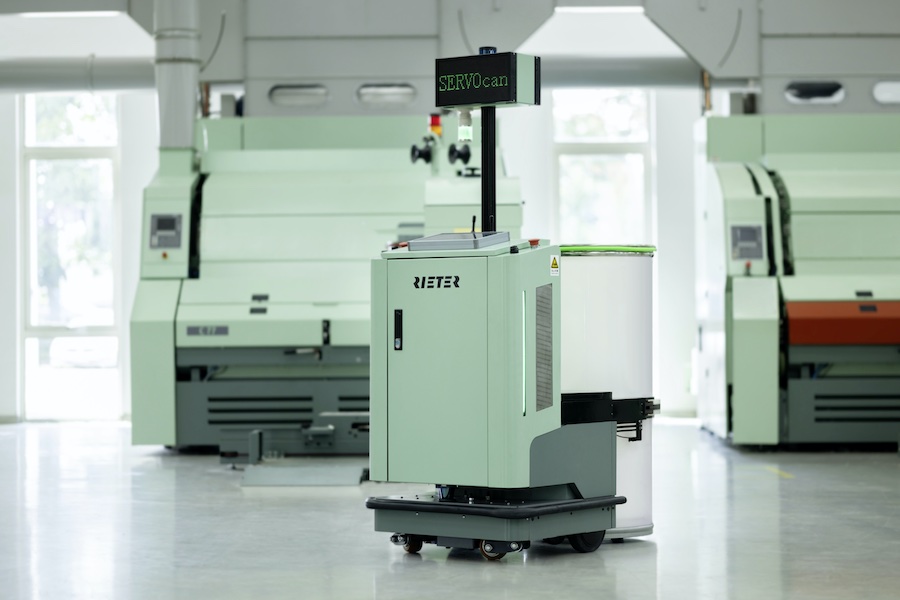
Rieter Servocan © 2026 Rieter
Rieter successfully completed the acquisition of Barmag on February 2, 2026, and reached an important milestone in the company’s repositioning. Barmag will be integrated into the Rieter Group as the “Man-Made Fiber” Division. With this strategically transformative acquisition, Rieter is expanding its core business beyond the short-staple fiber business in a targeted way. This positions Rieter as the global market leader along the entire value chain for natural and man-made fibers. In addition, as a complete systems supplier, Rieter is further strengthening its technological leadership in the areas of automation and digitization.


The transaction is a consistent step in implementing Rieter’s long-term growth strategy and builds on previous acquisitions that have systematically expanded the portfolio. Since acquiring the automatic winding machine in the 2021 financial year, Rieter has been the only system supplier covering the entire production process from fiber preparation to all four end-spinning technologies.

Through the acquisition of Barmag, Rieter is expanding its sales markets to include the structurally growing man-made fiber market. With this additional technological breadth, Rieter increases its resilience and reduces dependence on cyclical fluctuations in individual end markets. This paves the way for Rieter to capitalize on the expected recovery of the global textile machinery market. At the same time, the Man-Made Fiber Division strengthens Rieter’s market position in the long term in the strategically important Asia region.

Order intake

Order intake remained constant on a currency-adjusted basis. It amounted to CHF 703.4 million in 2025 (2024: CHF 725.5 million). The expected wider market recovery has been delayed due to the ongoing global trade conflict (particularly the punitive US tariffs) and geopolitical uncertainty.

The Machines & Systems Division posted an order intake of CHF 346.3 million (2024: CHF 364.2 million). While the Machines & Systems Division recorded an increase in demand, order completion was significantly impacted by uncertainty surrounding customs tariffs and the geopolitical and economic situation.

The Components Division generated an order intake of CHF 193.5 million (2024: CHF 206.6 million) and is suffering under lower demand for components for new machines, mainly due to the cautious investment activity in the market.

The After Sales Division recorded a pleasing 6% increase in its order intake to CHF 163.6 million (2024: CHF 154.7 million). This positive development confirms the strategic growth initiatives that have been launched. Incoming orders are benefiting from increased sales activities in the target markets, such as Central Asia and China, as well as from the ongoing expansion of the service and repair network.

Sales

The Rieter Group closed the 2025 financial year with sales of CHF 685.1 million (2024: CHF 859.1 million), thus remaining 20% below the previous year’s period.

The Machines & Systems Division posted sales of CHF 329.1 million, down 23% on the previous year (2024: CHF 424.9 million). Sales in the Components Division fell by 19% year on year to CHF 200.8 million (2024: CHF 247.6 million). The After Sales Division posted sales of CHF 155.2 million, down 17% over the previous year (2024: CHF 186.6 million).

Order backlog

At the end of 2025, the company had an order backlog of around CHF 510 million (December 31, 2024: CHF 530 million).

Operating EBIT, net profit, free cash flow

Despite the decline in sales, Rieter achieved a positive operating EBIT of CHF 2.5 million (before restructuring and transaction costs). This is primarily attributable to the consistent implementation of additional cost measures. Owing to extraordinary restructuring expenses and transaction costs in connection with the acquisition of Barmag in the amount of CHF 54.2 million, Rieter closed the 2025 financial year with a net loss of CHF 63.4 million (2024: net profit of CHF 10.4 million).

Free cash flow was CHF -40.6 million (2024: CHF 14.1 million). Owing to the capital increase already completed to finance the acquisition of Barmag, net liquidity amounted to CHF 184.3 million (2024: CHF -230.3 million).

The equity ratio increased to 53.3% as of December 31, 2025 (previous year: 33.7%), which was due in particular to the capital increase completed in October 2025 in connection with the Barmag acquisition. The acquisition was completed on February 2, 2026.

Dividends

The Board of Directors proposes to the shareholders that no dividend be distributed in view of the negative Group result. The company continues to adhere to its fundamental dividend policy of distributing at least 40% of net profit.

New medium-term targets

Rieter is pursuing a soft integration approach for Barmag. In this context, Rieter confirms a preliminary synergy assumption of at least CHF 20 million resulting from the acquisition. These synergies are reflected in the new medium-term targets. An update on the realization of synergies will be provided with the results for the first half of 2026.

Rieter sees strong potential for the combined company beyond 2026. To this end, it has defined three new market scenarios following the successful realization of synergies from the Barmag acquisition:

Low scenario

In a subdued market environment with slow recovery in terms of demand and ongoing price pressure, sales of around CHF 1.4 billion are expected, with an operating EBIT margin of 2 to 5%.

Medium scenario

In a normalized market environment with stable demand, sales of around CHF 1.8 billion are expected, with an operating EBIT margin of 5 to 8%.

High scenario

In a strong market environment with broad-based demand and high capacity utilization, sales could reach CHF 2.2 billion, with an operating EBIT margin of 8 to 11%.

Outlook for 2026

In 2026, a year of transition, Rieter expects sales in the range of CHF 1.3 to CHF 1.5 billion.

The outlook for 2026 reflects the integration of Barmag and the restructuring measures announced in 2025, which are yet to be fully implemented. As a result, a positive operating EBIT margin in the range of 0 to 3% is expected. Financing for the further development of the combined company is fully secured.
More News from Rieter Textile Systems

#Spinning

Rieter responds to higher raw material prices

Global political and economic developments have been leading to rising raw material and energy costs for some time. The textile machinery industry is also affected by this trend. Rieter machines and components consist to a large extent of steel, copper, aluminum and electronics. These materials in particular have seen higher demand and higher prices in recent months.

#Spinning

Rieter completes acquisition of Barmag

Rieter has successfully completed the acquisition of Barmag as of February 2, 2026. This strategically important acquisition makes Rieter the world’s leading system provider for natural and synthetic fibers.

#Spinning

Rieter adjusts group structure in preparation for Barmag integration

The planned acquisition of the “Barmag” Division of OC Oerlikon will create the leading system provider worldwide for natural and man-made fibers. Rieter is confident it will receive all regulatory approvals to complete the acquisition in the fourth quarter of 2025. The Rieter Group is therefore adjusting its Group structure as of January 1, 2026, to take this acquisition into account and to be able to provide an even more agile response to market challenges.

#Spinning

Rieter reports stable order backlog and strategic progress – outlook for 2025 adjusted

In its Investor Update 2025, Rieter announced an order intake of CHF 203.9 million in the third quarter and CHF 559.3 million after nine months, reflecting a continued cautious investment climate in the textile machinery sector. Sales totaled CHF 121.5 million in the third quarter and CHF 457.7 million for the first nine months of the year, while the order backlog stood at around CHF 590 million as of September 30, 2025.

More News on Spinning

#Spinning

Measure and control the fiber – optimize yarn quality

Producing consistent yarn quality is an everyday challenge – and a very difficult one. Detailed knowledge and understanding of the fiber raw material is absolutely critical to achieving the best possible quality in the yarn. To help spinners, Uster experts have put together guidelines for avoiding yarn irregularity claims, in a special edition of the Uster News Bulletin.

#Spinning

A breakthrough innovation for diaper manufacturers

Developed and manufactured by Mesdan, Italy, the Loop knotter type 093E is a special version of the well-known Loop knotter, specifically designed to join hygiene-grade spandex yarns used in the personal care industry.

#ITM 2026

The hub of smart and sustainable transformation in yarn technologies: ITM 2026

With global fiber production projected to reach 169 million tons by 2030, yarn manufacturing is becoming one of the most strategic fields within the textile machinery industry. Located in Halls 6, 7, and 10, the Yarn Hall at ITM 2026 is set to bring together industry professionals with innovative solutions developed around automation, energy efficiency, digitalization, and circular production.

#Spinning

Barmag: DTY efficiency for the future of fancy yarns

Fancy yarns continue to gain importance in the textile market: Whether in fashion, home textiles or the automotive industry - the trend towards individuality is fueling the demand for textured, haptically differentiated and at the same time comfortable yarns.”

Latest News

#Digital Printing

Hybris Productions scales licensed apparel production moving from screen to digital with Kornit Digital

Kornit Digital, a global pioneer in sustainable, on-demand digital fashion and textile production technologies, today announced that Hybris Productions has adopted Kornit’s direct-to-garment (DTG) digital production technology to scale licensed apparel manufacturing with greater speed, design flexibility, and on-demand production capabilities supporting retail and e-commerce growth.

#Composites

STFI at JEC

The Sächsisches Textilforschungsinstitut e.V. (STFI) will present composites for aviation made from recycled carbon fibres and natural fibres, as well as printed lightweight elements for surface heating in electric vehicles at JEC World in Paris.

#Nonwovens

Change in Suominen Leadership Team: Minna Rouru to pursue new opportunities outside the company

Suominen Chief People and Communications Officer (CPCO) Minna Rouru has announced her decision to leave Suominen to take on a role in another company. She will leave Suominen at the latest on August 26, 2026. The CPCO succession process has been initiated and will be announced in due course.

#Research & Development

Fabolose: Fabricating vegan and circular leather alternatives from bio-tech-derived cellulose

Fabulose is an EU funded project coordinated by the German Institutes of Textile and Fiber Research (DITF). Its consortium consists of leading research institutes, biotech innovators, and industry stakeholders who aim to create high-performance, biobased and recyclable leather-like fabrics, using efficient biotech production routes for bacterial cellulose, cyanophycin and bacterial pigments

TOP