[pageLogInLogOut]

#Spinning

Reifenhäuser extrusion lines provide carbon footprint calculation for more sustainable and economical production

Reifenhäuser is presenting a new digital solution for carbon footprint calculation at K 2022: the Carbon Footprint Dashboard. This enables film and nonwovens producers to see how the carbon footprint changes in ongoing production and identify how they can reduce their emissions. The dashboard thus contributes both to climate protection and to economic success, because a CO2 reduction is usually also accompanied by savings in energy and raw materials. The prerequisite for the carbon footprint calculation is the standard version of Reifenhäuser's digital solution ExtrusionOS & c.Hub Middleware and the availability of the required data.

Dr. Tim Pohl, Director Sustainability and Business Development at the Reifenhäuser Group, explains: "The Carbon Footprint Dashboard shows the different emission sources over the production period. In the basic version, assumptions are made about the carbon footprint of the raw materials used and the calculation is based on the energy mix of Europe, for example. This is sufficient to determine initial potential for carbon footprint reduction. If more precise information is required, we can customize the calculation according to local conditions. Such a calculation becomes exciting when in-house recycled material is used."

Carbon footprint calculation for manufacturing companies is quite complex and starts with the different methods of calculation - at the company level, but also at the product level. The corporate carbon footprint (CCF) balances the CO2 footprint for the entire company - from energy procurement to production to the vehicle fleet. The product carbon footprint (PCF) records all CO2 emissions that occur along the life cycle of a product, i.e. from raw materials to production and use to disposal.

Manufacturers of films and nonwovens can therefore approach the topic of calculation "bottom-down" via a corporate carbon footprint, or they can do it "bottom-up" via a product carbon footprint for each of their products. The latter is ideal if a broad product portfolio with different raw materials and recycled content is processed. For this purpose, a customer-specific carbon footprint dashboard can be created in Reifenhäuser's ExtrusionOS software solution.

From an economic point of view, the carbon footprint calculation is worthwhile in any case: Producers can show the carbon footprint to third parties and thus certify a particularly sustainable product series, for example. This opens up new sales markets and increases economic success. In addition, the savings in energy and raw materials pay off, especially in view of the current high purchase prices.
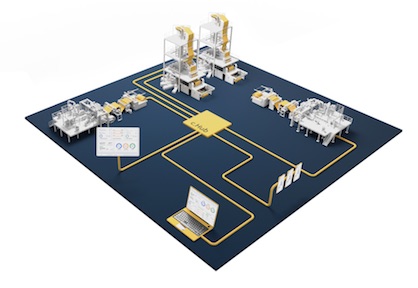
Reifenhauser Digital Ecosystem (c) 2022 Reifenhauser


Carbon footprint of a Reifenhäuser extruder

The Reifenhäuser Group has been following the path of the corporate carbon footprint for 10 years now. The machine manufacturer is energy certified according to ISO 50001 and reduces its emission sources every year. This year, for example, this includes the installation of a new photovoltaic system with which Reifenhäuser can produce more than 600,000 kWh of electricity and save approximately 175,000 kilograms of CO2 equivalents.

In addition, the PCF of components, such as screws and barrels, and of entire extruders was determined. One finding is that emissions during the production of the line components are significantly lower than emissions during the use phase. For example, the production of a 120 extruder generates a calculated one-time emission of around 27,000 kilograms of CO2 equivalents. In contrast, the operation of the extruder causes around 3.5 million kilograms of CO2 equivalents through electricity consumption over the course of ten years. In this case, the manufacturing process causes less than one percent of the PCF along the life cycle. By contrast, 99 percent is generated during the use of the extruder - so the leverage for reducing emissions is much greater at this stage. For extruder operators, investing in energy-efficient technologies and subsequent energy-saving measures is therefore doubly worthwhile - both the wallet and the environment benefit.

Carbon Footprint Dashboard at K 2022:

Reifenhäuser main booth: Hall 17 / C 22

More information and illustrations on the subject of sustainability

can be found at: www.reifenhauser-sustainability.de


More News from Reifenhaeuser GmbH & Co. Maschinenfabrik

#Industry 4.0 / Digitalization

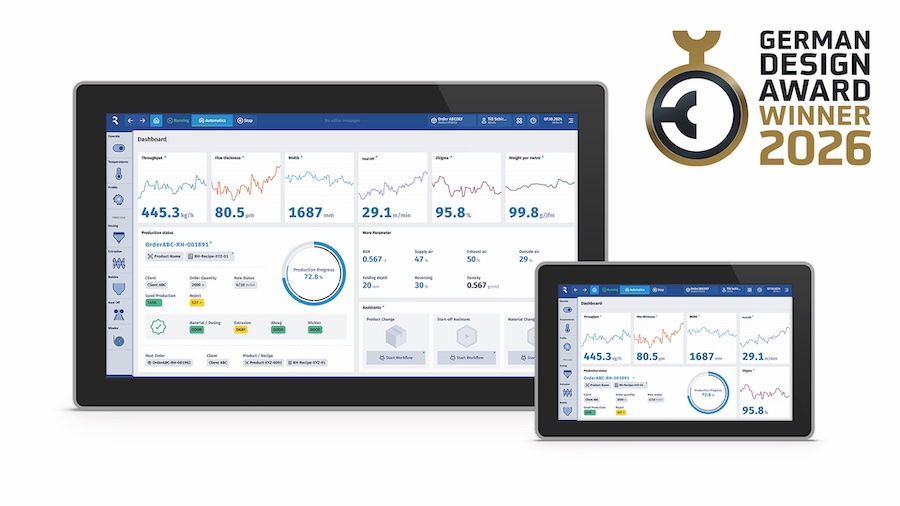
Reifenhäuser wins German Design Award for new user interface

At K 2025 in Düsseldorf, the Reifenhäuser Group unveiled its new company-wide machine user interface, which offers a uniform design language for blown film, flat film, and nonwoven lines – and stands out for its particularly simple operation. The overall concept impressed not only customers, but also the jury of the German Design Awards, who honored the system with the prestigious design prize during the trade fair.

#Industry 4.0 / Digitalization

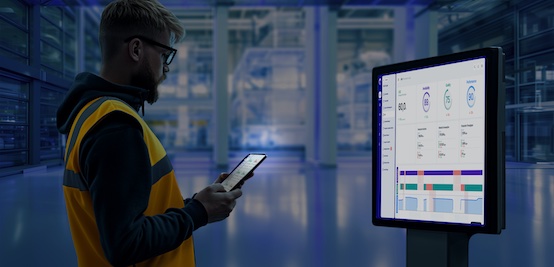
Reifenhäuser NEXT: Tackling the skills shortage and achieving operational excellence with industrial AI

At K 2025, the Reifenhäuser Group will demonstrate Industrial AI's full potential for productivity in plastics processing. At the heart of the dedicated “Reifenhäuser NEXT” brand is a powerful AI chatbot that enables even inexperienced line operators to quickly solve complex tasks in their daily work, thereby maximizing availability, productivity, and quality.

#Spinning

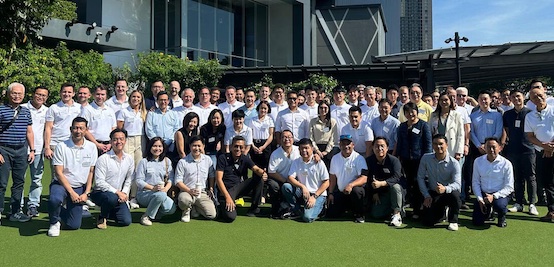
Reifenhäuser opens new Head Office Asia-Pacific in Bangkok

Reifenhäuser, leading global supplier of plastics extrusion technology, has opened its new Head Office Asia-Pacific in Bangkok (Thailand). In future, all sales, service and after-market activities for the Southeast Asian region will be managed centrally from Bangkok.

#Spinning

Reifenhäuser strengthens field service operations in the Middle East and Africa

Reifenhäuser Group, a global leader in plastics extrusion technology, announces a significant expansion of its field service operations across the Middle East and Africa (MEA) region. Building on a longstanding presence in the region, which includes a sales office established in United Arab Emirates five years ago, Reifenhäuser is now taking a major step forward to enhance its local customer support and service capabilities.

More News on Spinning

#Spinning

Rieter advances strategic repositioning amid market volatility

Rieter successfully completed the acquisition of Barmag on February 2, 2026, and reached an important milestone in the company’s repositioning. Barmag will be integrated into the Rieter Group as the “Man-Made Fiber” Division. With this strategically transformative acquisition, Rieter is expanding its core business beyond the short-staple fiber business in a targeted way. This positions Rieter as the global market leader along the entire value chain for natural and man-made fibers. In addition, as a complete systems supplier, Rieter is further strengthening its technological leadership in the areas of automation and digitization.

#Spinning

Measure and control the fiber – optimize yarn quality

Producing consistent yarn quality is an everyday challenge – and a very difficult one. Detailed knowledge and understanding of the fiber raw material is absolutely critical to achieving the best possible quality in the yarn. To help spinners, Uster experts have put together guidelines for avoiding yarn irregularity claims, in a special edition of the Uster News Bulletin.

#Spinning

A breakthrough innovation for diaper manufacturers

Developed and manufactured by Mesdan, Italy, the Loop knotter type 093E is a special version of the well-known Loop knotter, specifically designed to join hygiene-grade spandex yarns used in the personal care industry.

#Spinning

Rieter responds to higher raw material prices

Global political and economic developments have been leading to rising raw material and energy costs for some time. The textile machinery industry is also affected by this trend. Rieter machines and components consist to a large extent of steel, copper, aluminum and electronics. These materials in particular have seen higher demand and higher prices in recent months.

Latest News

#Recycled_Fibers

Selenis to double capacity in Portugal by Q3 2027 - Accelerating the Global transition to circular and low-carbon polyesters

Selenis, a global leader in high-performance specialty polyesters and part of the IMG Group, has announced a transformational expansion of its industrial headquarters in Portalegre, Portugal. This strategic investment is set to double the site’s production capacity by the third quarter of 2027, significantly accelerating the industrial scale-up of bio-based, medical-grade, and circular co-polyesters.

#Technical Textiles

Independent testing confirms no detectable PFAS in Milliken firefighter turnout gear fabrics

Independent laboratory testing has confirmed that Milliken fabrics used in the manufacturing of firefighter turnout gear contain no detectable PFAS, based on third-party analysis conducted by Forever Analytical, an independent laboratory specializing in screening products and environmental samples for the presence of per- and polyfluoroalkyl substances (PFAS).

#Home Textiles

Intertextile Shanghai Home Textiles returns in August as global sourcing hub and trend barometer for home textiles industry

Following the conclusion of Heimtextil last month, the flagship fair in Messe Frankfurt’s global home and contract textiles portfolio, Intertextile Shanghai Home Textiles – Autumn Edition will return 18 – 20 August 2026 at the National Exhibition and Convention Center (Shanghai). Building on the momentum generated in Frankfurt, the Shanghai fair will reinforce its position as the foremost home and contract textile platform in Asia – successfully bridging the gap between East and West, and connecting global product trends, supply-chain shifts, and buyer demand in one marketplace.

#Digital Printing

Express Print boosts production using an expanded fleet of Mimaki technologies

Express Print, a fast-growing Bulgarian provider of visual communication and soft signage solutions, has significantly enhanced its production workflow with a comprehensive portfolio of Mimaki digital printing systems. Based in Varna and active for more than 10 years, the company maintains a strong focus on the advertising sector. Over the years, it has steadily expanded its operations, driven by a clear vision to bring the full spectrum of large-format printing services in-house, avoiding outsourcing and ensuring complete control over production quality.

TOP