[pageLogInLogOut]

#Spinning

Spinners know what they want
© 2021 Uster
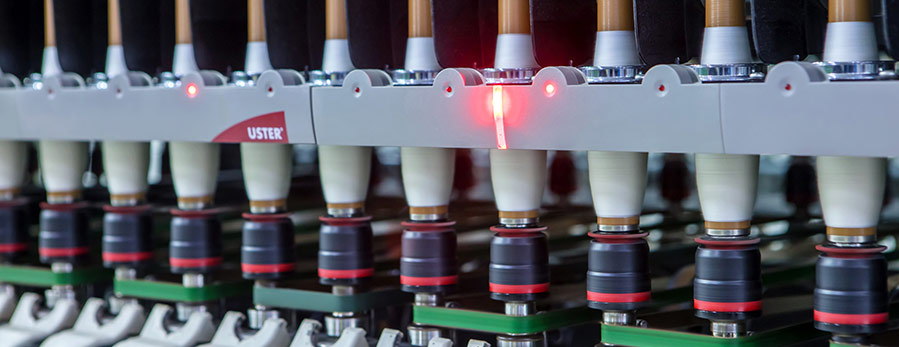
… and how to get it with Uster RSO 3D. For the first time, mills can now intelligently correlate ring quality data and winding quality data in a single system – for significant profitability increases. RSO 3D is the ‘third dimension’ of quality. A case study from practice shows how a mill made real gains, with the vital figures to prove it.

An ambitious spinner was aiming to reach the next level of quality management. For this customer, it was essential that quality, as well as profitability, had to be improved. The medium-sized spinning mill in India installed Uster-Muratec RSO 3D as part of an expansion project. The installation includes 30 compact ring spinning machines with Uster Sentinel, in combination with Muratec QPRO EX/FPRO EX featuring Spin Inspector and Uster Quantum yarn clearers. On these machines, the customer produces 100% combed cotton yarn, in counts Ne 26 and Ne 32.

Advantages in percentages

When the new installation was being started up, a direct comparison between RSO 3D and the standard installation was executed as a trial to demonstrate the difference.

The evidence showed that the spinner was able to reduce yarn faults by 10% and yarn alarms by 12% in both counts with RSO 3D. Quality blocks were reduced by a further 7% and finally clearer quality cuts by 8%.

Overall, this spinner was able to reduce the total yarn splices by 5%, producing about 5 kg more good yarn per machine per month.
© 2021 Uster
© 2021 Uster


Money talks, clearly

The mill’s results are impressive. Some small calculations convert the facts into numbers. Let’s start with energy savings. By reducing yarn joints on the winding machines, the customer needed less compressed air and thus less electricity for the machine compressor unit. These savings together amount to approximately 954 kWh per machine per month. Calculated at about 0.08 USD (6 INR) per kWh, this comes to 77 USD (5,724 INR) per machine per month. With 30 machines, this amounts to 27,720 USD (almost 2 million INR) the whole year.

On top of the financial savings, the mill also noted an increase in the level of ‘good’ material. The 5 kg reduction in waste means there is 5 kg more good yarn per machine every month which can be sold. With 30 machines, this totals 1800 kg more yarn per year. Based on a price of 3.77 USD (280 INR/kg), this achieves an increase in sales worth another 6,786 USD (500,000 INR).

Combining both these calculations, the overall gain for the spinner totals 2.5 million INR per year, equivalent to about 35,000 USD/year, apart from significant savings due to reduced clearer cuts.

Further advantages can also be expected in downstream processes. Fewer cuts mean the yarn has fewer potential weak points leading to less stoppages due to yarn breaks. This makes it possible to adapt subsequent process speeds, while the customer will also benefit from an improved fabric appearance.


Operators benefit too…

The working area for machine operators could be increased significantly – while reducing the stress factor. This is possible because Uster Sentinel notifies the operators from a distance about individual yarn breaks. The system uses signal lamps at the head of the machine, at the relevant section, and at the affected spinning position. So, the operator is logically guided to the next yarn break, instead of having to search laboriously for yarn breaks along all machine sides.

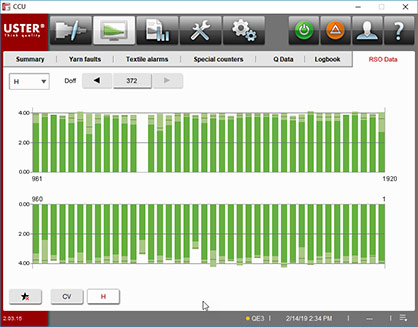
When an operator locates a yarn break, the type of break is indicated at the spinning position. Different signals categorize the problem as either Slip, Off Quality, Rogue or RSO 3D alarm. At this mill, operators are instructed to deal exclusively with yarn breaks, but not with the RSO 3D alarms. These are the responsibility of highly-trained technicians, because RSO 3D alarms indicate a faulty setting at the spinning position, and repairing them is both necessary and time-consuming. The RSO 3D alarms are displayed to the technicians by the Sentinel LEDs, and also on the Quantum control unit (CCU), as well as on the RSO 3D Quality Map.

As a result, the customer can deploy trained personnel in a very targeted and efficient manner. At the same time, the mill could increase spinning capacity and the working areas of the operators through path optimization.

Rapid payback

Individual quality data for each spindle position enables quality mapping across the ring spinning machine. This helps to identify outlier sides, sections or spindles, in addition to supporting maintenance decisions. Quality mapping also enables users to trace problems back to the individual roving machine and bobbin. Thanks to quality mapping, spinners can keep the entire ring spinning machine under control – and their profits as well.

RSO 3D proves its worth, for every cent invested, because of cost savings through reduced compressed air use and savings in energy. Payback comes earlier with the higher production efficiency based on saving cuts. It means the extra amount of good yarn sold is equal to what would have otherwise been wasted at the winding machine.

“The customer is convinced of Uster RSO 3D because of the increased spinning productivity and profitability, as well as facing the challenge of the lack of well-skilled staff by utilizing trained personnel in a very targeted and efficient manner,” says Amol Kekre, General Manager Sales & Marketing at Uster’s subsidiary in India.

Bigger profits come with increased quality standards, because of much smoother running at the winders. Claims are a thing of past and increased production efficiency assured for the future. The spinner’s downstream customers will also be delighted to increase production speed in their own processes – and to improve fabric appearance at the same time.

More News from Uster Technologies AG

#ITMA Asia + CITME Singapore 2025

Uster presents novelties at ITMA Asia + CITME 2025

There’s news from Uster Technologies to be announced for the industry’s upcoming event in Singapore. The Uster 360Q universe is growing with new products, solutions and services. Innovation developments can also be recorded in the fields of man-made fiber testing and fabric inspection. Uster innovations address the industry’s trending topics as mill management and process control, optimization of delivered fabric quality and yield.

#Spinning

Uster Technologies marks 150 years of empowering quality excellence

Uster Technologies marks 150 years of excellence – a milestone that reflects continuous adaptation to customer needs and industry change. Over the decades, Uster has evolved from manufacturing quality testing instruments into a trusted partner shaping the future of textile production.

#Recycling / Circular Economy

Challenges of making yarn from recycled fibers

What does it take to spin quality yarn from recycled fibers? Uster Technologies brought textile industry leaders together to discuss the role of technology, data and automation – as well as the current challenges in using recycled raw material. Experts from Rieter, Säntis Textiles, Otto Yarns, and TVU commented on the current situation and looked into the future of spinning in a panel discussion organized at Uster headquarters.

#Spinning

Uster Technologies wins another infringement lawsuit

In a ‘victory for innovation in China’ Uster Technologies has secured a decisive judgment in a patent infringement lawsuit against a competitor. The final ruling by the Supreme People’s Court of PR China confirms that the competitor’s actions in copying the patented yarn feeder of the Uster Tester 6 constitute unlawful infringement.

More News on Spinning

#Spinning

Rieter responds to higher raw material prices

Global political and economic developments have been leading to rising raw material and energy costs for some time. The textile machinery industry is also affected by this trend. Rieter machines and components consist to a large extent of steel, copper, aluminum and electronics. These materials in particular have seen higher demand and higher prices in recent months.

#ITM 2026

The hub of smart and sustainable transformation in yarn technologies: ITM 2026

With global fiber production projected to reach 169 million tons by 2030, yarn manufacturing is becoming one of the most strategic fields within the textile machinery industry. Located in Halls 6, 7, and 10, the Yarn Hall at ITM 2026 is set to bring together industry professionals with innovative solutions developed around automation, energy efficiency, digitalization, and circular production.

#Spinning

Barmag: DTY efficiency for the future of fancy yarns

Fancy yarns continue to gain importance in the textile market: Whether in fashion, home textiles or the automotive industry - the trend towards individuality is fueling the demand for textured, haptically differentiated and at the same time comfortable yarns.”

#Spinning

Perfect quality through collaboration: Machinery from Trützschler, Toyota and Murata at Zirve Tekstil

In today’s textile industry, excellence is not achieved by chance – it’s the result of deliberate decisions, technical expertise, and the courage to go beyond conventional paths. The Turkish company Zirve Tekstil has done just that: by combining the best technologies from Trützschler, Toyota and Murata, they’ve created a production setup that delivers outstanding yarn quality – recognized worldwide.

Latest News

#Sustainability

Ying McGuire becomes new CEO of Cascale

Cascale today announced the appointment of Ying McGuire as Chief Executive Officer, effective June 1, 2026.

#Technical Textiles

Sustainable, lightweight, and sound absorbing: Polyester-based front trunk solution for BEVs

As car manufacturers look to further reduce their carbon footprint, Autoneum has developed an innovative front trunk solution for battery electric vehicles (BEVs), made entirely from polyester-based textile. The Ultra-Silent Frunk offers significant weight reduction, improved acoustic and thermal insulation, and uses up to 70 percent recycled material, supporting sustainable and efficient vehicle design. Autoneum, global technology leader in acoustic and thermal management for vehicles, has already received orders for the new frunk from three major OEMs in Asia and Europe to be built in three BEV models. Series production for two BEVs has been underway in China and Germany since last year.

#Raw Materials

Modern testing methods for raw cotton

The 38th International Cotton Conference Bremen will take place from 25 to 27 March 2026 at the Bremen Parliament. This conference has traditionally stood for in-depth expertise and international exchange. The program will focus on technical innovations, market trends, and regulatory frameworks across the entire value chain – from agriculture to the circular economy. With high-profile speakers, the conference is regarded as the key meeting point for the global cotton industry. Today’s focus: Cotton quality and testing methods.

#Weaving

Stäubli demonstrates how innovation translates into real benefits for weaving mills at SITEX 2026

One of India’s most prominent textile industry events, SITEX 2026, is held from February 21 to 23 in Surat. Committed to empowering Indian weaving mills with state‑of‑the‑art solutions tailored to regional needs, Stäubli will present a selection of solutions designed for performance, reliability, and power efficiency. Through its weaving preparation, cam and dobby shedding solutions and Jacquard technologies, Stäubli highlights its global expertise tailored to the specific needs of the local market.

TOP