[pageLogInLogOut]

#Spinning

Competing in the DTY Specialties Market
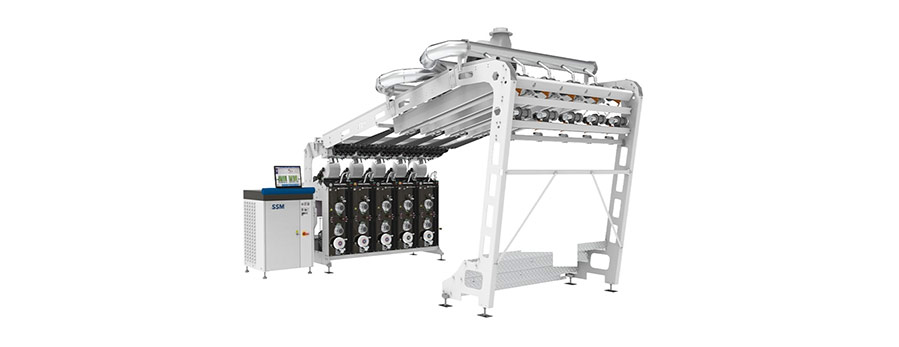
SSM DP5-FT © 2021 SSM
False-twist texturing is a cost-competitive sector of the textile industry. A winning strategy in this area is to produce specialty yarns with added value. With the launch of the new false-twist texturing machine DP5-FT, SSM is offering the right tool for this specialties market.

The SSM single-position machine concept for various applications 

Polyester DTY (Drawn Textured Yarn) was first produced in the 1960s and has since become a commodity yarn. However, over time, polyester yarns have evolved to be used in a variety of specialty yarns, ranging from coarse denier per filament (dpf) to micro-filament and even super-micro-filament yarns. These yarns can be used to produce fabrics with a very soft touch and a light weight.

Filaments with different cross-sectional shapes improve perspiration evaporation or provide the fabric with a distinctive luster. Another specialty is achieved by encapsulating functional chemicals directly into the polymer to create fabrics with additional characteristics such as anti-bacterial properties to eliminate odors or using infrared body emissions to increase body temperature. Furthermore, an increase in dope dyed POY (Partially Oriented Yarn) brings advantages for color fastness and in terms of environmental friendliness, as no subsequent dyeing is required.

All these specialties are the new standard in DTY and bring new challenges for texturizers, e.g., the need for more flexibility in production, as more specialties mean more but smaller lots to be produced. Thanks to the DP5-T, SSM is already in a strong leading position in the air-texturing market; now it is solidifying this position by launching the most flexible false-twist texturing machine, the DP5-FT (Fig. 1).

A single-position machine concept for full flexibility

An entire DP5-FT machine with 40 positions can be set up with up to 40 different recipes. Every position is almost a standalone false twist (FT) machine with its own heater, control board and is furthermore equipped with individually driven, programmable motors.

There is no need to invest in an equivalent laboratory machine. Customers can simply dedicate one or multiple positions of the DP5-FT to trials and sampling. The position(s) can be reassigned back to normal production later to maximize efficiency and reduce sampling costs.

The individual position concept also brings advantages in terms of power consumption and production efficiency. Unlike shaft machines, the power consumption of a position is reduced when it is not in use, as all affected motors are stopped. Moreover, a power-saving function can be activated after a certain amount of idle time has elapsed to reduce the temperature of the heater and godet – maximizing the potential savings. On a running shaft machine, it is also common to find positions without yarn, because a wrap after a yarn break cannot safely be removed while running, or because a faulty position is awaiting the next machine stop. There are no such limitations with an individual position machine concept because each position can be stopped individually and serviced immediately, resulting in higher machine efficiency.

Last but not least, the DP5-FT is the first choice for manufacturers whose top priority is personal safety, as the individual position concept allows the use of much smaller motors, limiting the risk of severe injuries to operators.


Flexibility to increase production capacity

The high flexibility of the DP5-FT is reflected in the minimum available number of five positions only, making it the perfect solution for customers entering the DTY business. It enables full flexibility in terms of lot sizes, types and counts of DTY yarns as well as better control of the supply chain. If a customer later wants to increase the DTY production capacity, the machine can be extended to include up to 40 positions without changing the head stock and using the same machine terminal.

Full control and inspection without stopping the machine

A unique feature of SSM texturing machines is the heated godet (Fig. 2) to heat-set the DTY yarn and achieve the required elasticity. This is state-of-the-art in the production of polyester DTY yarns. Due to their length, tube heaters on competitors’ machines are installed at the rear of the machine or underneath the catwalk. Therefore, operators can’t inspect them during production or remove the internal tube periodically for cleaning. On SSM texturing machines, the heat-setting godet is located at the front of the machine, enabling full control and inspection of the entire yarn path at any time without stopping the machine. Instead of using a tube heater with a predefined length, using a godet also allows operators to influence the duration of the heat setting process by increasing or decreasing the number of wraps around the godets.
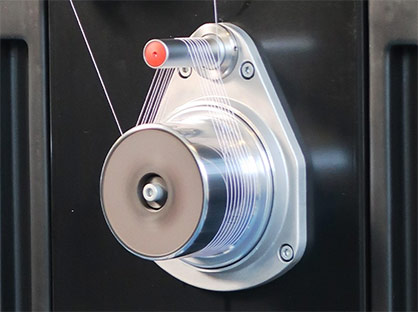
SSM DP5-FT Godet © 2021 SSM


With this modern machine concept, SSM offers texturizers a proper tool to stay at the forefront of the competitive DTY specialty market.

More News from SSM Schärer Schweiter Mettler AG

More News on Spinning

#Spinning

Graf at EXINTEX – Strengthening presence in Latin America

Graf successfully participated in EXINTEX, one of the leading textile exhibitions in Latin America, together with its local agent Eurotecnica. The exhibition provided an excellent platform to engage with customers, partners and industry experts across the region.

#Spinning

Temco launches a new DTY all-in-one solution

Temco introduces the DTY All-in-One Solution – a fully harmonized set of components engineered to give customers a highly stable, low maintenance and reproducible process environment. The solution reduces interruptions, extends component lifetimes and supports consistent yarn quality across all machine positions. All-in-One Solution – a fully harmonized set of components engineered to provide maintenance and reproducible process environment.

#Techtextil 2026

DIENES at Techtextil 2026: Flexible pilot lines for bio-based fiber development

The growing relevance of bio-based materials in technical textiles is accompanied by increasing demands for reproducibility, high-quality data, and scalable process routes. Especially when working with cellulose and its derivatives, chitosan, lignin-based approaches, or bio-based PAN as a carbon-fiber precursor, R&D teams face variable feedstock quality, tighter process windows, and the need for reliable comparability across trials. This calls for flexible, data-driven experimental setups that can be reconfigured efficiently when recipes, solvents, and raw-material batches change.

#Techtextil 2026

RETECH showcases high-precision godets for high-performance fiber processing at Techtextil 2026

RETECH designs and manufactures godets and draw frames for heated, ambient and cooled processes, enabling precise heat treatment and consistently high yarn quality for a wide range of polymers and applications, with process temperatures of up to 400 °C for high-performance fibers. The company’s key competence lies in exact and stable temperature and speed control, individually adapted to the specific material and process requirements.

Latest News

#Techtextil 2026

AI, Start-ups, Research: Techtextil and Texprocess bring together players in the textile industry

From start-ups to universities and research institutes: at Techtextil and Texprocess, the world’s leading innovation trade fairs in Frankfurt am Main, exhibitors present future-oriented concepts for the global textile industry. With the international Campus & Research area, a strong participation from start-ups and the latest AI applications for textile processing, both trade fairs showcase current developments in the textile industry. By bringing together innovation, research and application, they enable new partnerships across the textile value chain.

#Techtextil 2026

IVGT joint stand brings innovation and networking to Techtextil 2026

At Techtextil 2026 and the parallel Texprocess 2026, key transformation topics such as artificial intelligence, digitalisation, sustainability, recycling and the circular economy will be reflected across the show. Against this backdrop, the IVGT, together with 16 member companies, will present its joint stand in Hall 12.1 (Stand D62) as a platform for exchange and networking.

#Man-Made Fibers

Indorama Ventures supports Southeast Asia’s textile customers with reliable regional supply and global innovative portfolio

Indorama Ventures, one of the leading global polyester fiber and filament yarn suppliers globally, will participate in Indo Intertex 2026 in Jakarta this April, making its diverse global portfolio available to apparel, home textile, and hygiene customers across Southeast Asia.

#Raw Materials

New study shows low environmental impact by Cotton made in Africa Organic Cotton from Tanzania

Today, the Aid by Trade Foundation (AbTF) is announcing the results of a comprehensive life-cycle analysis (LCA) for cotton produced in Tanzania under the Cotton made in Africa Organic (CmiA Organic) standard. The study emphasises the small ecological footprint of CmiA Organic verified cotton. This can largely be traced back to the absence of synthetic pesticides, artificial fertilisers, and artificial irrigation. Consequently, CmiA Organic cotton can help the textile industry meet regulatory requirements as well as science-based targets. The results also show that the consequences of climate change threaten the livelihoods of these cotton farmers, even though the type of agriculture they practise barely contributes to climate change.

TOP