[pageLogInLogOut]

#Spinning

Hybrid customer service is currently the present and future

In order to continue providing the best-possible customer service throughout the manmade fiber industry during the coronavirus pandemic, the Manmade Fibers segment of the Swiss Oerlikon Group has comprehensively adapted its offerings to the requirements of all its customers across the globe. In doing so, it has developed – both for the present and for the future – a practicable, sustainable and attractive solution: hybrid customer service.

Oerlikon’s global Service Network combined with digital solutions:

The range of customer services for the machines and systems of the Oerlikon Barmag, Oerlikon Neumag and Oerlikon Nonwoven competence brands is broad and covers all customer requirements throughout the world. The ‘Start-up Services’, such as assembly and commissioning for the products that are continuing to be delivered during the coronavirus pandemic, are presently the greatest challenge. However, Oerlikon has excellent local service set-ups in its core markets of China, India, the USA and Turkey. Customers in Europe are looked after by staff at the German sites. As a result, virtually all projects have been successfully carried out over the past few months despite the difficulties. This was the case above all in China. Due to the travel restrictions relating to China, experienced construction site managers from Germany were involved by mean of videoconferencing, for example. “A particular challenge for all parties – but well-mastered by our team together with our customers in accordance with the circumstances”, explains Wolfgang Ernst, Head of Customer Services and Service Sales at Oerlikon Manmade Fibers.

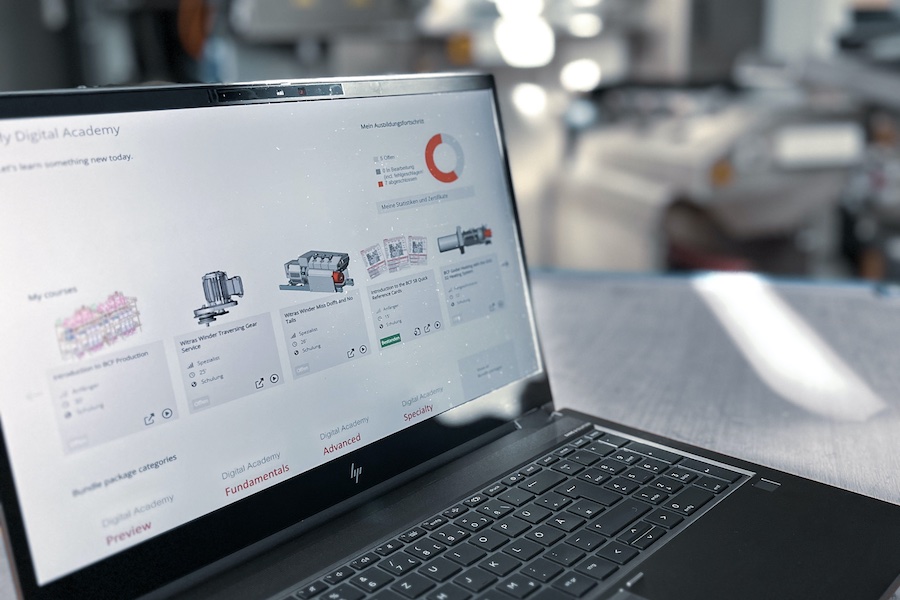
Online consultation and training are currently the order of the day (c) 2020 Oerlikon


Additional temporary staff on site

“Our local representatives provide support in those countries without own Oerlikon Service Station”, adds Ernst. Collaboration during these weeks and months has been even more important and has been going extremely well. And the locations in Germany have been providing Oerlikon Manmade Fibers online training seminars and intensive customer care using Microsoft Teams and Skype. “Currently, we are recruiting additional local temporary staff on site from our extended Service Network, training them – extensively online as well – and then bringing them together with local Oerlikon employees at the construction sites”, explains Wolfgang Ernst. To this end, ‘Start-up Services’ would continue to be complemented by ‘Service Lifecycle Management’ services such as upgrades, modernizations, maintenance, servicing and repairs.
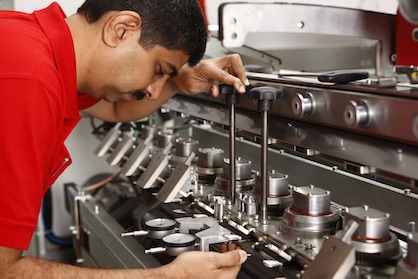


Oerlikon’s local Service Stations are also attending to customers during the coronavirus pandemic (c) 2020 Oerlikon


‘You have to be able to roll up your sleeves and touch the machines’

To the extent it is possible, Oerlikon is currently providing ‘Technical Services’ and ‘Advanced Services’ – where it is actually necessary to be present at the system with experts – using videoconferencing. “Here, there are of course limitations. You have to see, listen to and feel a machine. You often have to roll up your sleeves and touch the machines to make improvements and increase efficiency”, states the German engineer. However, customers are currently only rarely requesting so-called ‘performance checks’. Local concerns have, understandably, shifted elsewhere. But Oerlikon can carry out analyses and optimizations of the processes, hardware and software to a certain extent by means of remote access. Even before the coronavirus pandemic, the majority of the Manmade Fibers segment’s customer services were being provided – in collaboration with customers – in a digital, hybrid form. “Because, generally, we additionally deploy experienced engineers and technologists from the international Oerlikon network on site in order to provide the necessary services for all customers directly”, continues Ernst.

Supply chain up and running

There currently continues to be a reliable supply of Oerlikon Barmag, Oerlikon Neumag and Oerlikon Nonwoven original parts. “At the start of the coronavirus pandemic, the supply chain was stable – and it continues to be so. The logistics with all our partners across the globe are running smoothly”, comments the experienced Service Manager. Of course, Oerlikon’s customers can also place orders online using the ‘myoerlikon.com’ e-commerce shop. Items are then swiftly dispatched depending on the availability at our worldwide warehouses.

The Oerlikon Manmade Fibers segment experts can also be virtually ‘on site’ during the coronavirus pandemic by means of remote access (c) 2020 Oerlikon<br />
The Oerlikon Manmade Fibers segment experts can also be virtually ‘on site’ during the coronavirus pandemic by means of remote access (c) 2020 Oerlikon


More News from Barmag GmbH & Co. KG

#Nonwovens / Technical Textiles

Crimper repair workshop begins operations

Since the beginning of the year, Oerlikon Textile Inc. has been offering a crimper repair service, making it the company's first location worldwide to do so. The workshop in Charlotte specializes primarily in Fleissner and Neumag crimpers.

#Spinning

Oerlikon Manmade Fibers Solutions hosted successful Technology Day 2025 in India

Oerlikon Manmade Fibers Solutions recently hosted its highly anticipated Innovation and Technology Day at the Deltin Hotel in Daman by end of January 2025. The event attracted over 300 participants, including industry experts, partners, and stakeholders, who gathered to explore the latest advancements and trends in the manmade fibers industry in India.

#Spinning

Industrial yarn producer sees growth potential in tire cord sector

The Chinese Junma Group has expanded its HMLS capacities by 20 positions, hence becoming one of the largest tire cord manufacturers in China. At present, the company has 64 positions of HMLS systems, all of which are from Oerlikon Barmag.

#Spinning

Oerlikon reports third quarter 2024 results, highlights strong execution in a challenging market landscape

In the third quarter of 2024, Oerlikon reported a stable operational Group EBITDA margin, despite challenging market conditions, thanks to a focus on pricing, cost management, and efficiency across both divisions. Group order intake saw a 4% year-over-year decline at constant FX, attributed to temporary market softness in Surface Solutions, while orders in Polymer Processing Solutions showed signs of stabilization.

More News on Spinning

#Spinning

Object Carpet tests production of rPET BCF yarn on Neumag BCF line

In a joint project with Object Carpet GmbH, Denkendorf; the Institute for Textile Technology (ITA), Augsburg; and Next Generation Recyclingmaschinen GmbH (NGR), Feldkirchen, Austria, Barmag investigated the processing of recycled polyester for BCF yarn. The goal was to evaluate the fundamental suitability of 100% recycled carpet material for reuse in carpet yarn production to create a closed-loop system in carpet manufacturing. To date, commercial rPET BCF processes have been based solely on rPET from bottle pellets.

#Spinning

New spinning package with two-step filtration for recycled yarns and more

At the ITM in Istanbul, BB Engineering unveiled its new, patented ValuePack spinning package for the first time, which features a two-stage filtration system. This is particularly beneficial for re-cycling processes. Until now, spinning packs have used either metal powder (“sand”) or filter candles as filter media. Both options are suitable for differ-ent applications, and each has its own specific advantages and dis-advantages.

#Research & Development

GenuTrace client advisory: Is your cotton supply chain UFLPA ready?

U.S. Customs and Border Protection has released updated operational guidance (CBP Publication No. 5560-0526) expanding its forced labor enforcement framework. The guidance supersedes the original 2022 UFLPA Operational Guidance and now covers all forced labor enforcement authorities — UFLPA, CAATSA, and WROs/Findings — in a single unified document. For cotton importers, the enforcement posture has not softened. It has become more structured, more documented, and more demanding. Learn more about UFLPA.

Latest News

#Recycling / Circular Economy

Textiles Recycling Expo 2026 builds on successful debut with record attendance, global participation and expanded industry collaboration

The second edition of Textiles Recycling Expo concluded on 24–25 June at Brussels Expo, reinforcing its position as Europe's leading exhibition and conference dedicated exclusively to textile recycling and circularity.

#Composites

JEC Forum Southeast Asia 2026 highlights Taiwan as a strategic hub for the global composites industry

The third edition of JEC Forum organized in Southeast Asia brought together 350+ participants from 22 countries for three active days of high-level Business Meetings, conferences, and networking, emphasizing Southeast Asia’s growing role in the global composites market. Held for the first time in Taipei from 23 to 24 June 2026, following the successful first editions in Bangkok, JEC Forum Southeast Asia 2026 confirmed its position as the region’s leading business platform dedicated to the composites industry.

#Associations

Textile machinery: Italian technology charts the course for revival

Operating in a scenario characterized by geopolitical instability, slowing industrial investments, and new protectionist pressures. This is the main challenge for the Italian textile machinery industry that emerged during the General Assembly of ACIMIT (Association of Italian Textile Machinery Manufacturers), held today in Milan at the Shareholders’ Hall of Palazzo Edison.

#Recycling / Circular Economy

New skills for a circular textile economy

Based on the results of a comprehensive analysis, the Erasmus+ project Skills4Circularity is developing three practical training modules covering recycling technologies, eco-design for the circular economy and sustainable manufacturing. The content of the first module, Recycling Technologies, has now been developed and validated together with industry representatives. The module provides participants with knowledge of regulatory requirements, material sorting and the preparation of textile waste for recycling.

TOP