[pageLogInLogOut]

#Spinning

Stop poor quality at source

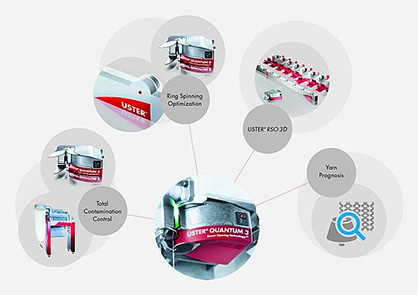
Yarn producers no longer need to rely on expensive clearer cuts at winding to protect their quality. Now, USTER® QUANTUM 3 brings the ultimate in connected intelligence: prevention of yarn faults at source. Data from fiber cleaning and ring spinning is integrated with in-line monitoring of 100% of yarn, to unlock optimization potential for the entire mill.

USTER has devised three special Value Modules – introduced at ITMA 2019 – enabling preventive actions to improve quality, reduce waste and maximize performance. The Value Modules apply comprehensive analysis of data from quality systems at the blowroom, spinning machines and winders to provide all-round protection, actually preventing bad quality before it is produced.

Clearers are the final safeguard against disturbing faults and outliers in yarns. Unique technology for USTER® QUANTUM 3 means it now fulfills the time-tested concept: “prevention is better than cure.”

Tackling contamination at both ends

Spinners can implement Total Contamination Control by combining information from the USTER® JOSSI VISION SHIELD fiber cleaning system and USTER® QUANTUM 3 clearers. Proven technology eliminates foreign matter at both ends of the yarn manufacturing process, so that mills can manage remaining yarn contamination and avoid unnecessary waste. Contamination control in the blowroom results in less contamination – and fewer cuts – at winding, with ultimately reduced contamination in both yarn and fabric. Balancing waste levels and clearer cuts controls quality and reduces costs, optimizing the whole process.

Stop poor quality, instead of cutting it

USTER Ring Spinning Optimization (RSO) works at the most costly stage in yarn manufacturing, allowing mills to analyze combined quality data from spinning and winding in a single system. Information from USTER® SENTINEL and USTER® QUANTUM 3 is intelligently translated by RSO into enhanced options for improvements, while the Roving Stop function stops defective yarn production. Spinners benefit from significant profitability increases and protection against claims.

Even greater potential for improvement comes with the state-of-the-art USTER® RSO 3D, for extended Ring Spinning Optimization. This delivers quality data for each individual spindle position. The facility for quality mapping across the entire ring spinning machine helps to identify outlier sides, sections or spindles, as well as assisting maintenance decisions.

(c) 2019 Uster
(c) 2019 Uster


USTER® QUANTUM 3 also collaborates seamlessly with Muratec QPRO EX/FPRO EX, Spin Inspector and USTER® SENTINEL. Outlier quality data from these connections activates Roving Stop at individual spindle positions where a quality problem is detected – again showing how USTER® QUANTUM 3 prevents the production of poor quality yarn.

Preventing claims with yarn prognosis

It is becoming more important for spinners to understand the quality perspectives of their customers in weaving and knitting – so that issues such as claims can be prevented before the yarn is shipped. Combining USTER® QUANTUM 3 with USTER® TENSOJET and USTER® QUALITY EXPERT helps provide the ‘customer viewpoint’, by giving an accurate prognosis of weaving performance, based on an easy-to-understand grading system. No fabric samples are needed, and testing costs are virtually zero. Feedback suggests that the prognosis information is an accurate reflection of real yarn behavior on both warping and weaving machines.

Productivity plus

A further advantage of the Ring Spinning Optimization Value Module is its impact on cop build-up quality. Yarn clearer data from USTER® QUANTUM 3 flows into the RSO Module of USTER® QUALITY EXPERT and a comprehensive speed curve analysis is made. The results guide spinners to the best machine settings for higher production yields and the required quality. This reduces quality variations over the cop and boosts the overall performance of the ring spinning machine.

In one smart system, USTER® QUANTUM 3 has the power to create a future of better quality and productivity for spinners – in which defects are prevented rather than merely cleared.
More News from Uster Technologies AG

#ITMA Asia + CITME Singapore 2025

Uster presents novelties at ITMA Asia + CITME 2025

There’s news from Uster Technologies to be announced for the industry’s upcoming event in Singapore. The Uster 360Q universe is growing with new products, solutions and services. Innovation developments can also be recorded in the fields of man-made fiber testing and fabric inspection. Uster innovations address the industry’s trending topics as mill management and process control, optimization of delivered fabric quality and yield.

#Spinning

Uster Technologies marks 150 years of empowering quality excellence

Uster Technologies marks 150 years of excellence – a milestone that reflects continuous adaptation to customer needs and industry change. Over the decades, Uster has evolved from manufacturing quality testing instruments into a trusted partner shaping the future of textile production.

#Recycling / Circular Economy

Challenges of making yarn from recycled fibers

What does it take to spin quality yarn from recycled fibers? Uster Technologies brought textile industry leaders together to discuss the role of technology, data and automation – as well as the current challenges in using recycled raw material. Experts from Rieter, Säntis Textiles, Otto Yarns, and TVU commented on the current situation and looked into the future of spinning in a panel discussion organized at Uster headquarters.

#Spinning

Uster Technologies wins another infringement lawsuit

In a ‘victory for innovation in China’ Uster Technologies has secured a decisive judgment in a patent infringement lawsuit against a competitor. The final ruling by the Supreme People’s Court of PR China confirms that the competitor’s actions in copying the patented yarn feeder of the Uster Tester 6 constitute unlawful infringement.

More News on Spinning

#Spinning

Rieter responds to higher raw material prices

Global political and economic developments have been leading to rising raw material and energy costs for some time. The textile machinery industry is also affected by this trend. Rieter machines and components consist to a large extent of steel, copper, aluminum and electronics. These materials in particular have seen higher demand and higher prices in recent months.

#ITM 2026

The hub of smart and sustainable transformation in yarn technologies: ITM 2026

With global fiber production projected to reach 169 million tons by 2030, yarn manufacturing is becoming one of the most strategic fields within the textile machinery industry. Located in Halls 6, 7, and 10, the Yarn Hall at ITM 2026 is set to bring together industry professionals with innovative solutions developed around automation, energy efficiency, digitalization, and circular production.

#Spinning

Barmag: DTY efficiency for the future of fancy yarns

Fancy yarns continue to gain importance in the textile market: Whether in fashion, home textiles or the automotive industry - the trend towards individuality is fueling the demand for textured, haptically differentiated and at the same time comfortable yarns.”

#Spinning

Perfect quality through collaboration: Machinery from Trützschler, Toyota and Murata at Zirve Tekstil

In today’s textile industry, excellence is not achieved by chance – it’s the result of deliberate decisions, technical expertise, and the courage to go beyond conventional paths. The Turkish company Zirve Tekstil has done just that: by combining the best technologies from Trützschler, Toyota and Murata, they’ve created a production setup that delivers outstanding yarn quality – recognized worldwide.

Latest News

#Sustainability

Ying McGuire becomes new CEO of Cascale

Cascale today announced the appointment of Ying McGuire as Chief Executive Officer, effective June 1, 2026.

#Technical Textiles

Sustainable, lightweight, and sound absorbing: Polyester-based front trunk solution for BEVs

As car manufacturers look to further reduce their carbon footprint, Autoneum has developed an innovative front trunk solution for battery electric vehicles (BEVs), made entirely from polyester-based textile. The Ultra-Silent Frunk offers significant weight reduction, improved acoustic and thermal insulation, and uses up to 70 percent recycled material, supporting sustainable and efficient vehicle design. Autoneum, global technology leader in acoustic and thermal management for vehicles, has already received orders for the new frunk from three major OEMs in Asia and Europe to be built in three BEV models. Series production for two BEVs has been underway in China and Germany since last year.

#Raw Materials

Modern testing methods for raw cotton

The 38th International Cotton Conference Bremen will take place from 25 to 27 March 2026 at the Bremen Parliament. This conference has traditionally stood for in-depth expertise and international exchange. The program will focus on technical innovations, market trends, and regulatory frameworks across the entire value chain – from agriculture to the circular economy. With high-profile speakers, the conference is regarded as the key meeting point for the global cotton industry. Today’s focus: Cotton quality and testing methods.

#Weaving

Stäubli demonstrates how innovation translates into real benefits for weaving mills at SITEX 2026

One of India’s most prominent textile industry events, SITEX 2026, is held from February 21 to 23 in Surat. Committed to empowering Indian weaving mills with state‑of‑the‑art solutions tailored to regional needs, Stäubli will present a selection of solutions designed for performance, reliability, and power efficiency. Through its weaving preparation, cam and dobby shedding solutions and Jacquard technologies, Stäubli highlights its global expertise tailored to the specific needs of the local market.

TOP