[pageLogInLogOut]

#Software

Lectra’s Design to Cost approach gives companies the power to anticipate real costs earlier in the design and product development phases
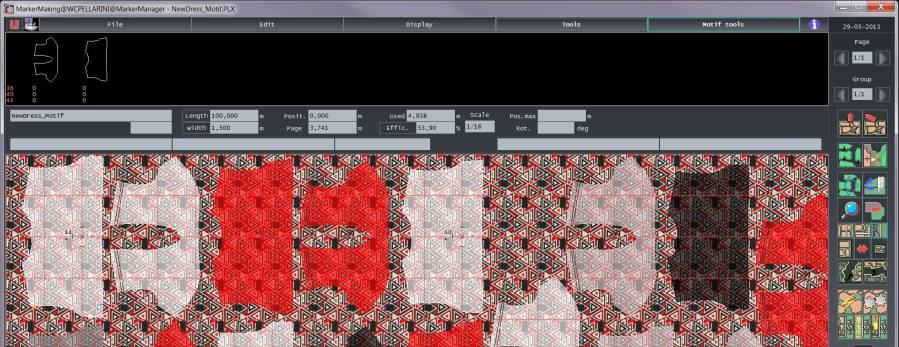
Lectra is pleased to announce an improved Design to Cost approach to product development that draws on design, pattern-making, marker-making and 3D prototyping technologies and expertise.

“At a time when companies are striving to remain competitive, materials represent a significant percentage of the cost of a garment, companies therefore need to manage material usage effectively in order to preserve and increase their margins,” says Anastasia Charbin, Director, Marketing Fashion, Lectra. “Lectra’s Design to Cost approach, which combines design, product development and marker-making solutions, allows companies to analyze the cost of final garments and then use that information to make important business decisions in the design and product development phases.”

Visual fabric layout increases accuracy and cuts out manual labor

An integral component of Lectra’s Design to Cost approach is the new pre-costing and marker-making solution Diamino® V6, which now allows fabric to be visualized on costing and production markers to help companies better anticipate and control material consumption. During the conceptualization phase, a period in which many ideas are proposed, challenged and reworked, material consumption is often only very roughly estimated. By more tightly integrating its core product design and development technologies and allowing for a more fluid exchange of visual and technical information, Lectra has opened the door to faster and more realistic evaluation of possible production scenarios.

“It allows us to exchange information faster and to more quickly identify potential problems before production,” says Nicolas Drevet, Head of Production Methods at French lingerie company Lise Charmel.

In addition, non-specialist profiles like product managers, cutting room managers, research departments and product development teams can now have access to this information. Fabrics can also be visualized in the marker layout to enhance the impact of fabric choices on cost, while providing clear visual instructions on repeat placement and orientation.

“We now better control material consumption and cost and have improved our ability to foresee problems,” says Davide Lunardon, CAD Manager, Staff International, part of the group Only The Brave (OTB).

Design to Cost is especially useful for companies that work with engineered prints and complex or intricate fabrics. They are able to import sketches, graphics or scanned fabrics from the design department to evaluate production scenarios before fabric is ordered, printed or cut. If changes need to be made in design to reduce costs at the production end, Diamino V6’s visual capacities make it easier to communicate across departments quickly and accurately to keep development moving forward.

“I can see exactly where the markers are going to fall on the print. If it doesn’t work out, I can make my recommendations to the print department before the screen is sent out and costs are committed to,” explains Alex Canoro, Head of Marker Making at American dress company Maggy London.

“The decisions that are made in design have an impact on final garment cost, but this often isn’t apparent until the production phase. With a holistic Design to Cost approach supported by Lectra, companies now have the capacity to take production constraints into account early on in design,” says Antoine Mercier, Product Manager, Lectra. “What used to be manual, time-consuming and rife with errors, has become a more streamlined process that enables companies to evaluate the impact that both style and fabric design have on material consumption, before production commitments are made.”


More News from Lectra Deutschland GmbH

#Industry 4.0 / Digitalization

Mango joins TextileGenesis pioneering traceability solution, a Lectra company, for a transparent value chain

Mango, one of the leading international fashion groups, has joined TextileGenesis, the pioneering traceability solution for the fashion and textile industries, to trace their natural and animal fibers, synthetics, man-made cellulosic fibers and leather. TextileGenesis, a Lectra company, offers a complete and secure cutting-edge technology with its six-dimensional (6D) offering and unique “fiber forwards” approach. Mango, has long been committed to maintaining a fully transparent supply chain, and TextileGenesis will reinforce this commitment.

#Textiles & Apparel / Garment

New Retviews study by Lectra: the luxury market in 2025, between margin protection strategies and new iconic pieces

After more than a decade of uninterrupted growth, the luxury fashion market is now experiencing a more pronounced slowdown. Global luxury goods sales have fallen from €369 billion in 2023 to €364 billion in 2024 (according to Bain & Co.), exposing the vulnerabilities of a model long supported by aggressive price increases.

#Recycling / Circular Economy

Recover and TextileGenesis collaborate to verify supply chain integrity of recycled materials

RecoverTM, a global producer of recycled cotton and cotton-blend fibers, has commenced a traceability collaboration with TextileGenesis, a Lectra company, to digitally track its recycled waste materials across the entire textile value chain.

#Industry 4.0 / Digitalization

Lectra launches the Observatory of innovation and transformation in the fashion, furniture and automotive markets

As a leader in technology solutions accelerating the transition of fashion, furniture and automotive companies to Industry 4.0, Lectra announces the launch of its Observatory to mark its 50th anniversary. The Observatory will focus on innovations and changes in the fashion, furniture and automotive markets, to help these sectors stay informed and adapt to new opportunities. The Lectra Observatory’s first white paper on the advent of Industry 4.0 is already available online.

More News on Software

#Software

Coats Digital appoints Himanshu Mehrotra as Managing Director to lead next phase of cloud and AI-driven innovation

Coats Digital is delighted to announce the appointment of Himanshu Mehrotra as Managing Director to lead the company’s strategic direction, innovation agenda, and global growth as it accelerates the development of its cloud-native, AI-powered software solutions for the global apparel and footwear supply chain.

#Software

Tunicotex Group boosts OTDP to 85%, cuts planning time by 25% & expands production capacity by 40%

Coats Digital is delighted to announce that following the implementation of FastReactPlan, leading Tunisian premium knitwear manufacturer, Tunicotex Group, has significantly improved its on-time delivery performance from 75% to 85%, reduced planning time by 25%, minimised delays and penalty costs, and unlocked 40% additional capacity to take on more customer orders and support sustained business growth.

#Industry 4.0 / Digitalization

Suzhou Tianyuan boosts costing accuracy to 98% with Coats Digital’s GSDCost

Coats Digital is delighted to announce that Suzhou Tianyuan Garments Co., Ltd., a leading manufacturer of high-quality sportswear and functional apparel for global brands such as Adidas, FILA, ANTA, and The North Face, has achieved remarkable productivity and cost management improvements following the implementation of Coats Digital’s award-winning method-time-cost optimisation solution, GSDCost.

#Software

Textile Solutions Group appoints Anton Hofmeier as Group CEO

TSG strengthens Group-level coordination and aligns ERP, CAD, MES and shop-floor execution to deliver faster, lower-risk improvements for textile manufacturers.

Latest News

#Raw Materials

New study shows low environmental impact by Cotton made in Africa Organic Cotton from Tanzania

Today, the Aid by Trade Foundation (AbTF) is announcing the results of a comprehensive life-cycle analysis (LCA) for cotton produced in Tanzania under the Cotton made in Africa Organic (CmiA Organic) standard. The study emphasises the small ecological footprint of CmiA Organic verified cotton. This can largely be traced back to the absence of synthetic pesticides, artificial fertilisers, and artificial irrigation. Consequently, CmiA Organic cotton can help the textile industry meet regulatory requirements as well as science-based targets. The results also show that the consequences of climate change threaten the livelihoods of these cotton farmers, even though the type of agriculture they practise barely contributes to climate change.

#Raw Materials

Better Cotton Initiative strengthens regenerative focus in standard update

The Better Cotton Initiative (BCI) has strengthened the regenerative focus of its field-level standard with the launch of a new version of its Principles & Criteria (P&C), which marks the next step in the organisation’s journey to becoming a regenerative standards system.

#Man-Made Fibers

Selenis and Kintra Fibers partner to scale 100% bio-based synthetic fiber technology

Selenis, a leading global specialty polyester manufacturer, today announced a strategic manufacturing partnership with materials science company Kintra Fibers to scale Kintra’s patented fiber-grade PBS resin - a 100% bio-based and biodegradable material designed for textile applications.

#Functional Fabrics

PERFORMANCE DAYS proves its relevance as the industry’s key meeting point

Held on March 18–19, 2026, PERFORMANCE DAYS once again confirmed its position as a leading international platform for functional textiles. A total of 3.366 trade visitors and around 560 exhibitors gathered in Munich, with the event already kicking off successfully on DAY 0, which received highly positive feedback for its interactive format. Despite challenging conditions caused by the public transport strike in Munich, the event saw strong attendance and a consistently high level of activity across both exhibition days.

TOP