[pageLogInLogOut]

#Software

Avatars -the new top models!
(c) 2020 Human Solutions
How do you ensure an optimal fit for new fashion products if no fitting model is available? With avatars! Avalution offers you the optimal digital model for the different steps of the product development process. Our fit expert Anke Rissiek talks in an interview about how avatars can keep processes running, especially during the corona crisis.

The  fit quality  is proven by  testing on  humans.  How  can avatars  contribute  in  the  current  pandemic  situation  to keep product development running? In the apparel industry, too, many people are currently working from home or are very much on their own in the office. Product developers are sent products, but cannot technically validate the fit because there is no possibility of using a fitting model. With ouravatars, which are all based on real body dimension data   from   representative   measurement   surveys,   we   can provide digital models to keep the processes running.

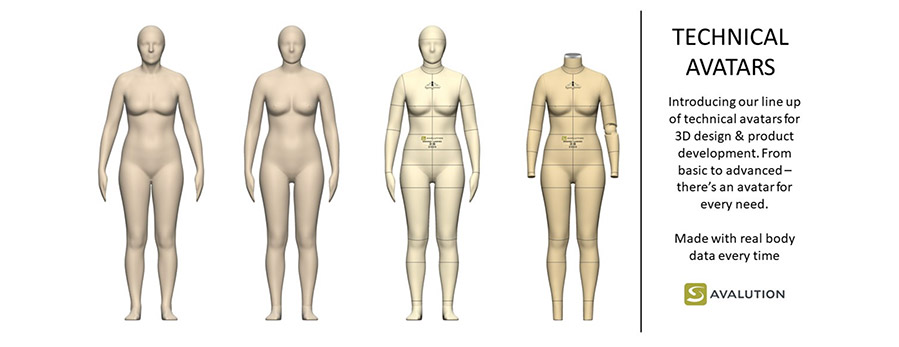
Which avatars are available? We  have  developed  different  technical  avatars  for  different work steps. Depending on the task a product developer faces, we can provide him with the appropriate avatar –regardless of which  3D  system  is  used.  The  3D  systems  usually  offer avatars,  but  these  are  not  realistic  enough  to  make  final decisions about the fit that should represent the typical target customer and conform the quality requirements of a brand. We offer single avatars, but also complete rows of a standard size chart or even a brand specific size chart. Here the avatars have a big advantage over a fitting on a fit model: they are available in every size, so that the complete grading can be checked in all sizes. 

What makes the avatars from Avalution stand out? Our  avatars  are  all  based  on  real  body  dimension  data  from representative measurement surveysthat we have been taking for many years, and therefore correspond to real bodies. This allows them to very realistically depict the typical body shapes of target customers, even in larger sizes or special figure types. It  is  also  possible  to  map  special  morphotypes,  i.e.  specific body  shapes  and  proportions.  The  avatars  are  prepared  in such  a  way  that  they  can  provide  the  same  fit  results  in  the virtual  fitting  as  in  the  real  model  fitting. 

They  also  have dimension   lines   that   visualize   the   position   of   the body measurements on the avatar, which probably offers the biggest difference to many other avatars available. These can provide the   product   developer   and   the   supplier   with   valuable information on where exactly they need to start with all fit areas in the case of fit problems or adjustments. This means that the fit  can  be  objectively  evaluated  and  further  developed  with them.

How can I start with an avatar – is training necessary? The avatars can be provided in a standard format (OBJ) that can be read by all common 3D systems. This means that no special training is necessary before use.

More News from Human Solutions Group

More News on Software

#Industry 4.0 / Digitalization

Coats Digital wins SaaS award for AI in apparel manufacturing

Coats Digital has been named Best Company in AI-Powered Fashion Technology at the 2026 Best in SaaS Awards. The company’s AI applications cover garment costing, the analysis of operational data and the use of computer vision to study how tasks are performed on the factory floor.

#Industry 4.0 / Digitalization

White House reduces production planning time by up to 80% with Coats Digital’s FastReactPlan

Indian garment manufacturer White House has reduced its production planning cycle by 60–80% following the implementation of Coats Digital’s FastReactPlan software. The integrated planning solution provides greater visibility across production, capacity and material requirements while supporting faster decision-making and improved delivery performance.

#Software

UNIFEQ Europe adopts Coats Digital’s GSDCost and AI-powered GSDQuest to support rapid growth

Coats Digital is pleased to announce that rapidly growing Polish defence and uniform manufacturer UNIFEQ Europe Sp. z o.o. has invested in its award-winning GSDCost solution together with its AI-powered GSDQuest platform to establish a consistent approach to garment costing, improve sewing-floor productivity and accelerate labour costing for tenders and new products.

#Industry 4.0 / Digitalization

Orient Rongheng connects production planning across China and Bangladesh with FastReactPlan

Chinese apparel manufacturer Orient Rongheng is implementing Coats Digital’s FastReactPlan to digitalize production planning across its manufacturing operations in China and Bangladesh. The project aims to connect capacity, materials and order planning across multiple factories while integrating these processes with the company’s existing ERP and Manufacturing Execution System (MES).

Latest News

#Industry 4.0 / Digitalization

Smartex.ai names Tony Fadell chairman and previews new fabric inspection system

Smartex.ai has appointed Tony Fadell as chairman and will present its new fabric inspection hardware and software at SmartCollab Hong Kong on 27 November. Fadell co-designed Inspect, the hardware at the centre of the system, which Smartex developed with a supplier in H&M Group’s network.

#Digital Printing

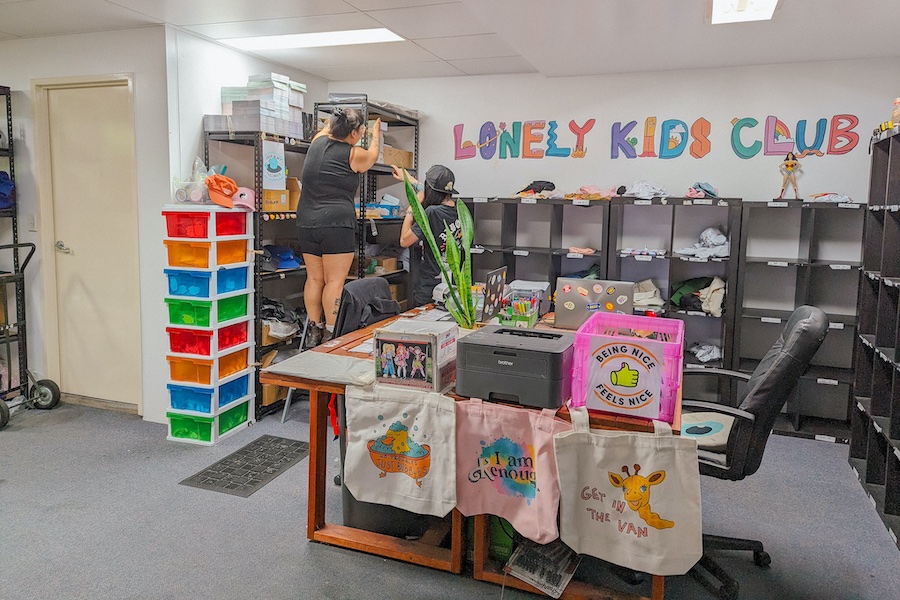
From a bedroom startup to 3,000 designs: How Lonely Kids Club built its business with DTG printing

Founded in Sydney in 2011, independent clothing label Lonely Kids Club has grown from a bedroom startup into a business offering around 3,000 graphic T-shirt designs. With its own production studio, direct-to-garment printing and a demand-driven manufacturing model, the company demonstrates how smaller apparel brands can combine creative independence with flexible production – while navigating the everyday challenges of quality control, workflow efficiency and sustainability.

#Recycled Fibers

Recover and SUPIMA partner to develop recycled Pima cotton fibers and yarns

Recover and SUPIMA have partnered to turn waste from SUPIMA cotton production into a new line of recycled fibers and yarns. The collaboration will explore how recycled American-grown Pima cotton can be used in a wider range of yarns and garments for the premium market.

#India ITME 2026

India’s textile industry: Current position, growth targets and industrial development

With ambitious export targets, major investments in manufacturing infrastructure and new international trade agreements, India is pursuing a comprehensive development strategy for its textile and apparel industry. An overview of the industry’s current position, government initiatives, progress achieved and challenges ahead.

TOP