[pageLogInLogOut]

#Research & Development

Soft interfaces: Textile-integrated light switches, made possible by printable Liquid Metal Ink
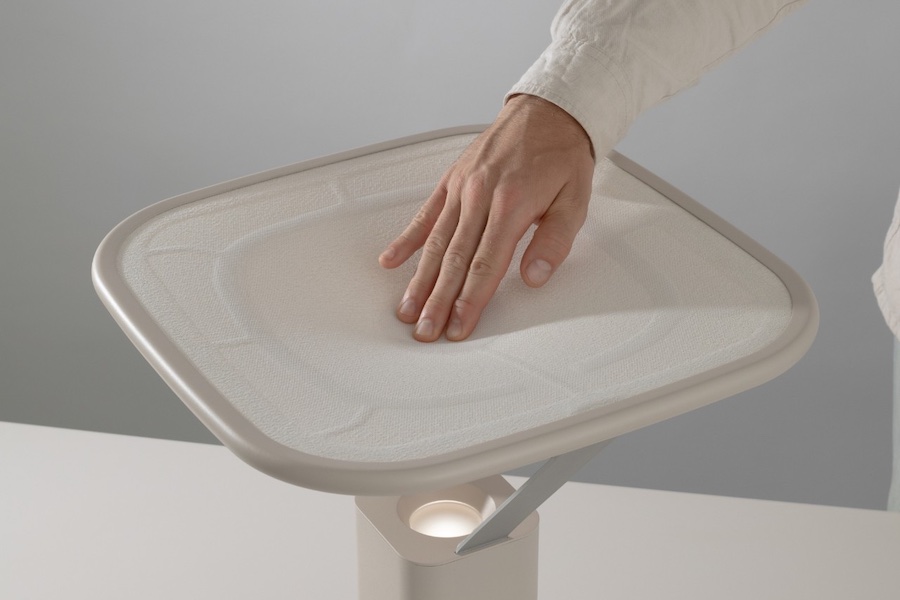
A look at the demonstrator © WINT Design Lab / Michelle Mantel
A gentle tap on the knitted lampshade is enough to switch on the light. The lamp developed by Fraunhofer IZM in cooperation with WINT Design Lab works with a revolutionary conductive ink. Visitors can find out more and try the lamp themselves at the Berlin Science Week on November 1st and 2nd.


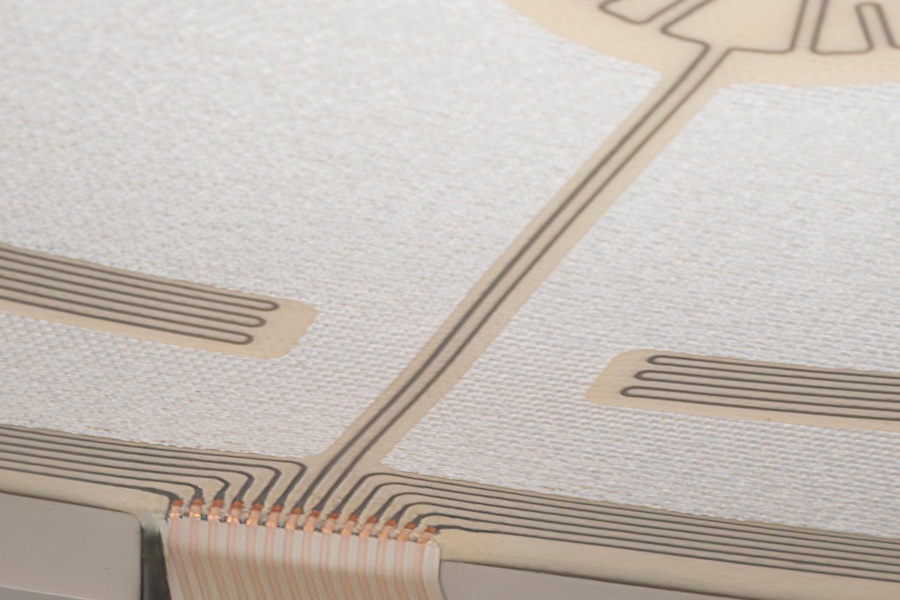
Lukas Werft and Christian Dils of the Fraunhofer Institute for Reliability and Microintegration IZM and their counterparts, Robin Hoske and Felix Rasehorn of WINT Design Lab, are coming to the Berlin Science Week to reveal their »Soft Interfaces« project to the waiting public. The aim of this innovative research is to develop textiles that can respond to touch and interact intelligently with their environment. The project’s magic lies in the newly developed and fully printable Liquid Metal Ink (LMI) made with Galinstan. The electrically conductive ink is covered in highly elastic thermoplastic polyurethane (TPU) and can be laminated right into knitted textiles to create surfaces that are not just functionally usable, but also flexible, stretchable, pleasing to touch and pleasing to the eye.

Showcasing the technology with a special lamp

One great example that shows the capabilities of the technology is an interactive, 3D-printed lamp with a special textile lampshade. The clean lines of the 3D-printed lamp are not harmed by any intrusive switches or buttons. Only a subtle difference in the knitted pattern invites users to touch the flat lampshade, intuitively switching the light on or off. LEDs are integrated into the body of the lamp that can be dimmed or change their color in this way.

The lampshade is made from a knitted fabric stretched over a 3D-printed frame. It includes seven LMI sensor units for controlling the light intuitively. With a simple touch, the user can turn the light on or off, dim the light, or change the color temperature. The fabric itself becomes the user interface, opening up a whole new dimension of interactivity.

Innovative technology

All of this is made possible by the newly invented Liquid Metal Ink (LMI), an electrically conductive, but also environmentally friendly ink that works with Galinstan. This alloy of gallium, indium, and tin is mixed with a solution of thermoplastic polyurethane (TPU), resulting in the viscous LMI that can be printed onto elastic substrates to create structures that work like resistive strain sensors. Gentle pressure is enough, and the resistivity of the material changes, alerting the light controllers to switch on the lamp, dim the light, or change its color.
© WINT Design Lab / Michelle Mantel


Interdisciplinary collaboration

The project was born from the close cooperation between design and material science that is supported by the Fraunhofer Network »Science, Art, Design. « Regular workshopsand collaborative work at Fraunhofer IZM and WINT Design Lab brought together technological know-how and product and interaction design insights into a streamlined tactile user experience.

Future opportunities

»Soft Interfaces« shows the great potential of liquid metal conductors for diverse applications in elastic fabrics, from novel control interfaces for smart home textiles, intuitively functional surfaces for vehicles, or wearable sensors to soft robotics. The technology is currently still limited to laboratory or prototype uses, but is very promising for scalable, energy-efficient products.

On November 1st and 2nd, 2025 researchers from the Fraunhofer network »Science, Art, Design« will be on site at the Museum of Natural History’s CAMPUS as part of the Berlin Science Week. For more information, visit: https://berlinscienceweek.com/programme/textilien-die-fuhlen-mit-intelligenten-oberflachen-zur-neuartigen-interaktion


Credits:

Technical Management: Fraunhofer IZM (Lukas Werft, Christian Dils, Carlos Wisbar, Raphael Mgeladse)

Design: WINT Design Lab (Felix Rasehorn, Robin Hoske, Julia Huhnholz)

Fabric Development: Case Studies (Laura Krauthausen, Konstantin Laschkow)

Video und Fotografie: Michelle Mantel

Project Funding: Fraunhofer Network »Science, Art, Design (WKD)«


More News from Fraunhofer-Institut für Zuverlässigkeit und Mikrointegration IZM

More News on Research & Development

#Research & Development

Textile cascade filter for removing microplastics from wastewater

Microplastics are now found almost everywhere, even in remote regions of Antarctica. They enter the human body through the food chain. Studies indicate that microplastics may have negative effects on the human health.

#Research & Development

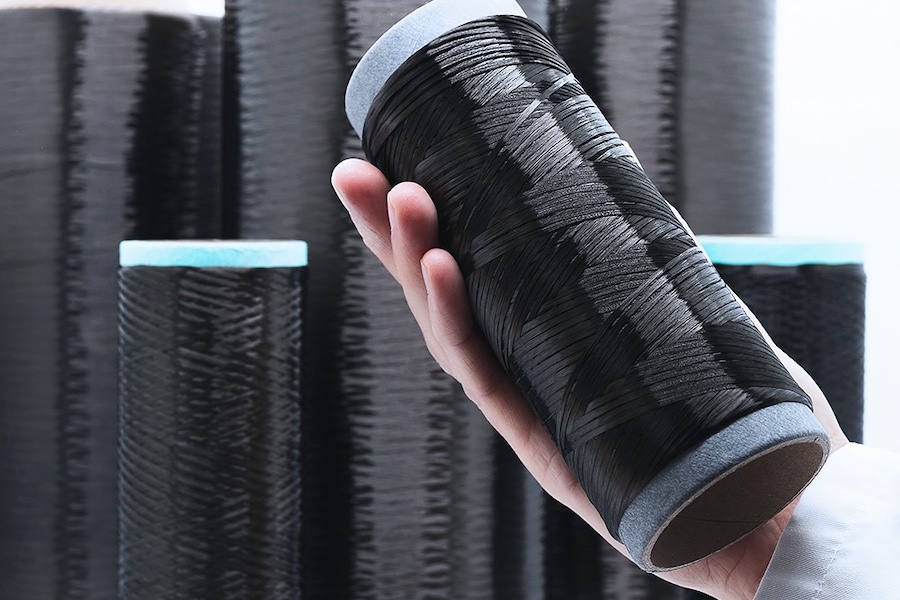
Fraunhofer IAP paves the way for "Green" carbon fibers

A new pilot plant in Guben is set to enable the production of bio-based carbon fibers. The plant is part of the Carbon Lab Factory Lausitz and will make an important contribution to the transformation of the Lausitz region—from a traditionally raw material- and basic industry-oriented region to a hub for innovative high-performance materials. The German federal government and the state of Brandenburg are providing the Fraunhofer Institute for Applied Polymer Research IAP with 53.3 million euros for this purpose.

#Research & Development

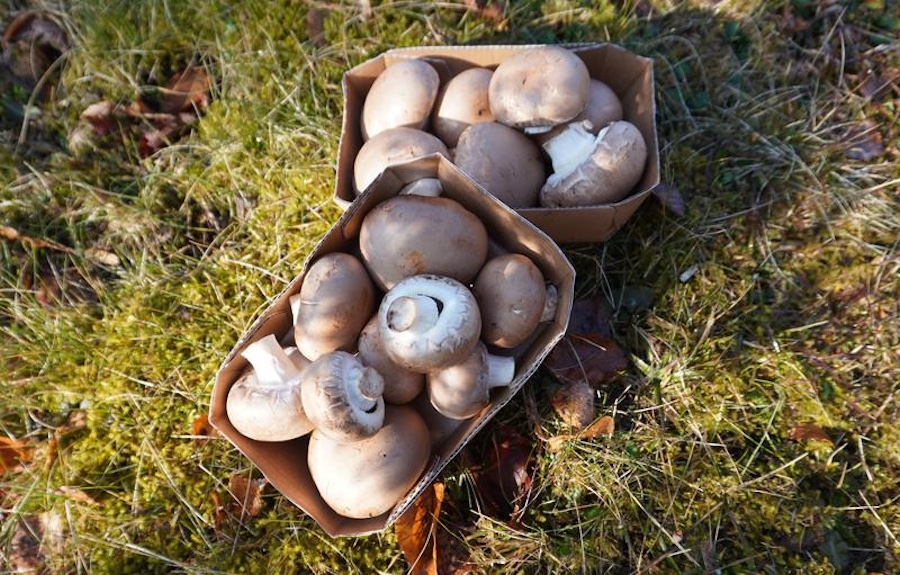
Hof University develops sustainable textile coating for the fashion of tomorrow from mushrooms

Clothing is often treated as disposable: T-shirts for events, general merchandise, or short-term campaigns frequently end up in the trash after only a few uses. This is particularly problematic given that their production still largely relies on fossil-based materials. This is precisely where a new research project at Hof University of Applied Sciences comes in.

#Research & Development

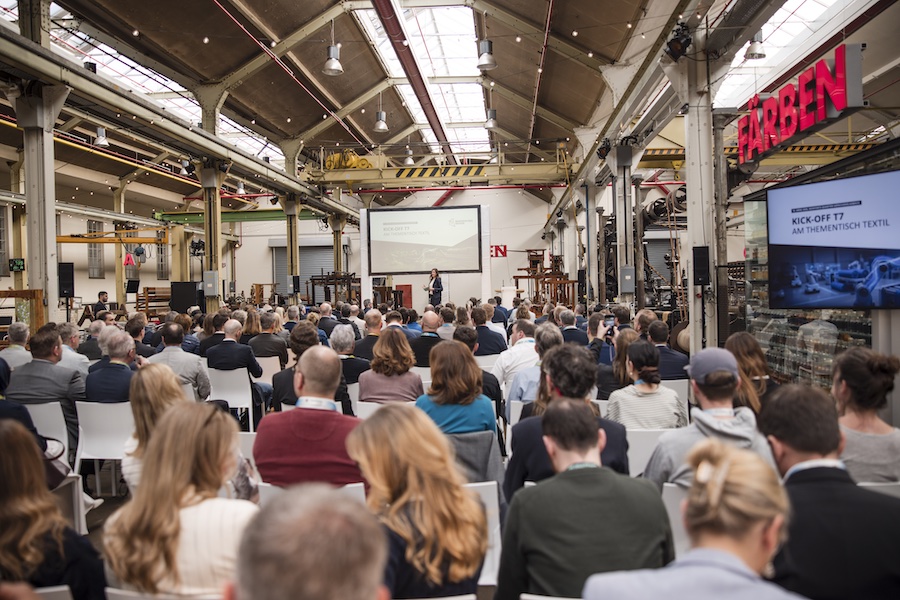
Textilfabrik 7.0 launched: Mönchengladbach becomes a real-world lab for sustainable textile production

With the official kick-off event of the Textilfabrik 7.0 (T7), a major transformation project for the German textile and apparel industry has been launched in the Monforts Quarter in Mönchengladbach. At the “Textile Roundtable,” an event format organized by the Zukunftsagentur Rheinisches Revier, representatives from industry, research, politics, and the regional economy came together to jointly lay the foundation for CO₂-neutral, circular, and economically viable textile production in Germany.

Latest News

#Composites

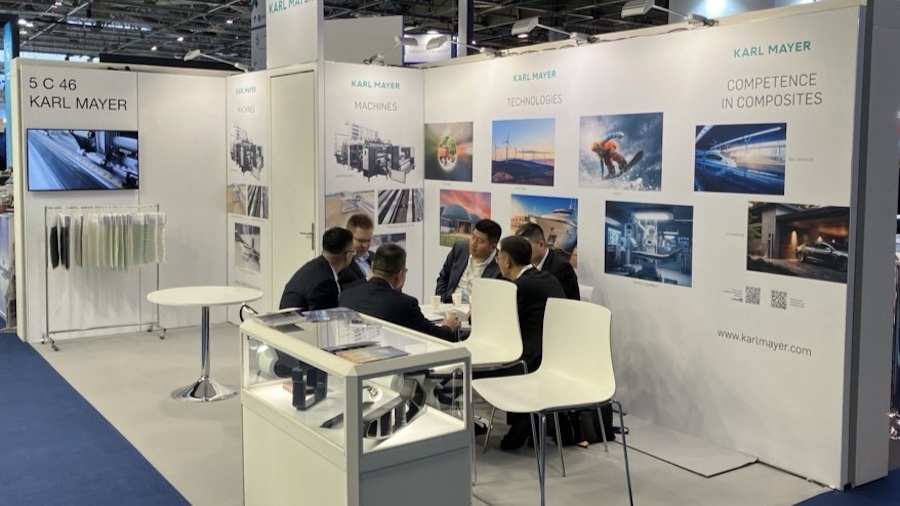
KARL MAYER strengthens partnerships in the composites industry at JEC World 2026

KARL MAYER further strengthened its role as a reliable and competent partner to the composites industry at JEC World 2026. The global market leader in textile machinery manufacturing used the trade show to meet key customers, establish numerous new contacts, and engage in in-depth technical discussions.

#Recycling / Circular Economy

ABB and Syre partner to explore technologies for industrial-scale textile recycling

ABB has signed a Memorandum of Understanding (MoU) with Swedish textile impact company Syre to jointly explore technologies to support the development of Syre’s first textile-to-textile recycling plant in Vietnam. The agreement establishes a framework for collaboration to investigate how ABB’s automation, electrification and digital technologies could contribute to safe, efficient and scalable operations. It will also explore how these capabilities could further optimize process and quality control performance as Syre advances its ambition to produce circular polyester at industrial scale.

#Techtextil 2026

From Nature Performance to Circular Economy: Techtextil 2026 focuses on the future market for technical textiles

Alternative materials and recycling technologies are one of the most important future segments and drivers of innovation in technical textiles. Sustainability goals and regulatory requirements increase their relevance, while advances in performance and economic viability enhance their market competitiveness. Taking place from 21 to 24 April 2026, Techtextil reflects this key industry trend with a growing number of specialised exhibitors. With the new “Nature Performance” label, the leading global trade fair bundles relevant market offerings and facilitates access to new solutions – from natural fibres and yarns to bio-based materials and circular approaches.

#Textile processing

Jeanologia showcases the future of product development

Jeanologia is showcasing how software is transforming product development in the fashion industry at PI Apparel Europe: The Fashion Technology Show, taking place on March 30–31 in London.

TOP