[pageLogInLogOut]

#Research & Development

STFI opens technical center for wetlaid nonwovens
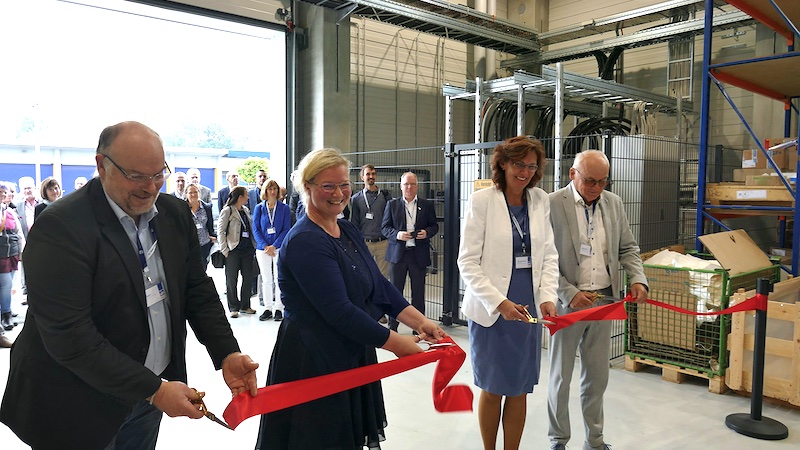
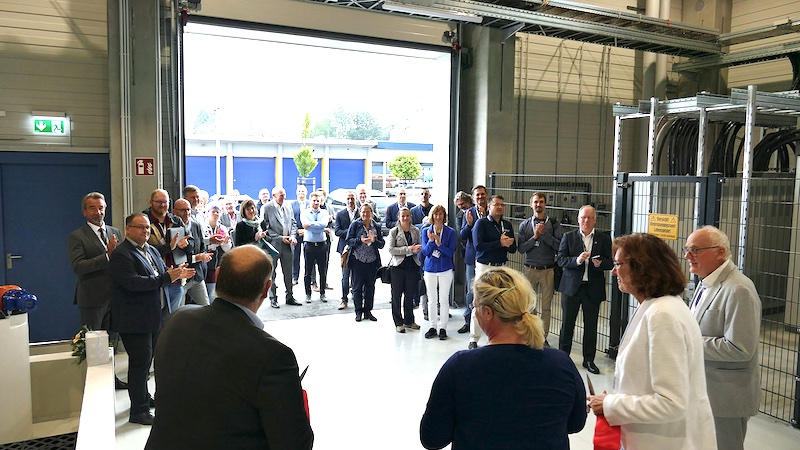
On September 17, 2020, the Wetlaid Technical Center was opened at the Saxon Textile Research Institute (STFI) in the Center for Textile Sustainability. For over 30 years, STFI has been dedicated to a variety of fields of application in the textile industry as an innovation partner and service provider. More than 40 invited guests from industry, research and politics attended the opening of the technical center.
The opening ceremony on September 17, 2020 attracted over 40 industry and research partners to Chemnitz. © 2024 STFI


Opening ceremony attracted numerous industry and research partners to Chemnitz

With the new Center for Textile Sustainability and the installation of a wetlaid nonwovens line, the Chemnitz institute has expanded its expertise in the areas of nonwoven development, textile recycling and testing. The wetlaid nonwovens line now enables STFI to offer application-specific processing of short fibers.

The opening ceremony started with an overview of the portfolio of the Nonwovens Competence Center, which offers a unique variety of equipment and technologies. In addition to a Reicofil® 4.5 spunbond line, a laboratory-scale meltblown line and spunbond lines, both on a laboratory and semi-industrial scale, are available for research and development. Fibre nonwoven bonding at STFI is possible purely mechanically by needling, stitching or hydroentanglement as well as chemically by various binder systems. In the field of recycling, tests are possible on a combined system for random web formation using the airlay or airlaid process. With the wetlaid nonwoven system, all available nonwoven formation technologies are now installed at STFI for the first time.
© 2024 STFI
© 2024 STFI


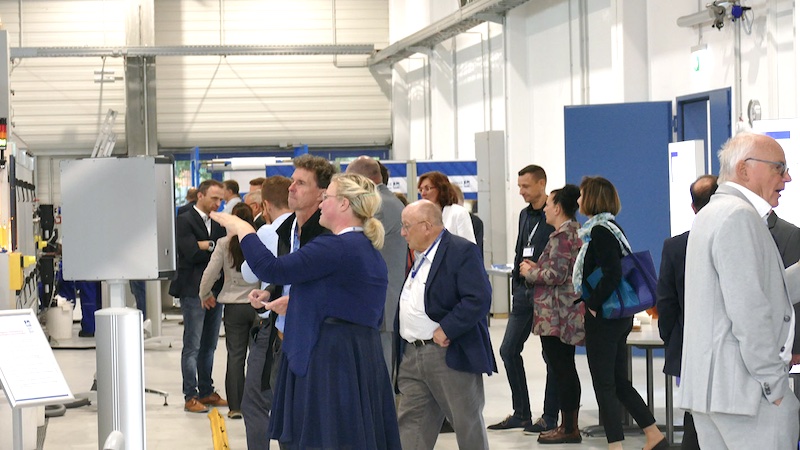
The highlight of the opening ceremony, after a short introductory lecture, was a tour of the wet-laid nonwovens line in operation. With a working width of 600 mm and a line speed of up to 10 m/min, single-layer wet-laid nonwovens can be produced. Short fibers with lengths of up to 25 mm and fiber dusts are processed in the production of wet-laid nonwovens. Almost all fiber types and materials in different lengths, thicknesses or processing states, as well as material mixtures and recycled fibers, can be processed into wet-laid nonwovens. The dispersion behavior of the fibers and the fiber length, among other things, are crucial for the product. In the first step of the process, fibers are dispersed in water to form a suspension. The suspension is then formed into a fleece on an inclined wire belt using a headbox. The fleece is then thermally bonded by adding binder fibers or by applying an additional binder. Finally, the web is dried and rolled. 

Wet-laid nonwovens are characterized by high surface uniformity with low material thickness and uniform strengths in the longitudinal and transverse direction, which gives them unique material properties. In addition, they have the potential for novel material properties, such as electromagnetic shielding. Their fields of application include, among others, hygiene articles, packaging, battery separators, filter media, reinforcing structures and technical textiles in the broadest sense. Current R&D topics in wetlaid technology include not only the development of modern filter media but also the processing of recycled carbon fibers, optimization of raw materials and process parameters, and the development of battery components. In addition, STFI will in future be conducting research into the scaling and productivity increase of wetlaid nonwovens lines and into innovative material combinations.
© 2024 STFI
© 2024 STFI


STFI would like to thank everyone who made this day an extraordinary experience. In particular, they would like to thank the Sächsische Aufbaubank (SAB) and our partner Pill Nassvliestechnik GmbH, Reutlingen, for their support in installing the wet-laid nonwovens production line.
More News from Sächsisches Textilforschungsinstitut e.V. (STFI)

#Techtextil 2026

STFI presents concepts for the textile circular economy and solutions for a healthy and safe life at Techtextil

Sächsisches Textilforschungsinstitut e.V. (STFI) has been supporting companies in developing marketable innovations for over 30 years. With a clear focus on sustainability, the environment, health and protection, the STFI offers future-oriented research, textile testing for tailor-made solutions and certification of per- sonal protective equipment. At Techtextil 2026, the institute will present ideas for the textile circular econ- omy and showcase solutions for healthy and safe living.

#Composites

STFI at JEC

The Sächsisches Textilforschungsinstitut e.V. (STFI) will present composites for aviation made from recycled carbon fibres and natural fibres, as well as printed lightweight elements for surface heating in electric vehicles at JEC World in Paris.

#Research & Development

The region of renewable raw materials: Central German Alliance for Bioplastics

The development of sustainable plastic solutions is rapidly gaining importance in light of global environ- mental pollution, dwindling fossil resources and ambitious climate protection targets. As part of the re- gional alliance RUBIO, which brings together 18 partners from central Germany and the Berlin-Branden- burg area, the bio-based and biodegradable plastic polybutylene succinate (PBS) was comprehensively investigated, starting with the raw material, through the manufacturing process, to industrial application.

#Recycling / Circular Economy

17th Colloquium on Recycling for Textiles with accompanying trade exhibition in Chemnitz

On 3 and 4 December 2025, the 17th colloquium on recycling for textiles will take place at the Hotel Chemnitzer Hof. The event brings together experts from industry, science and research to present and discuss current developments, technologies and business models for a sustainable circular economy in the textile industry.

More News on Research & Development

#Research & Development

Textile cascade filter for removing microplastics from wastewater

Microplastics are now found almost everywhere, even in remote regions of Antarctica. They enter the human body through the food chain. Studies indicate that microplastics may have negative effects on the human health.

#Research & Development

Fraunhofer IAP paves the way for "Green" carbon fibers

A new pilot plant in Guben is set to enable the production of bio-based carbon fibers. The plant is part of the Carbon Lab Factory Lausitz and will make an important contribution to the transformation of the Lausitz region—from a traditionally raw material- and basic industry-oriented region to a hub for innovative high-performance materials. The German federal government and the state of Brandenburg are providing the Fraunhofer Institute for Applied Polymer Research IAP with 53.3 million euros for this purpose.

#Research & Development

Hof University develops sustainable textile coating for the fashion of tomorrow from mushrooms

Clothing is often treated as disposable: T-shirts for events, general merchandise, or short-term campaigns frequently end up in the trash after only a few uses. This is particularly problematic given that their production still largely relies on fossil-based materials. This is precisely where a new research project at Hof University of Applied Sciences comes in.

#Research & Development

Textilfabrik 7.0 launched: Mönchengladbach becomes a real-world lab for sustainable textile production

With the official kick-off event of the Textilfabrik 7.0 (T7), a major transformation project for the German textile and apparel industry has been launched in the Monforts Quarter in Mönchengladbach. At the “Textile Roundtable,” an event format organized by the Zukunftsagentur Rheinisches Revier, representatives from industry, research, politics, and the regional economy came together to jointly lay the foundation for CO₂-neutral, circular, and economically viable textile production in Germany.

Latest News

#Raw Materials

New study shows low environmental impact by Cotton made in Africa Organic Cotton from Tanzania

Today, the Aid by Trade Foundation (AbTF) is announcing the results of a comprehensive life-cycle analysis (LCA) for cotton produced in Tanzania under the Cotton made in Africa Organic (CmiA Organic) standard. The study emphasises the small ecological footprint of CmiA Organic verified cotton. This can largely be traced back to the absence of synthetic pesticides, artificial fertilisers, and artificial irrigation. Consequently, CmiA Organic cotton can help the textile industry meet regulatory requirements as well as science-based targets. The results also show that the consequences of climate change threaten the livelihoods of these cotton farmers, even though the type of agriculture they practise barely contributes to climate change.

#Raw Materials

Better Cotton Initiative strengthens regenerative focus in standard update

The Better Cotton Initiative (BCI) has strengthened the regenerative focus of its field-level standard with the launch of a new version of its Principles & Criteria (P&C), which marks the next step in the organisation’s journey to becoming a regenerative standards system.

#Man-Made Fibers

Selenis and Kintra Fibers partner to scale 100% bio-based synthetic fiber technology

Selenis, a leading global specialty polyester manufacturer, today announced a strategic manufacturing partnership with materials science company Kintra Fibers to scale Kintra’s patented fiber-grade PBS resin - a 100% bio-based and biodegradable material designed for textile applications.

#Functional Fabrics

PERFORMANCE DAYS proves its relevance as the industry’s key meeting point

Held on March 18–19, 2026, PERFORMANCE DAYS once again confirmed its position as a leading international platform for functional textiles. A total of 3.366 trade visitors and around 560 exhibitors gathered in Munich, with the event already kicking off successfully on DAY 0, which received highly positive feedback for its interactive format. Despite challenging conditions caused by the public transport strike in Munich, the event saw strong attendance and a consistently high level of activity across both exhibition days.

TOP