[pageLogInLogOut]

#Research & Development

Small tolerances, big impact and a recyclable alternative to elastane
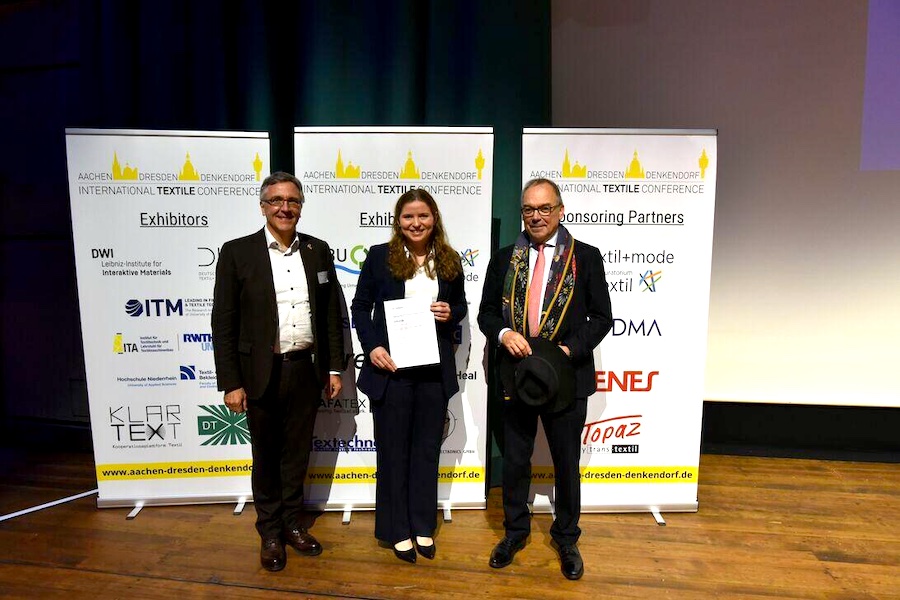
ITA Institute Director Professor Dr Thomas Gries, Janne Warnecke, and Peter D. Dornier, Chairman of the Walter Reiners Foundation (f. l. t. r.) © 2025 DITF
ITA Master's student Janne Warnecke investigated tension differences over the fabric width in the weaving process and thereby contributed to quality assurance; ITA Bachelor's student Jasmin Roos found a basis for the development of recyclable yarns and textiles. For these developments, they were awarded the Walter Reiners Foundation's Promotion and Sustainability Prizes on 27 November. Peter D. Dornier, Chairman of the Walter Reiners Foundation, presented the awards at the Aachen-Dresden-Denkendorf International Textile Conference (ADD-ITC) in Aachen, Germany.


Small tolerances, big impact: A finite element study on the fabric take-up of a weaving machine

The phenomenon of “edge draw-in” — the lower warp thread tension at the fabric edges compared to the centre — can lead to inhomogeneous mechanical properties and thus to reduced fabric quality. In her master’s thesis “Advanced Numerical Modelling of Fabric Take-up Systems: Influence of Mechanical Tolerances on the Fabric”, Janne Warnecke provided an important contribution to understanding the factors influencing these tension differences across the fabric width.

She demonstrated that even small deviations of just 1 mm in the fabric take-up rollers, well within typical manufacturing tolerances, can lead to differences in tension values of more than 600%. These insights are particularly valuable for weaving machine manufacturers in evaluating the geometric design and tolerances of their take-up systems.

To achieve this, Janne Warnecke used the finite element method, modelling the take-up system of a weaving machine and examining how manufacturing tolerances within the system affect the stress distribution in the fabric. A new aspect of her work is the macroscopic modelling of the take-up system combined with the integration of geometric deviations. Including these manufacturing tolerances enables a deeper understanding of how geometric factors influence the stress state within the fabric.

For her master’s thesis, Janne Warnecke was awarded the Walter Reiners Foundation's Promotion Award, including prize money of €3,500.

Thermoplastic elastomers as a recyclable alternative to elastane

The increasing importance of a circular economy for conserving resources and minimising negative environmental impacts requires innovative recycling concepts for textiles. The increasing use of elastane poses a particular challenge in textile recycling. Even small amounts of elastane cause difficulties in established recycling technologies such as thermomechanical recycling, for example by clogging filter media or decomposing into potentially toxic degradation products.

Jasmin Roos won the Sustainability Award for her bachelor's thesis on the topic: ‘Potential of thermoplastic elastomers for thermomechanical textile recycling as an alternative to elastane: Experimental evaluation of PET/TPC blends’ with prize money of €3,000.

In her thesis, Jasmin Roos, supervised by ITA scientist Ricarda Wissel, took an in-depth look at the development of sustainable solutions for recycling elastic textiles. The innovative approach aims to replace conventional, non-recyclable elastane with melt-spun yarns made from thermoplastic copolyester elastomers (TPC). This can not only improve recyclability, but also contribute to reducing environmental impact, as harmful solvents can be dispensed with in yarn production.

The main objective of her work was to evaluate the suitability of blends of TPC and polyethylene terephthalate (PET) for joint thermomechanical recycling. Blend and melt spinning tests were carried out on a laboratory and pilot scale at the ITA facilities. Jasmin Roos succeeded in producing blends of different proportions of PET and TPC, based on typical elastane proportions in textiles, and successfully processing them into yarns on a melt spinning line – a crucial aspect for closed-loop recycling. The results of her bachelor's thesis thus form a promising basis for the development of recyclable elastic yarns and textiles.
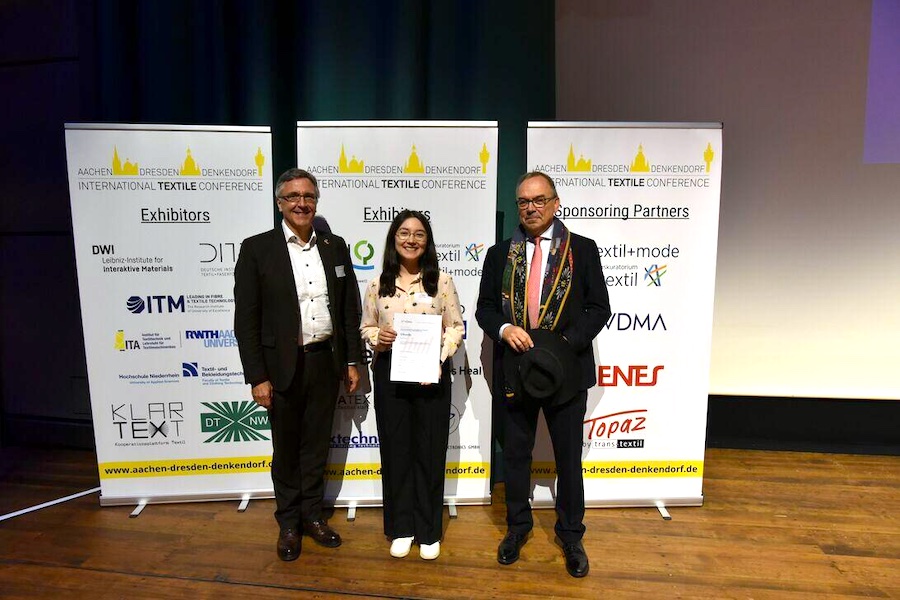
ITA Institute Director Professor Dr. Thomas Gries, Jasmin Roos, and Peter D. Dornier (from left to right) © 2025 DITF


More News from Institut für Textiltechnik of RWTH Aachen University (ITA)

#Research & Development

IRG Polymer Recycling wraps up productive 2025 project cycle

The Industry Research Group (IRG) Polymer Recycling has completed another successful project year. Last week, partners from across the textile value chain met at the Institute for Textile Technology (ITA) at RWTH Aachen University for the full-term project meeting.

#Research & Development

Aachen Summer School: Strengthening German-Korean cooperation in 4D and robotics

The Aachen Summer School has established itself as an important platform for promoting cooperation between RWTH Aachen University and Seoul National University. The focus is on practice-oriented research projects in the field of 4D and robotics technologies, which have been successfully implemented for years at the Institut für Textiltechnik of RWTH Aachen University.

#Research & Development

ITA postdoc Dr Leonie Beek is revolutionising oil filtration with a bionic textile

On various biological surfaces, oil is adsorbed from water surfaces and transported along the leaf. In her dissertation, ITA Postdoc Dr Leonie Beek transferred this effect to a technical textile using her Bionic Oil Absorber (BOA), which can remove up to 4 litres of diesel per hour from water at technological readiness level 4. For this development, Dr Beek was awarded the Paul Schlack Prize 2025 for her dissertation ‘Bionic textiles for oil-water separation modelled on superhydrophobic biological surfaces’ on 10 September 2025. The award ceremony took place during the opening event of the Dornbirn GFC Global Fiber Congress in Austria.

#Research & Development

Cooperation between Germany and India (Tamil Nadu) in the field of AI-supported manufacturing, robotics and smart textiles

The Tamil Nadu Industrial Development Corporation (TIDCO) and the Institut für Textiltechnik (ITA) of RWTH Aachen University are planning to cooperate in the future in the field of AI-supported manufacturing, robotics and smart textiles. At the same time, the aim is to promote talent exchange and a sustainable Indian-German partnership.

More News on Research & Development

#Associations

Young researchers recognised for cutting-edge work in recycling, fibre technology and textile mechanics

At the Aachen-Dresden-Denkendorf International Textile Conference held in Aachen at the end of November, Peter D. Dornier, Chairman of the Walter Reiners Foundation of the VDMA, honoured five successful young engineers. Promotion and sustainability prizes were awarded in the categories bachelor/project theses and diploma/master theses. Academic theses that develop solutions for resource-saving products and technologies, for example, are eligible for the sustainability awards.

#Research & Development

The region of renewable raw materials: Central German Alliance for Bioplastics

The development of sustainable plastic solutions is rapidly gaining importance in light of global environ- mental pollution, dwindling fossil resources and ambitious climate protection targets. As part of the re- gional alliance RUBIO, which brings together 18 partners from central Germany and the Berlin-Branden- burg area, the bio-based and biodegradable plastic polybutylene succinate (PBS) was comprehensively investigated, starting with the raw material, through the manufacturing process, to industrial application.

#Nonwoven machines

Cooperation in the field of meltblown laboratory technology

The Nonwoven Institute (NWI) at North Carolina State University and Oerlikon Nonwoven will be collaborating in the field of meltblown laboratory technology in the future. This was announced by Professor Raoul Farer, Executive Deputy Director of the NWI and Professor at the Wilson College of Textiles at North Carolina State University, and Dr. Ingo Mählmann, Sales Director Nonwoven at Oerlikon Neumag, during this year's ITMA Asia and CITME in Singapore.

#Recycling / Circular Economy

European research project addresses textile waste through integrated recycling technologies

A major European research initiative coordinated by Fraunhofer UMSICHT has been launched to develop integrated solutions for textile waste recycling. The AUTOLOOP project aims to create a comprehensive system that could process 1.24 million tonnes of textile waste annually by 2050, whilst potentially creating over 130,000 green jobs across the EU. This project aims to develop, test and integrate automated sorting, tracing, and closed-loop recycling technologies for polyester-based textiles (NRT), addressing the pressing challenge of textile waste management.

Latest News

#Spinning

First PA66 spinning plant with EvoQuench successfully commissioned

With the successful commissioning of a multi-digit PA66 spinning line for microfiber yarns, Chinese textile company Shandong Nanshan Fashion Technology Co., Ltd. has added yarn production to its textile value chain.

#Associations

Joint Statement: Urgent clarification needed on scope of Textiles EPR for PPE and Medical Devices

EDANA, the voice of nonwovens, alongside fellow industry associations CIRFS (European Man-Made Fibres Association), EURATEX (The European Apparel and Textile Confederation), ESF (European Safety Federation), and EuroCommerce (Retail & Wholesale), has issued a joint statement raising critical concerns regarding the transposition of Directive (EU) 2025/1892, the targeted revision of the Waste Framework Directive.

#Textile chemistry

Archroma and Lilienweiss join forces to deliver faster and localized color management services in Europe

Archroma, a global leader in specialty chemicals focused on sustainable solutions, today announced its partnership with Lilienweiss, who will begin offering Archroma Color Management solutions across Europe starting January 2026.

#Recycling / Circular Economy

Textiles Recycling Expo announces collaboration with Future Fabrics Expo for 2026

The Textiles Recycling Expo has entered a major new collaboration with the Future Fabrics Expo which means that both events will run alongside each other at the Brussels Expo, Belgium on 24–25 June 2026. This co-location marks a significant step forward for the textile and fashion industries, bringing together two influential and complementary events under one roof.

TOP