[pageLogInLogOut]

#Research & Development

Aachen Summer School: Strengthening German-Korean cooperation in 4D and robotics
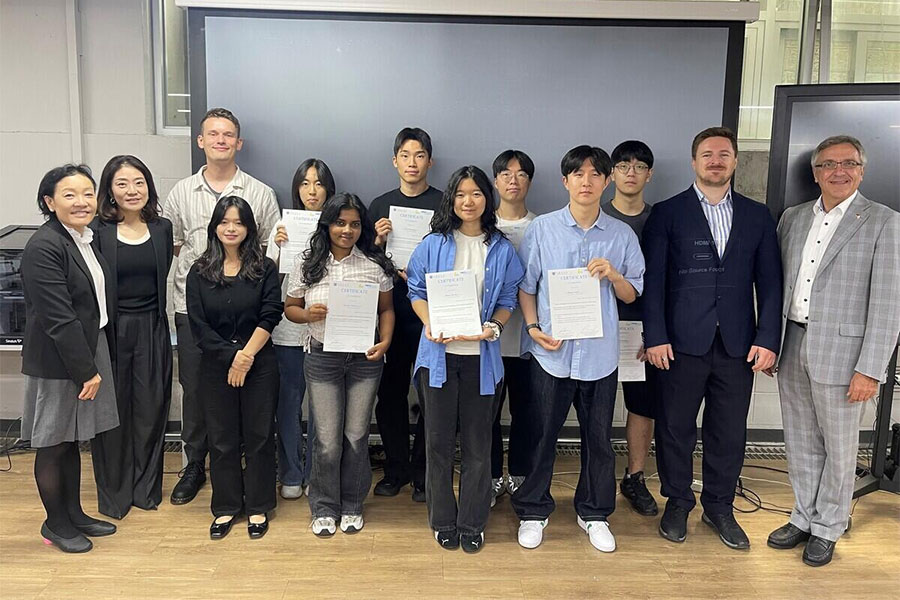
Participants in the summer school, Photo ITA
The Aachen Summer School has established itself as an important platform for promoting cooperation between RWTH Aachen University and Seoul National University. The focus is on practice-oriented research projects in the field of 4D and robotics technologies, which have been successfully implemented for years at the Institut für Textiltechnik of RWTH Aachen University.

This year, the theme of the Summer School was soft robotics and 4D materials. Participating students had the opportunity to develop innovative concepts for gripping systems by working with various actuators and stepper motors.

The programme structure comprised two intensive weeks. In the first week, various sample projects, including a three-finger gripper, were presented and replicated. In the second week, students were able to develop a modular system under supervision and implement their own project ideas.

The International Office at RWTH Aachen University encouraged German students to take part in this unique opportunity during their stay in Korea. Associate Professor Howon Lee specifically promoted the summer school to German mechanical engineering students.

The participants consisted of mechanical engineers, electrical engineers, materials scientists and industrial engineers. Each group presented the results of their work in a final presentation.

Particularly noteworthy was the participation of Dr Hokyenong Rhee and Ms Jayoung Na from the German Academic Exchange Service (DAAD), who gave the students insights into possible funding programmes for studying abroad. This initiative underscores the motto of the summer school: ‘Let's shape the future together!’

This event impressively demonstrates how international cooperation in education can not only impart knowledge, but also build bridges between cultures – a decisive step towards an innovative future in the field of 4D and robotics.
More News from Institut für Textiltechnik of RWTH Aachen University (ITA)

#Research & Development

Sustainable athletic wear made from bio-based Polyethylene

Conventional sports textiles made from petroleum-based synthetic fibres are to be replaced in the future by sustainable, bio-based, cooling textiles. Polyethylene, previously used mainly in the packaging industry, is thus qualified for use in textiles and, as a bio-based drop-in solution, offers a cost-effective, sustainable alternative for the future.

#Research & Development

India, ITA and innovation – enhanced cooperation in research, implementation and bilateral projects such as hydrogen mobility

The Indian Consul General, Dr Shuchita Kishore, visited the Institut für Textiltechnik (ITA) of RWTH Aachen University on 15 December to inspect the joint project between the ITA, the Indian Institute of Technology (IIT) Bombay and industrial partners from India and Germany and to tour the ITA.

#Research & Development

Small tolerances, big impact and a recyclable alternative to elastane

ITA Master's student Janne Warnecke investigated tension differences over the fabric width in the weaving process and thereby contributed to quality assurance; ITA Bachelor's student Jasmin Roos found a basis for the development of recyclable yarns and textiles. For these developments, they were awarded the Walter Reiners Foundation's Promotion and Sustainability Prizes on 27 November. Peter D. Dornier, Chairman of the Walter Reiners Foundation, presented the awards at the Aachen-Dresden-Denkendorf International Textile Conference (ADD-ITC) in Aachen, Germany.

#Research & Development

IRG Polymer Recycling wraps up productive 2025 project cycle

The Industry Research Group (IRG) Polymer Recycling has completed another successful project year. Last week, partners from across the textile value chain met at the Institute for Textile Technology (ITA) at RWTH Aachen University for the full-term project meeting.

More News on Research & Development

#Research & Development

Innovation center for textile circular economy inaugurated

Just over eight months after the foundation stone was laid, the new Innovation Center for Textile Circular Economy was officially inaugurated today at TITK Rudolstadt. Thuringia's Minister President Mario Voigt, TITK Director Benjamin Redlingshöfer, and other guests of honor cut the ribbon to the modern building complex and viewed the premises, which are now ready for occupancy. The “DICE – Demonstration and Innovation Center for Textile Circular Economy” is TITK's largest single investment to date. The Free State of Thuringia supported the total cost of €11.5 million with €8 million in GRW and FTI funding.

#Research & Development

Sustainable design of Geosynthetics and roof underlayments made from recyclates

Is it possible to recover plastic recyclates from previously unused waste streams in order to produce high-quality fibers and films? How can bio-based polymer fibers be manufactured so as to allow adjustable biodegradability? These are the questions being addressed by researchers from the Fraunhofer Cluster of Excellence Circular Plastics Economy CCPE in the Zirk-Tex project.

#Research & Development

More safety and comfort for protective clothing thanks to auxetic fabrics

When everyday materials are pulled, they stretch or elongate in the direction of the pull and become narrower in cross-section. We can also observe this property in two-dimensional textiles. Auxetic structures behave differently here. They have the striking property of not changing under tensile stress or even increasing their width or thickness. These properties are advantageous, for example, in protective textiles or textile filter media. The DITF are researching auxetic fabrics for various applications.

#Research & Development

Fraunhofer CCPE presents the “Monomaterial Design Set” – Innovative solutions for circular product design

Composite materials made from different types of plastic often extend the lifetime of products but make recycling more difficult in the circular economy. That is why Fraunhofer CCPE has developed the “Monomaterial Design Set”. This new approach helps to reduce the variety of plastics used in durable products and offers circular solutions for designers and product developers.

Latest News

#Knitting & Hosiery

Terrot introduces T-Frame platform to redefine stability and flexibility in large-diameter circular knitting

Terrot Textilmaschinen GmbH has unveiled the new T-Frame, a universal machine frame platform for large-diameter circular knitting machines. Designed to meet growing demands for flexibility, stability, and operational safety, the T-Frame provides a next-generation foundation for both current and future industrial knitting machines, combining German engineering expertise with a modular, future-ready design approach.

#Business

Canopy introduces a first-of-its-kind $2 billion USD investment blueprint to decarbonize global materials supply chains

Today, the global, solutions-driven not-for-profit Canopy joined partners at Davos to introduce a new finance model designed to accelerate the growth of low-carbon materials and transform the paper, packaging, and textile supply chains. The event was anchored by a keynote speech from Sri A Revanth Reddy, Hon’ble Chief Minister of Telangana, with India set to host the first iteration of the new investment blueprint.

#Yarns

Biella Yarn launches Collection “Reimagined” for Spring/Summer 2027 with fresh approach to fibre design

Biella Yarn, the flat knitting brand of Suedwolle Group, introduces its Spring/Summer 2027 collection “Reimagined” featuring refined yarn blends and advanced spinning technologies designed for contemporary summer knitwear. Under the motto “And the story goes on…”, Biella Yarn continues to push the boundaries of responsible yarn development, offering versatile materials that elevate modern craftsmanship.

#Recycled_Fibers

Circular progress: Trevira® CS Eco fabrics can now be made using textile-recycled, permanently flame-retardant fibers and yarns

Indorama Ventures, a global sustainable chemical company, takes an important next step toward making textiles more circular for homes and public spaces. To support fabric makers in creating a more sustainable version of the well-known flame-retardant Trevira CS fabric, the company now offers Trevira® flame-retardant fibers and filament yarns that contain 50% recycled textile material. First customers were introduced to the new offering during Heimtextil trade show mid-January in Frankfurt, Germany.

TOP